Get Full Government Meeting Transcripts, Videos, & Alerts Forever!
Get email alerts on the Critical Minerals Coal topic
No spam. Unsubscribe anytime.
Senate committee hears HB1459 to let coal leases cover rare earths; sharp disagreements over royalties and constitutionality
Summary
Lawmakers, coal companies and landowners debated House Bill 1459, which would declare rare earth elements and other critical minerals in coal seams subject to existing coal leases and set a 2.5% royalty; proponents said the move could jump‑start a U.S. supply chain, while opponents warned of constitutional takings and urged private negotiation.
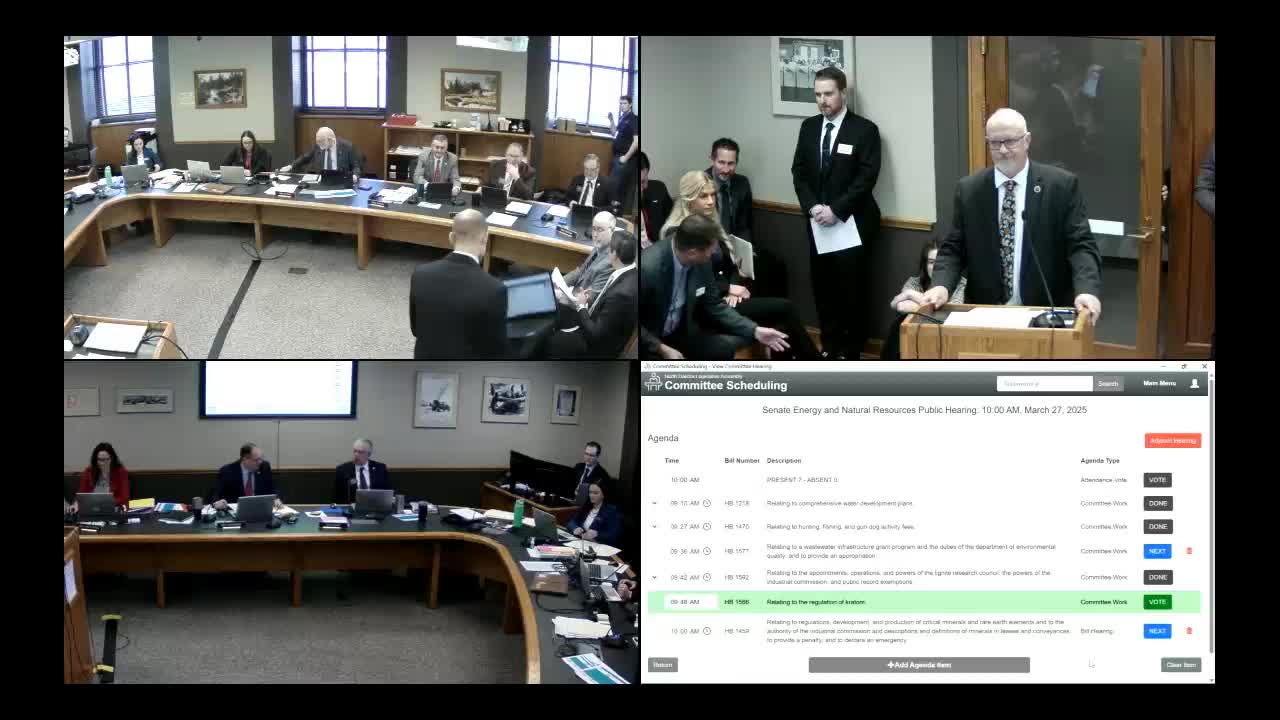
BISMARCK, N.D. — Lawmakers, industry representatives and landowners spent more than two hours on March 27 debating House Bill 1459, a measure that would declare critical minerals and rare earth elements found in coal seams to be recoverable under existing coal leases and set out a regulatory and royalty framework to support extraction.
The bill would give the North Dakota Industrial Commission authority to permit and regulate extraction of rare earth elements and critical minerals when those materials are “embedded, commingled, included, contained within, in any other way associated with any coal seam or coal deposit,” and would require operators to pay a 2.5% royalty on net profits to mineral owners unless otherwise reserved, according to testimony and excerpts from the bill.
Supporters told the Senate Energy and Natural Resources Committee the measure is aimed at building a domestic supply chain for materials used in electronics, national security systems and green technologies — products now mostly produced and refined abroad.
Representative James Anderson, the bill sponsor, told the committee he had brought samples to make the point that the materials are both valuable and delicate. “I brought magnets this morning. And, as you can see, they’re pretty powerful, but they’re kinda brittle,” Anderson said. He described fly ash and coal seams as potential domestic sources and urged quick action, saying, “I think we have to move very quickly on this.”
Representative Anna Novak (R‑District 33) framed the bill as an economic and national security opportunity for her district. Novak said she represents thousands of workers tied to coal production and transmission and argued North Dakota has existing permitting and workforce advantages that could help create a domestic rare‑earth industry.
David Straley, testifying for North American Coal, described the sponsors’ approach as narrowly targeted to coal seams and existing mine permits and said the intention was not to create a new property interest: “We have to be able to use the existing coal leases,” he said. Straley and other industry witnesses said the value of rare earths is currently difficult to map until coal is exposed by mining, and they proposed a 2.5% royalty on net profits as a compromise anchored to federal and industry royalty ranges cited in a General Accounting Office report.
Brian Biella, an attorney for the coal interests, told the committee the bill includes a public policy statement modeled on federal and state precedents and framed the measure as, in effect, North Dakota declaring an energy emergency to support domestic critical‑mineral development. Biella said the bill aims to limit the measure to coal seams within existing mine permits and to provide “fair and adequate compensation” to mineral owners.
Not all testimony supported the sponsors. Chris Selsley, minerals director at the Department of Trust Lands, proposed an amendment replacing a net‑profit royalty with a 2.5% gross‑proceeds royalty to avoid litigation over allowable deductions; the department also suggested a sunset review. Landowner representatives warned that the bill, as written, would retroactively change the meaning of long‑standing coal leases and could impair contract rights.
Kurt Swenson, a landowner from Beulah, and Troy (representing the Northwest Landowners Association) both argued the bill risks violating the Contracts Clause and the Fifth Amendment takings clause if it effectively transfers mineral rights without negotiated agreement or appropriate market compensation. “We need to be very cognizant of what you’re about to do here if this is passed,” Swenson said, urging private negotiation or other mechanisms before statutory reallocation.
Attorney Derek Broughton, representing landowners, recommended negotiated agreements or targeted quiet‑title and pooling procedures rather than a statute that would alter existing contracts. He said forced legislative reallocation “will lead to quiet‑title litigation” and urged the parties to try collective negotiation or an agreed arbitration process as a first step.
Committee members pressed for details on several technical points: whether the bill would cover minerals in fly ash or only in situ coal seams (sponsors repeatedly said the bill was limited to coal seams and existing mine permits), how royalties would be calculated (the bill defines “net profits” as gross receipts less costs tied directly to extraction and processing), and how owners of unleased coal acres would be handled (witnesses said existing law requires mines to obtain leases for areas they intend to mine).
No formal action or vote occurred. Chairman Patton left the hearing open and directed parties to continue negotiations, setting the record to remain open until next Thursday at 9 a.m. He asked stakeholders to attempt to produce compromise language the committee could consider: if no acceptable, constitutional compromise is found, the committee may take no action on the bill.
Why it matters: Critical minerals and rare earth elements are central to electronics, defense and renewable technologies. Supporters said the bill could create a domestic supply chain and new revenue for landowners and the coal industry; opponents warned it could erode private‑property protections and spur costly litigation if it changes existing leases retroactively. The committee’s decision on next steps will affect whether work to develop a rare‑earth processing sector tied to North Dakota coal moves forward in the near term.
Committee direction and next steps: The committee left the hearing record open for additional testimony and asked interested parties to present draft compromise language next Thursday at 9 a.m. Committee members signaled they remain divided on royalties (net vs. gross, percentage level) and on constitutional structure; the Industrial Commission and Department of Trust Lands offered to continue technical discussion on regulatory language.