Get Full Government Meeting Transcripts, Videos, & Alerts Forever!
Get email alerts on the Legislation Votes topic
No spam. Unsubscribe anytime.
West Virginia Senate approves energy reliability measure and a package of bills; close vote on electricity rates bill
Summary
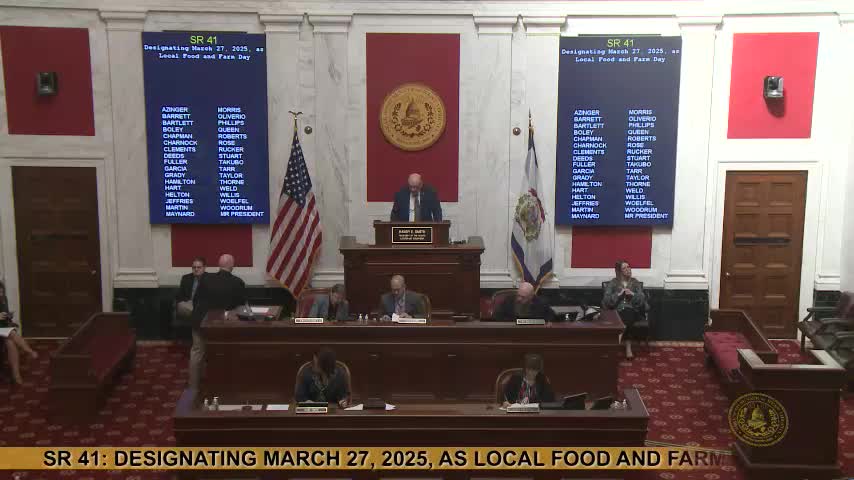
The West Virginia Senate on March 26 passed a measure aimed at making electric utilities’ reliability part of rate decisions after a contested floor discussion, and approved a series of other bills ranging from rulemaking requirements to technical code cleanups.
CHARLESTON, W.Va. — The West Virginia Senate on March 26 passed a bill that requires the Public Service Commission to consider bulk power system reliability when approving utility rate increases and approved a package of largely noncontroversial bills affecting rulemaking, education, emergency response and other technical changes.
The most contested floor debate concerned the engrossed committee substitute for Senate Bill 505, the “Ensuring Reliable and Affordable Electricity Act,” which passed 22 yeas to 11 nays with one absent. A member of the public identified as an employee of an electric utility rose during floor debate to ask for a ruling on Senate rule 43, saying, "I'm asking for a ruling on senate rule 43, mister president." The bill’s floor sponsor summarized the measure and urged passage, saying, "That is the bill, mister president, I urge passage." The legislation directs the Public Service Commission to include bulk power system reliability as a factor when determining whether rates requested by an electric utility are just and reasonable, and to state in rate orders the dollar amount of any approved increase and any costs denied for rate recovery.
Why it matters: proponents said the bill prevents customers from paying both for power purchased off the grid and for local generation assets that are not meeting reliability needs. During debate a senator asked whether the bill would require plants to burn more coal; the sponsor replied that it would not dictate fuel choice but would tie allowed returns to the reliability of the generation used.
The Senate also adopted a number of bills with unanimous or near-unanimous votes and limited floor debate, including:
- Senate Bill 570 (committee substitute) — requiring economic impact statements for certain legislative rules; passed 33-0. The bill defines factors agencies must consider for economic impact statements, including regulatory costs, business productivity, job creation and private-sector investment.
- Senate Bill 820 — creating the Whistleblower Protection Fund Act to support whistleblowers reporting misconduct in certain clinical treatment settings; passed 33-0 and was later made effective from passage by the Senate.
- Senate Bill 823 — clarifying and separating investigatory responsibility between the Division of Emergency Management and the Department of Environmental Protection for mine/industrial and well/pipeline incidents; passed 33-0. A title amendment was adopted on the floor.
- Senate Bill 825 — allowing institutions of higher education to contract with certain nonprofit corporations for economic development and job-creation purposes; passed 31-0 (three absent).
- Senate Bill 829 — consolidating state preparedness classifications into a single state of preparedness that expires in 30 days unless extended; passed 31-0 (three absent).
- Senate Bill 839 — requiring separate licensing classifications for plumbers who work exclusively in residential dwellings and those who work in commercial facilities; passed 31-0 (three absent).
- Senate Bill 856 — removing various reporting requirements previously required of the insurance commissioner; passed 32-0 (two absent).
- Senate Bills 861–863 and 864 — a series of updates and repeals of obsolete statutory references and technical corrections (including consolidation of information services into the Office of Technology and repeal of an expired voluntary state tax checkoff program); each passed by margins recorded on the floor (most 33-0 with one absent). Senate Bill 864 also included a title amendment adopted on the floor.
- Senate Bill 871 — removing residential drywall installation from the definition of "contractor" so residential drywall installers need not hold a contractor’s license (commercial drywall remains licensed); passed 24-9 with one absent.
- Senate Bill 876 — ending a set of periodic reporting requirements by the Tax Division effective January 1, 2025, while allowing the Tax Commissioner to continue providing information the office deems useful; passed 33-0 with one absent.
Votes at a glance (bills with floor tallies reported in the transcript):
- SB 505, Ensuring Reliable and Affordable Electricity Act — Passed 22 yeas, 11 nays, 1 absent. (Floor debate included questions about whether the measure would require more coal use and an appearance by an electric utility employee seeking a recusal ruling.)
- SB 570, Economic impact statements for rules — Passed 33-0, 1 absent.
- SB 820, Whistleblower Protection Fund Act — Passed 33-0, 1 absent. Senate subsequently voted to make the bill effective from passage (33-0, 1 absent) on the floor.
- SB 823, Clarify emergency management/DEP duties — Passed 33-0, 1 absent; title amendment adopted.
- SB 825, Higher education contracting with nonprofits for economic development — Passed 31-0, 3 absent.
- SB 829, Single state of preparedness classification — Passed 31-0, 3 absent.
- SB 839, Separate plumbing licensing classifications — Passed 31-0, 3 absent.
- SB 856, Remove reporting requirements for insurance commissioner — Passed 32-0, 2 absent.
- SB 861, SB 862, SB 863 — Passed (each recorded as passed on the floor; most recorded 33-0 with 1 absent in the transcript).
- SB 864, Clarify inference of criminal intent in burglary prosecution — Passed 33-0, 1 absent; title amendment adopted.
- SB 871, Remove residential drywall installation from contractor definition — Passed 24-9, 1 absent.
- SB 876, Terminate certain Tax Division reporting requirements after Jan. 1, 2025 — Passed 33-0, 1 absent.
What happened next: the clerk was directed to communicate the Senate’s actions to the House for enrolled bills. The Senate recessed at the scheduled time after routine introductions and announcements.
Speakers are identified in the record by role or name where available; the floor record includes committee chairs and numerous senators speaking for bills, as well as one utility employee who addressed the chamber during SB 505 debate.
There were no recorded floor amendments that changed policy outcomes for the major bills summarized here, aside from title amendments and the single technical amendment adopted for one bill and the motion to make SB 820 effective from passage.
This account is based on the Senate floor transcript of March 26, 2025.