Get Full Government Meeting Transcripts, Videos, & Alerts Forever!
Get email alerts on the School Transportation Seatbelts topic
No spam. Unsubscribe anytime.
Committee substitute for seat‑belt bill shifts toward reporting, phased compliance for districts lacking three‑point belts
Summary
A committee substitute to SB 546 would require districts unable to immediately equip buses with three‑point lap‑shoulder belts to submit a public plan and a TEA report, and sets a four‑year compliance timeline while exempting buses that would lose warranty coverage if retrofitted.
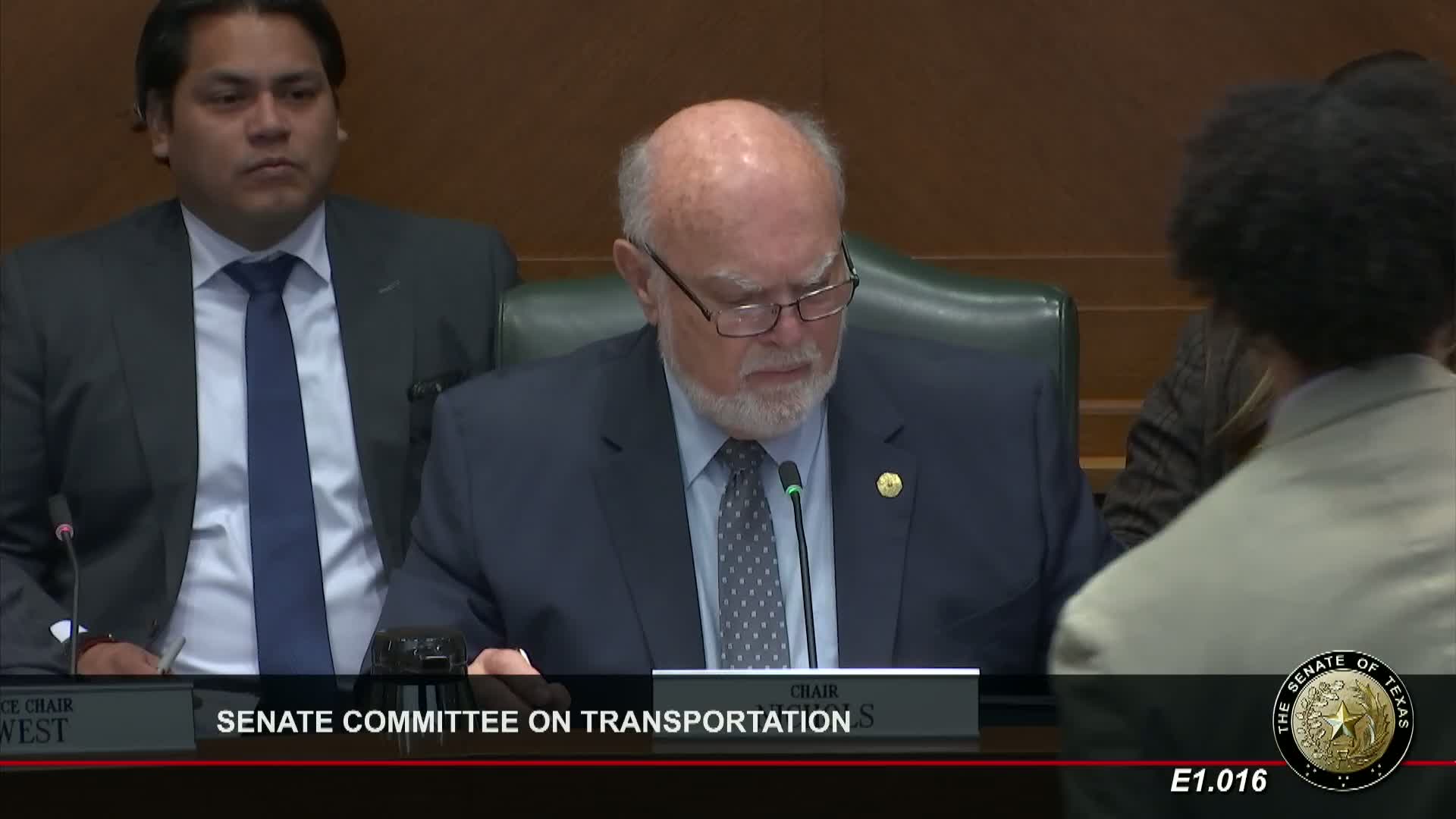
A committee substitute to Senate Bill 546, aimed at increasing three‑point seat‑belt use on school buses, was presented to the Senate Transportation Committee and drew broad support from crash survivors’ advocates and pupil‑transportation professionals.
What the substitute does: Senator Menendez said the substitute removes a previously proposed two‑point (lap) belt option, requires school districts that cannot immediately equip buses with three‑point lap‑shoulder belts to submit a “plan of action” to the Texas Education Agency (TEA) and their school boards, and establishes a four‑year implementation period. The substitute exempts buses whose manufacturer warranties would be voided by retrofitting.
Why it matters: Witnesses said three‑point belts offer better protection than lap belts and that local reporting would help the Legislature identify districts that need financial assistance. Senator Menendez said the reporting will let the Legislature and TEA “know how we need to help our school districts and who needs the help and where.”
Support and testimony: The National Association for Pupil Transportation (represented by Kane Smith) affirmed that NHTSA and NAPT endorse three‑point lap‑shoulder belts over two‑point lap belts. Brad Brown, representing the Westbrook bus crash families, described his personal advocacy after a 2006 crash that killed his daughter and urged the committee to support the substitute. Brown said NHTSA in 2015 recommended three‑point belts for every child on every school bus.
Practical issues discussed: Witnesses and Senator Menendez noted retrofit costs and warranty issues — replacing seats to add three‑point belts can be prohibitively expensive for property‑poor districts. The substitute asks for a public district plan and a TEA report to the Legislature so lawmakers can target assistance rather than create unfunded mandates.
Outcome: The committee heard testimony and left the bill pending for further consideration; no final vote was taken at the hearing.
Ending: The substitute reflects compromise between safety advocates seeking universal three‑point belts and districts concerned about retrofit costs; it adds transparency through required district reporting to TEA and public school boards.