Get Full Government Meeting Transcripts, Videos, & Alerts Forever!
Get email alerts on the Industrial Siting Quarry Vs Semiconductor topic
No spam. Unsubscribe anytime.
Senate panel weighs Grayson County pilot to study quarry vibrations near wafer plant
Summary
Senators heard SB 17 58, a proposal to fund a University of Texas Bureau of Economic Geology pilot study in Grayson County to determine whether aggregate production operations cause subterranean vibrations that would harm semiconductor wafer manufacturing.
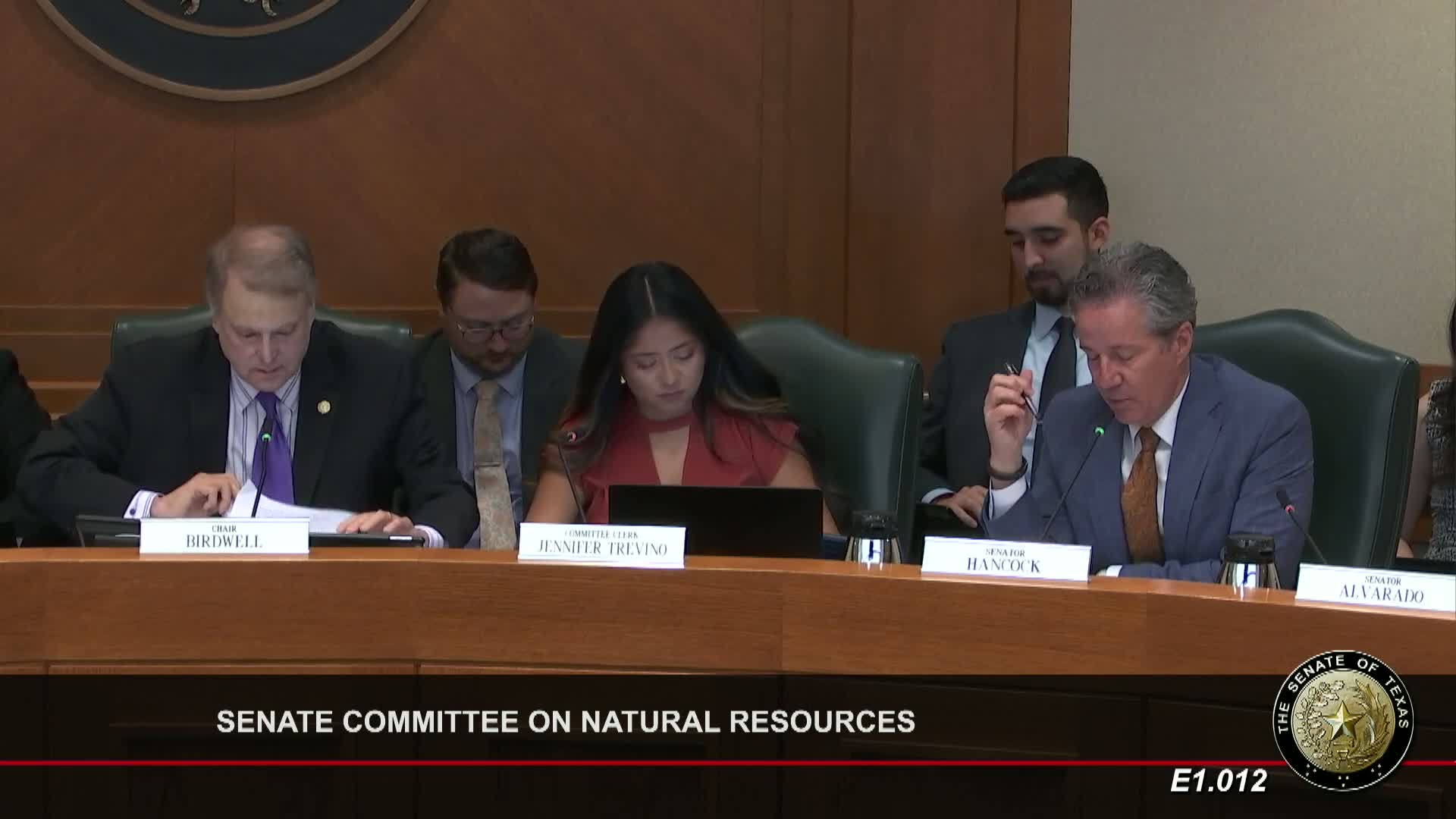
The Senate Natural Resources Committee held an extended hearing on Senate Bill 17 58, a bill proposing a Grayson County pilot program to study whether aggregate production operations (quarries and kilns) cause subterranean vibrations that could impair semiconductor wafer manufacturing.
Sponsor explanation: Senator Birdwell said the bill responds to an unresolved conflict in Grayson County where a proposed cement kiln and quarry is sited a few miles from a semiconductor wafer facility under construction. SB 17 58 would direct the University of Texas Bureau of Economic Geology (BEG) to analyze seismological data and the vibrational impact of aggregate production operations on wafer manufacturing and to report back to the Legislature. The filed bill set an initial study radius of 10 miles; the committee substitute requires BEG to consider distances within and beyond that radius and moves the BEG reporting deadline to Aug. 1, 2026.
Key provisions in committee substitute: the substitute extends liability protection to aggregate production operations more broadly (not only cement kilns), clarifies reporting deadlines, adds severability language, and ties a budget rider to funding included in the Senate’s SB 1. The substitute also clarified that the designation of a declared emergency in other bills was for 30 days with extensions; it ensures liability protection applies to responders, not to parties that caused the emergency.
Public testimony and industry views: Jacob Bender, principal at Black Mountain (the quarry applicant), opposed SB 17 58 as filed and said his company put the property under option years earlier and had an air‑permit application that was administratively complete in November 2021 and received a notice of application draft (NAPD) in February 2024. Bender said the company has removed blasting from its plans and offered concessions to engage with neighbors.
Wyatt Watson, engineering director for Global Wafers America, testified that Global Wafers is building a multibillion‑dollar wafer manufacturing facility in Sherman and supports the BEG study; Watson said the wafer facility will be a critical domestic supplier for chips and that the company recommended two technical edits to the bill’s definitions.
Local officials and other witnesses: Grayson County Commissioner Josh Marr and Grayson County Judge Bruce Dossi urged study and cautioned that if both operations proceed without study, a “train wreck” of litigation or operational failure could follow. Industry groups—including the Texas Aggregate and Concrete Association represented by Rich Saatchi—opposed provisions that would slow or block new permits, saying the state already faces a cement shortage and that permitting delays would worsen supply constraints.
Technical and permitting clarifications: TCEQ resource witness Samuel Short clarified that the permit currently at issue is an air permit and that TCEQ does not permit the mine or quarry itself if there is no stationary source; the air permit process had progressed to the contested‑case stage and, under current schedules, SOAH hearings and related proceedings could extend toward the fall before completion.
Committee outcome: The committee closed public testimony and left SB 17 58 pending. Sponsors and industry representatives were urged to continue negotiations; BEG’s study, funding, and reporting timeline (committee substitute deadline Aug. 1, 2026) were highlighted as central next steps.