Get Full Government Meeting Transcripts, Videos, & Alerts Forever!
Get email alerts on the Energy Lng Permitting topic
No spam. Unsubscribe anytime.
Senate committee hears bill to set deadlines for LNG export terminal permit steps
Summary
The Senate Natural Resources Committee heard testimony on Senate Bill 2037 on an expedited state permitting track for liquefied natural gas export terminals.
The Senate Natural Resources Committee heard testimony on Senate Bill 2037 on an expedited state permitting track for liquefied natural gas export terminals.
SB 2037, filed by Senator Sparks, would require the Texas Commission on Environmental Quality to adopt an expedited review process for air-quality and wastewater permit amendments and applications for LNG export terminals; require the TCEQ executive director to respond to relevant public comments on draft permits within 120 days after the comment period ends; require an extra applicant fee to fund the expedited review; and require the State Office of Administrative Hearings to hold a preliminary contested‑case hearing within 30 days if a contested case is requested. The bill does not remove public participation rights, according to testimony.
Why it matters: Industry witnesses told the committee that parts of the current state permitting process sometimes add months to project timelines and have, in some cases, stretched projects for years. Proponents said defined state timelines would reduce uncertainty for financing, construction and commercial contracts for LNG projects.
Tony Bennett, president and CEO of the Texas Association of Manufacturers, told the committee SB 2037 “provides certainty and firm timelines in the state permitting process so that project applicants can better plan their customer, supplier, and construction contracts along with project financing.” Bennett said contested‑case and air permitting delays have lengthened some amendments to nearly three years and that faster state timelines would not eliminate public participation.
Matt Barr, vice president of government affairs and community engagement at Cheniere Energy, said his company experienced “a permanent amendment that took 3 years and 11 months, from filing date to issuance of the permit.” Barr said the bill “simply puts time frames in which certain actions during that process will occur” and “does not do anything to reduce or eliminate any of those requirements or any part of the process.”
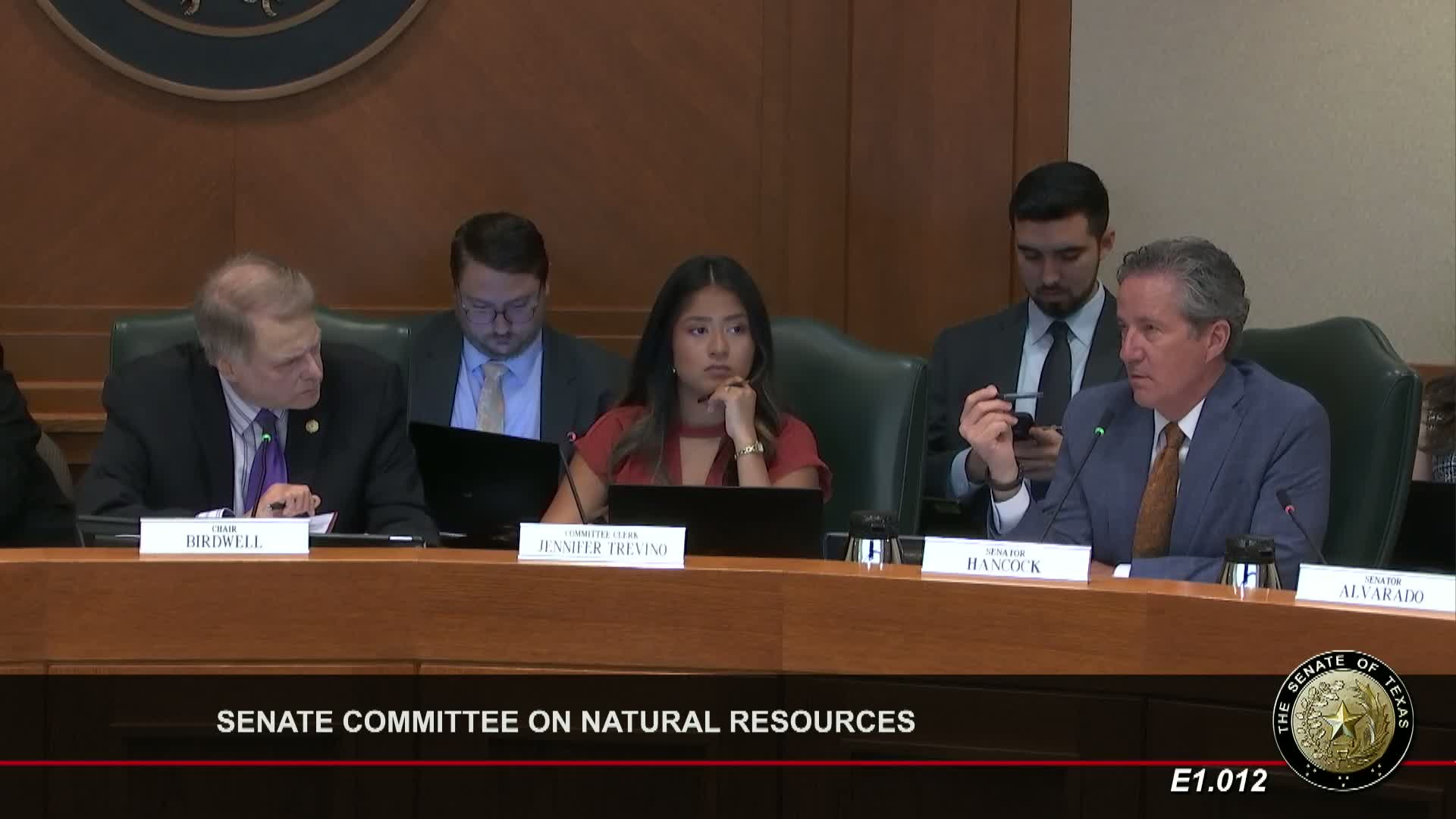
Committee discussion included Senators Parker and Hancock expressing strong support for expediting state timelines and inviting industry to propose germane amendments that could strengthen or accelerate the process before the bill moves further.
Public testimony on SB 2037 was limited to two resource witnesses from TCEQ and the two industry witnesses above. The committee closed public testimony and left SB 2037 pending for further work and consideration; no committee vote on SB 2037 occurred during the hearing.
Ending: Committee staff indicated a committee substitute was expected that would clarify that the expedited process would cover both air quality and wastewater permit applications for LNG export terminals; the chair left the bill pending.