Get Full Government Meeting Transcripts, Videos, & Alerts Forever!
Get email alerts on the Reproductive Health Law topic
No spam. Unsubscribe anytime.
Committee hears SB 31 to clarify 'life of the mother' medical-emergency exception
Summary
The Texas Senate Committee on State Affairs heard testimony on SB 31, the "Life of the Mother" bill, which would unify statutory definitions of a medical emergency, add physician and attorney education requirements, and create procedural protections for clinicians treating pregnancy complications; the bill was left pending.
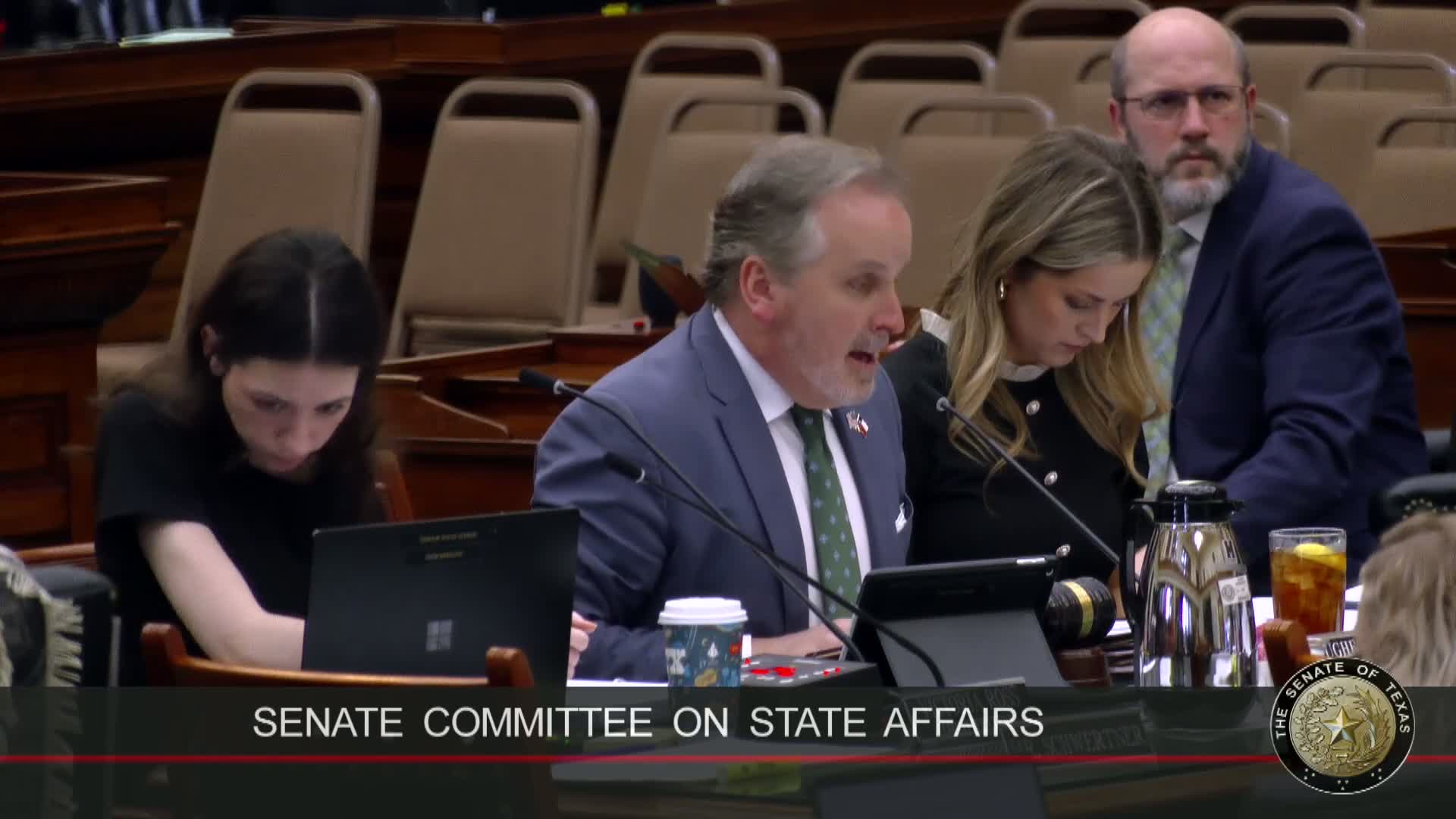
Senator Hughes, chair of the Committee on State Affairs and the author of Senate Bill 31, told the committee the bill is intended to remove ambiguity for physicians treating pregnancy complications that threaten a mother's life or major bodily function. “When the mother is in danger, that is an exception that Texas has always recognized,” Hughes said as he laid out the measure and invited testimony.
Supporters told the committee they backed SB 31 as a clarification rather than an expansion of exceptions to Texas' abortion prohibitions. Jennifer Allman, executive director of the Texas Catholic Conference of Bishops, said the bill aims to align older statutes with modern medical practice and to give patients “security that their health and life will be respected and protected.” John Seago, president of Texas Right to Life, said the measure would create a “safe harbor” for doctors acting in good faith and would treat litigation over emergency treatment as health-care liability claims subject to higher procedural and evidentiary standards. “This will protect doctors in civil suits, criminal prosecutions, as well as any discipline from the medical board,” Seago said.
Chelsea Yeoman, national director of public policy for Human Coalition, and Lisa Kaufman of the Texas Civil Justice League described the bill as a negotiated compromise that reiterates the state’s protection of unborn life while clarifying when intervention for a pregnant patient is permitted. “Texas law allows women facing dire medical emergencies to receive medical treatment when they need it — not when they are at death’s door,” Yeoman said, citing recent court and administrative guidance.
Medical and hospital representatives said the bill would reduce confusion among clinicians and administrators. Dr. Julie Ayala, an obstetrician-gynecologist speaking for the Texas Medical Association, said the continuing medical education requirement would help recruit and retain OB-GYNs and save lives by clarifying the standard of care. Heather Delagarza Barone, associate general counsel for the Texas Hospital Association, said SB 31 would harmonize the medical-emergency standard across multiple abortion statutes, clarify the definition of ectopic pregnancy to match current medical standards, and confirm that communications among physicians, administrators and lawyers to navigate the exception are not “aiding and abetting.”
Proponents repeatedly told the committee that the bill does not create new exceptions to Texas law but instead clarifies existing exceptions and provides training for clinicians and attorneys. Witnesses referenced recent litigation and administrative guidance since the U.S. Supreme Court’s Dobbs decision as the source of confusion among some hospitals and clinicians.
No formal vote was taken. The chair left SB 31 pending before the committee and said invited and public testimony would continue once related bills were also presented.
The committee will return later in the day to continue testimony; the bill’s legal text and any amendments remain under committee consideration.