Get Full Government Meeting Transcripts, Videos, & Alerts Forever!
Get email alerts on the Finality Of Termination Orders topic
No spam. Unsubscribe anytime.
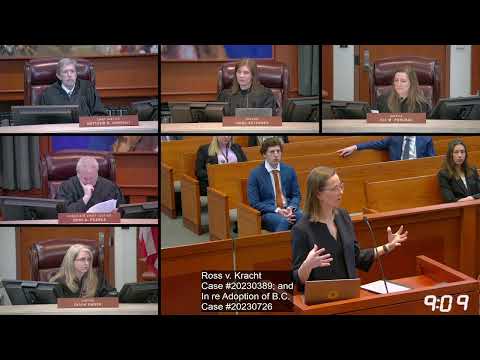
Utah Supreme Court hears argument on whether district-court termination orders are immediately appealable
Summary
At oral argument the court considered whether orders terminating parental rights in district-court adoption proceedings are final and immediately appealable or instead require certification or statutory authorization; counsel urged a narrow rule recognizing termination orders as final to avoid due-process problems for parents and children.
The Utah Supreme Court heard argument on whether orders terminating parental rights entered in district-court adoption proceedings are final and immediately appealable or instead require a statutory exception or Federal Rule 54(b)-style certification.
Appellate counsel for the petitioners urged the court to treat a district-court order that terminates parental rights as final and appealable at the time the termination order is entered. Alexander Marshall, counsel for the appellants in Cracked v. Ross, told the court that “termination orders are always final” and argued the same finality principles that apply in juvenile court should apply in district-court adoption proceedings because a termination order “fully resolves the termination petition and resolves all of the claims as to all of the parties for that petition.” He told the court that treating termination orders as final avoids placing children in the position of an adoption being undone later if an underlying termination order is successfully challenged.
Appellees’ counsel Taylor Webb said she did not have substantive disagreement with recognizing practical concerns but asked that if the court were to change the jurisdictional rule the court either construe the present appeals as interlocutory, allow certification under Rule 54(b), or apply any new rule prospectively so the parties who relied on the prior practice are not prejudiced.
At oral argument, the justices probed several alternatives: (1) construing the Adoption Act’s language that labels termination and adoption orders “final” as sufficient statutory signal that termination orders are appealable; (2) adopting a case-law rule that defines an “action” narrowly so that a resolved petition is a final action; or (3) adopting an explicit exception or rule that termination orders terminating parental rights are always final because of the child-protection and liberty interests at stake. Counsel and several justices discussed practicalities such as existing practice in district courts to wait the 30-day notice-of-appeal period before setting an adoption hearing and to stay adoption proceedings when an appeal is filed.
Several justices asked whether a narrow rule limited to termination orders is preferable to a broader rule that would treat any resolved petition in a civil proceeding as final. Counsel and the court noted bankruptcy litigation is often treated differently because a bankruptcy case encompasses many discrete controversies, and Supreme Court precedent in that context permits interlocutory appeals from discrete, finally resolved controversies so as to avoid later procedural unraveling.
Counsel for appellants emphasized practical due-process concerns for parents whose rights are terminated: once a termination order is entered in the adoption context, a parent typically loses access to the court’s electronic filings and may lack notice of later proceedings, which raises the risk that an indigent or unrepresented parent will miss the opportunity to seek appellate review unless the order is treated as immediately appealable or certification is automatic.
Counsel also pointed to a body of Utah precedent (cited at argument as ACM 2009 Utah 30 and earlier Court of Appeals decisions) that has treated termination orders as final in juvenile proceedings, and argued the Adoption Act’s use of the term “final” for termination and adoption orders indicates the legislature understood those orders as final. Other cases cited at argument included Miller, Powell v. Cannon, and Bradbury v. Valencia (citation as discussed at argument). Counsel debated how strictly the court should require an express statutory exception before recognizing an appealable order.
Both sides acknowledged the court could address the issue by (1) adopting a bright-line court-made rule that termination orders are final, (2) construing the Adoption Act’s wording as a statutory signal that termination orders are appealable, or (3) retaining the existing framework and requiring district courts to make explicit Rule 54(b)-type certifications when appropriate. Appellate counsel for the appellees asked that this court avoid broad language that could unintentionally sweep into other areas of civil practice and suggested limiting any rule to termination orders to avoid collateral consequences.
The court also discussed retroactivity: if the court were to create a new rule recognizing termination orders as final, it could choose not to apply that rule retroactively to the pending appeals that were filed under prior case law and practice; counsel requested that existing pending cases proceed on the merits if the court adopted a prospective change.
The court took the matter under advisement at the conclusion of argument.