Get Full Government Meeting Transcripts, Videos, & Alerts Forever!
Get email alerts on the Coverage Payment Primatic topic
No spam. Unsubscribe anytime.
Arguing coverage: whether PRIMatic payment created insurance for Jared Weston
Summary
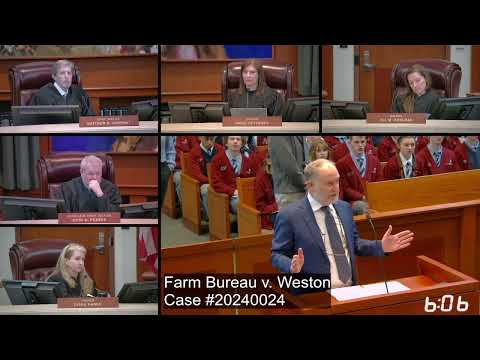
Counsel for Jared Weston told the Utah Supreme Court that three undisputed facts—the Dec. 14 billing notice, an accepted $158.92 payment, and PRIMatic's forwarding promise—require a finding of coverage for Weston on Feb. 15, 2004.
Counsel for Jared Weston asked the Utah Supreme Court to find that payment and contractual promises created coverage for Weston at the time of a February 2004 crash. Daniel Burch, counsel for Weston, told the court that "three undisputed facts compel a conclusion of coverage for Jared": a December 14, 2003 billing notice that represented a $158.92 payment would buy coverage for Jan. 18–Feb. 17; the $158.92 was paid and accepted by Jan. 15; and the PRIMatic agreement (parts B2 and B3) expressly promised to forward funds to Farmers to extend coverage.
Why it matters: if the court finds PRIMatic's acceptance of the payment and its agreement to forward funds produced coverage for Weston on Feb. 15, 2004, responsibility for the underlying judgment — and which insurer or party must pay — changes. The debate also implicates whether an arbitration award confirming a judgment was enforceable, whether it could have been modified, and whether the judgment later expired.
Burch argued that the payment was accepted within the timeframes the billing and PRIMatic documents contemplated and that PRIMatic had an express contractual obligation to forward funds to Farmers. "Three undisputed facts from day 1 compelled coverage for Jared pursuant to the undisputed cashing of the check and the clear language of the PRIMatic agreement," Burch said, adding that if PRIMatic did not forward funds timely it had promised to indemnify the customer for losses caused by that failure.
Farmers' counsel countered that the record shows a right to cancel for nonpayment that required notice and a 10‑day cure period, that endorsement language amended the policy to monthly periods and set the premium due dates differently, and that billing language ("billing period" versus "policy period" or "premium") created ambiguity. Farmers' counsel urged the court to accept the trial court and court of appeals' reading that a missed payment and unmet cure conditions resulted in cancellation. As Farmers' counsel summarized the practical sequence, a notice allows a 10‑day cure; if the additional funds never arrive, the policy may be canceled after that window and refunds or accounting follow under statute and the parties' agreements.
The court also heard argument about the arbitration confirmation and enforcement timeline. Counsel for Weston said the arbitration award had been confirmed and then enforced by district-court writs; counsel described statutory and rule-based time limits for modifying or vacating arbitration awards (counsel cited 90 days and 21 days as modification windows under the Arbitration Act) and argued the conforming judgment became enforceable and, on counsel's view, could be stale after an enforcement period (counsel referenced an eight-year enforcement/expiration window discussed in the record).
Justices questioned whether Farmers had been a party to the arbitration and whether it had grounds to seek modification or vacatur for alleged fraud or collusion; counsel for Weston said Farmers had notice and an opportunity to participate but did not intervene. The justices also asked whether a confirmed arbitration award that included damage items would have to be modified if coverage later turned out to exist and whether that modification mechanism exists under the Arbitration Act or other court rules.
No final ruling was issued at argument. The justices pressed both sides on contract language in the policy endorsements, the PRIMatic agreement's operation (parts B2 and B3), the dates in billing notices (December 14, January due dates, January 15 check cashing, and Feb. 3 cure deadline), and whether the district court's factual findings about ambiguity should control on appeal.