Get Full Government Meeting Transcripts, Videos, & Alerts Forever!
Get email alerts on the Military Deployment topic
No spam. Unsubscribe anytime.
Committee backs bill restricting Arizona National Guard combat deployments absent congressional declaration of war
Summary
Senate Bill 1495 would prohibit the Arizona National Guard from being released into active‑duty combat unless Congress declares war or takes other specified action; the committee gave the bill a due‑pass recommendation after testimony from veterans advocacy groups and the Department of Emergency and Military Affairs.
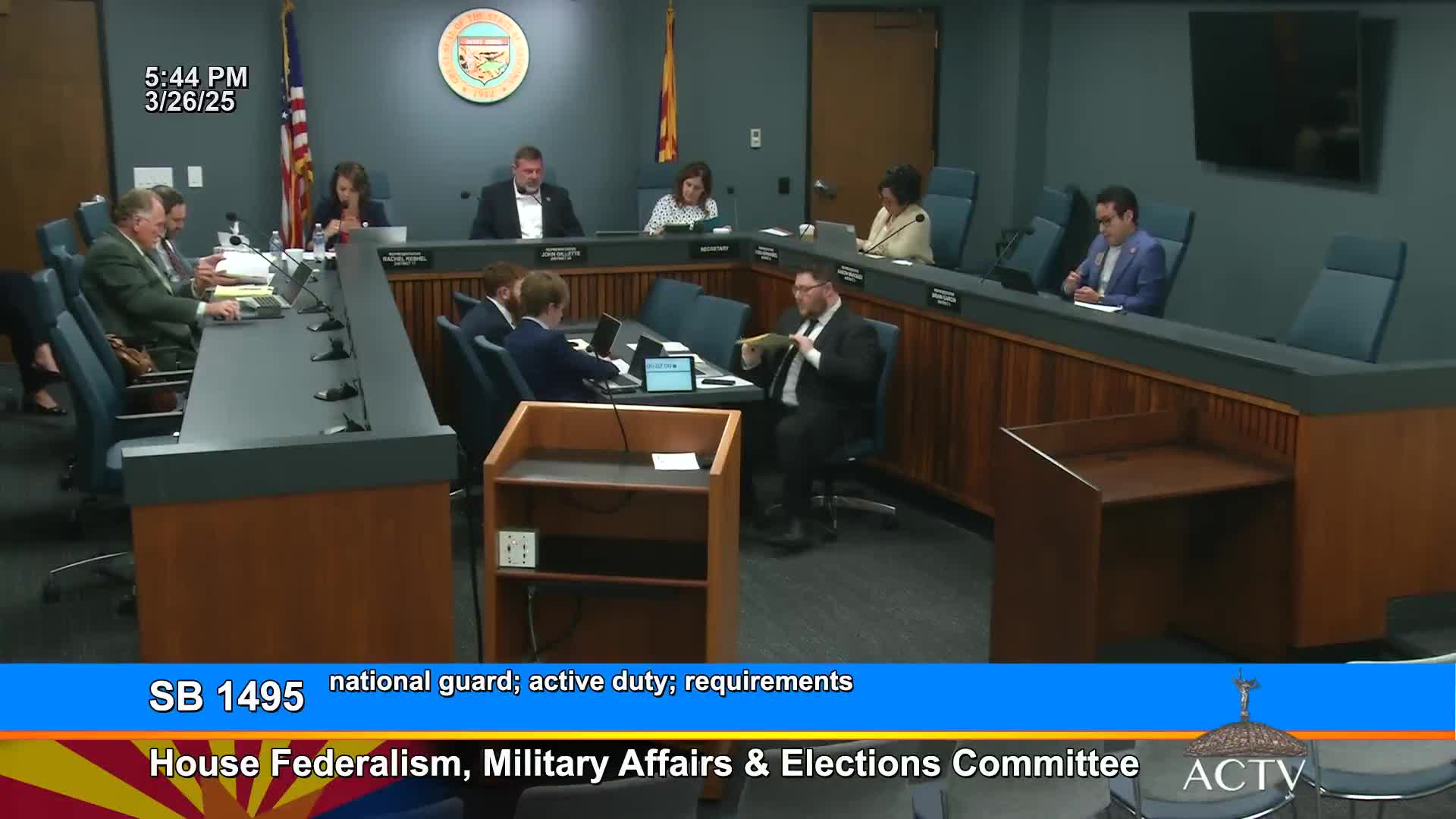
The Committee of Federalism, Military Affairs and Elections voted 4‑2 to advance Senate Bill 1495, a measure that would bar the Arizona National Guard from being released into active‑duty combat unless the U.S. Congress issues a declaration of war or takes specified official action.
Senator Rogers, the bill sponsor, framed SB 1495 as an effort to protect the state militia from deployment to "undeclared wars." "We will not send the Arizona National Guard into combat unless the United States Congress has declared war," Senator Rogers said, describing similar bills filed in other states and citing public and legislative interest.
Supporters included Diego Rivera of Bring Our Troops Home, who identified himself as the group's director of field operations and a combat veteran, and who answered committee questions about the bill's scope. Rivera said the group's goal is to prevent National Guard deployments to undeclared conflicts.
Department of Emergency and Military Affairs legislative liaison Travis Schulte testified in opposition, warning that state law cannot prevent the federal government from activating the National Guard for federal service and that passing the bill could risk federal reallocation of forces or funding. Schulte cited federal law and case law, including Perpich v. Department of Defense (1990), and explained that National Guard members take dual oaths and that Title 10 activations shift control from the state to the federal government. Schulte told the committee that funding flows through federal chains (National Guard Bureau and title‑10 authorities) and that refusal to meet federal wartime obligations could, under current law, put funding at risk.
Committee members asked about potential loss of federal funding and effects on state emergency missions. Senator Rogers and other supporters argued the bill is constitutional and offered to refine language to ensure training and non‑combat uses are not swept into a ban on certain federal statuses. Schulte warned that existing statutes such as 32 U.S.C. § 108 and the supremacy clause could limit the bill's effectiveness in preventing federal activations.
Representative Hernandez explained his vote, saying he understood the intent but worried about potential financial impacts and the current deployment of the Guard to the border; he voted no. The chair announced the committee's result as four ayes and two nays.
The transcript includes references to DOD instruction updates and to the interplay of federal activation authorities; committee members asked staff and Schulte to identify specific DOD guidance and funding mechanics if the measure advances.
If enacted, SB 1495 would create new state restrictions on when the Arizona National Guard may be released into active‑duty combat absent congressional action; the committee record shows both constitutional and operational questions remain for the House and Senate floors.