Get Full Government Meeting Transcripts, Videos, & Alerts Forever!
Get email alerts on the Insurance Duty To Defend topic
No spam. Unsubscribe anytime.
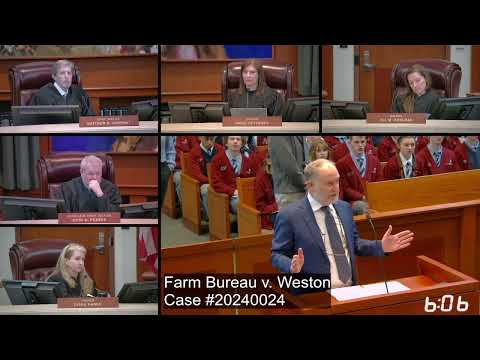
Justices hear argument on whether Utah should adopt Illinois rule for insurer duty to defend
Summary
At oral argument the Utah Supreme Court considered whether to adopt the "Illinois rule," which can require insurers who fail to defend to pay judgments even when they had a reasonable basis to decline; Farmers Insurance urged the court to stick with Utah's majority-rule approach and to treat the duty to defend as arising from contract.
The Utah Supreme Court heard competing legal arguments over whether Utah should adopt the so-called Illinois rule for insurer liability during oral argument. Troy Buer, counsel for Farmers Insurance Exchange, told the court that adopting the Illinois rule would be unnecessary on the record in this case and would expand insurer exposure beyond existing Utah precedent.
Why it matters: the choice between the Illinois rule and the majority rule affects when an insurer that declines to defend an insured can later be required to pay an underlying judgment. Adopting the Illinois rule can increase the financial risk insurers face when they decline to defend; keeping the majority rule preserves the current allocation of risk between contract remedies and potential tort claims.
Troy Buer, counsel for Farmers Insurance Exchange, told the justices that the court could avoid the duty-to-defend question on this record if it declined to adopt the Illinois rule. "If indemnification goes away and there's no responsibility for the judgment ... you're left with a contingent fee with a judgment of 0. And so there would be no need to reach the duty to defend if the court does not adopt the Illinois rule," Buer said. He argued the Illinois rule — as some states state it — applies only where an insurer ``breached without reasonable basis,'' and therefore would not apply on facts where a trial court found the insurer had a reasonable basis to decline to defend.
Buer urged the court to treat the duty to defend as a contractual obligation in Utah. "I think it actually would be pretty important to clarify that the duty to defend can only arise from a contractual relationship in the State of Utah," he said, citing the court of appeals' unusual procedural posture in the case and a prior partial summary-judgment record that removed tort bad-faith liability.
Justice Hagan questioned the policy incentives behind the competing rules, asking whether courts should encourage insurers to seek declaratory judgments at the outset so coverage is resolved before litigation: "Why isn't that the avenue that we would want to as a policy matter incentivize?" The court discussed practical tradeoffs: a rule that forces insurers to defend until coverage is adjudicated could require insurers to use premium funds to defend parties who ultimately prove not to be insured, while a rule that gives insurers more room to refuse defense risks moral hazard if insurers routinely decline defense and later are required to indemnify.
Counsel for Farmers pointed to Utah precedent he described as aligning with the majority rule and cited cases (for example, McCarthy and Thirkelson in counsel's argument) to argue the court has already limited insurer exposure when a reasonable basis supported declining defense. He said the court could limit the application of any broader rule by requiring a showing that an insurer unreasonably refused to defend before expanding liability under the Illinois rule.
The justices also questioned practical lines between a coverage dispute and the related remedies (contractual breach, indemnification, and tort claims such as bad faith). Counsel for Farmers emphasized that, on this record, much of the tort overlay had been dismissed below and that remaining claims were contract-based, which shaped his recommendation on resolving the certiorari question.
No decision was announced from the bench. The court's resolution will determine whether Utah joins the subset of states applying the Illinois rule in whole or in a cabined form, or whether Utah courts will continue to follow the majority approach urged by Farmers' counsel.