Get Full Government Meeting Transcripts, Videos, & Alerts Forever!
Get email alerts on the Elections topic
No spam. Unsubscribe anytime.
Committee advances bill allowing on‑site tabulation and new ID rule for dropped off early ballots
Summary
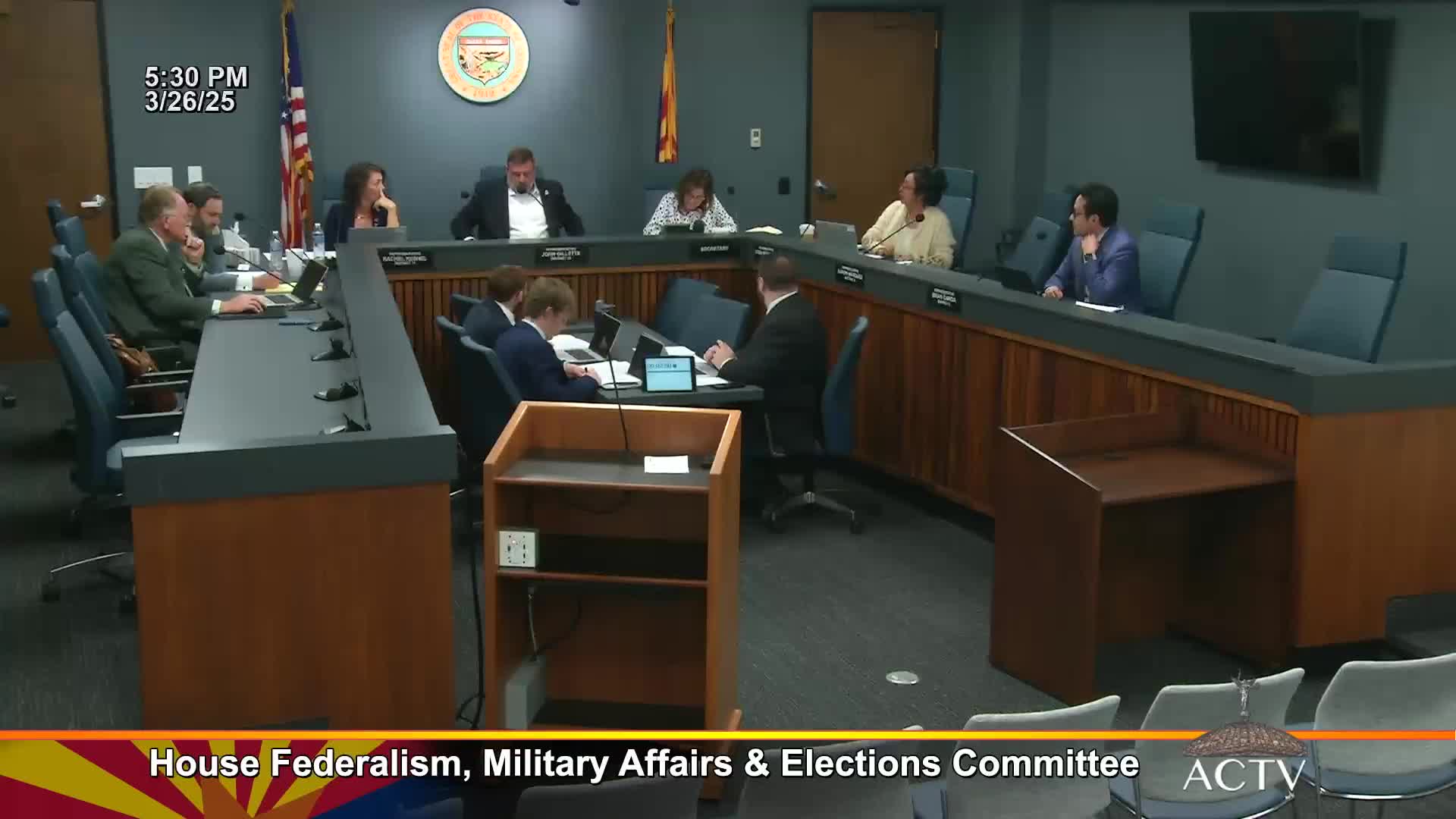
A House committee voted 4-2 to give Senate Bill 1001 a due‑pass recommendation after debate on on‑site tabulation, chain‑of‑custody logs and a provision that would remove late ballot droppers from early voting lists if they do not show ID.
The Committee of Federalism, Military Affairs and Elections advanced Senate Bill 1001 on a 4‑2 vote, moving the bill to the next chamber with a due‑pass recommendation.
Senate Bill 1001 would authorize counties to perform on‑site tabulation during the early‑voting period, require identification and chain‑of‑custody documentation for voters who return early ballots after the Friday before Election Day, and repeal a statute regarding emergency voting centers. The bill also includes a provision that would remove a voter from the early‑voter list if they drop off their early ballot on Election Day and do not present identification.
The bill sponsor, identified in the hearing as the bill sponsor, said the measure is a continued effort to speed vote counting after long post‑election tabulation times in 2022 and 2023. "If you come to the polls and drop off your ballot and don't show ID, so it doesn't prevent you from dropping off, but you don't show ID, we are going to remove you from the early voting list," the bill sponsor said during the hearing.
Committee members discussed how SB1001 differs from earlier, broader proposals that were vetoed by the governor. Committee staff said page 23 of the engrossed bill includes chain‑of‑custody logs to document ballot handling and that page 25 retains an affirmation provision for election officials. Representative Colligan asked whether the chain‑of‑custody language matched prior bills; staff said the bill's logs are present but worded differently than earlier measures.
Opponents in caucus meetings said they were not ready to fully support the bill, expressing concern that removing voters from the early‑voter list for not showing ID could be viewed as punitive when signature verification would still occur. A committee member said the proposal "seems very different than the Florida‑style stuff" and that the change may not be sufficient to markedly speed final results; that member voted no but reserved the right to change on the floor.
The committee recorded two nays—Representative Garcia and Representative Hernandez—and four ayes. The motion before the committee was that SB 1001 be returned with a due‑pass recommendation; the committee secretary then called the roll and the chair announced the 4‑2 result.
The bill leaves several operational details to counties, including exactly how on‑site tabulation would be scheduled and how election offices would handle ballots for which ID was not presented at drop‑off. Staff and members noted some instruction language was open to revision before floor consideration.
If the bill continues to move, counties and the Secretary of State's office would be among the agencies impacted by changes to early‑voter processing and chain‑of‑custody documentation.