Get Full Government Meeting Transcripts, Videos, & Alerts Forever!
Get email alerts on the Diversity Equity Inclusion topic
No spam. Unsubscribe anytime.
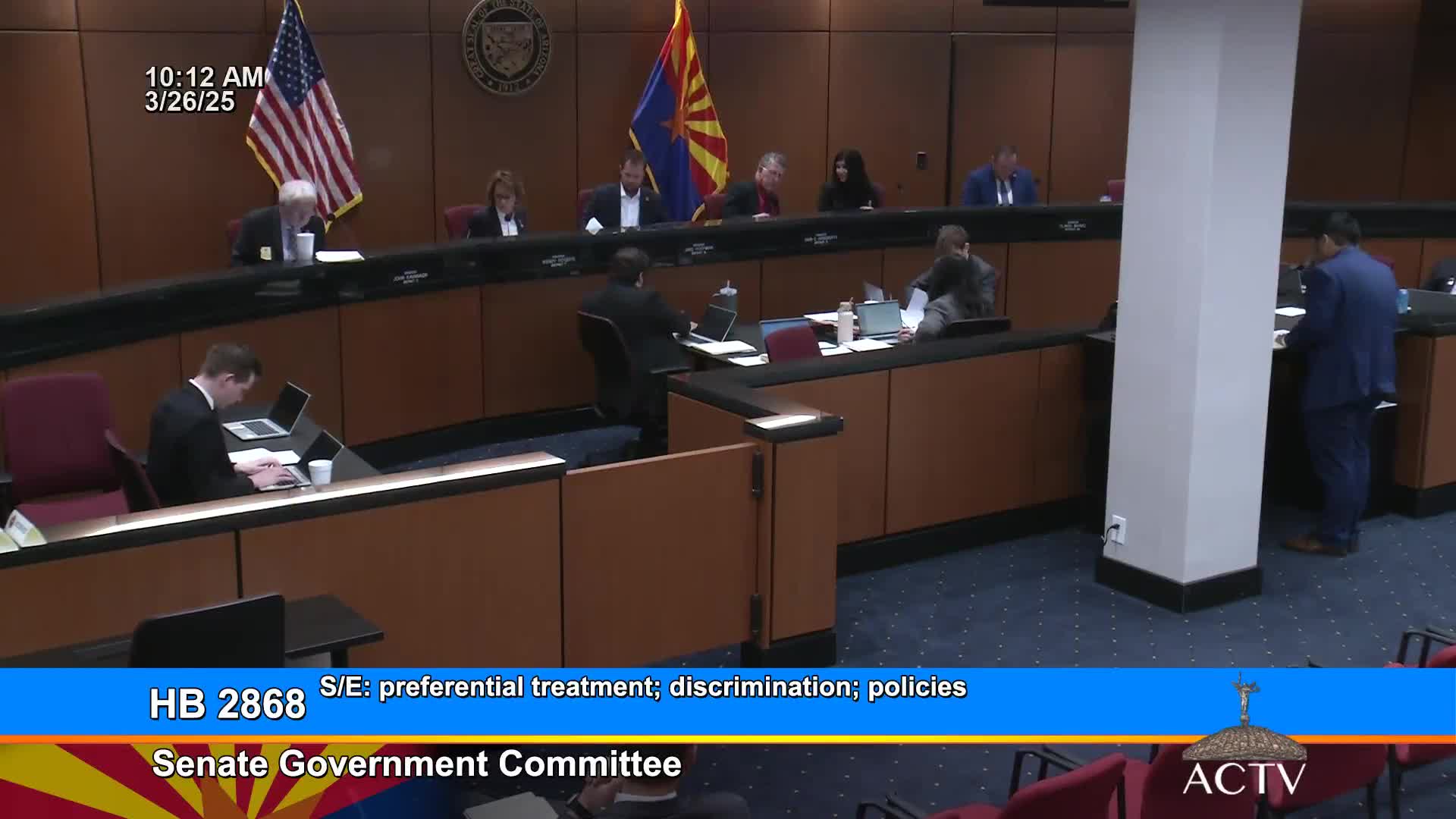
Senate committee advances bill restricting DEI offices at state and public colleges after contentious hearing
Summary
The Senate Government Committee gave House Bill 2,868 a due-pass recommendation after lengthy debate and public testimony for and against a strike-everything amendment that would bar state entities from maintaining diversity, equity and inclusion offices or requiring DEI statements. The bill passed the committee by a 4-3 vote.
The Senate Government Committee voted 4-3 on March 25 to advance House Bill 2,868 as amended, a measure that would restrict how state agencies, universities and community colleges use diversity, equity and inclusion (DEI) offices and practices.
The strike-everything amendment adopted in committee would prohibit a state agency, city or town, county, community college district, governing board, and state university from establishing or maintaining a DEI office, hiring or assigning an employee or contracting with a third party to perform the duties of a DEI office, or compelling a person to provide a DEI statement. The amendment also requires colleges and universities to certify compliance before spending appropriated funds; it preserves academic instruction, scholarly research, creative work, registered student organizations and certain other activities as exceptions.
Supporters framed the bill as a protection of equal treatment and a guard against what they described as reverse discrimination. Brian Sickma, testifying for Do No Harm, said the measure would “get rid of sort of reverse discrimination” and urged lawmakers to ensure hiring and promotion decisions are based on merit rather than identity. House sponsor Representative White, in closing remarks, said the bill "emphasizes the importance of equal treatment under the law."
Opponents warned of legal risk and broader harms if the bill becomes law. Harrison Redmond of the ACLU of Arizona told the committee the bill would "erase the tools necessary" to address persistent barriers and described DEI initiatives as measures that help ensure a level playing field. Counsel and senators in the hearing referenced recent litigation involving race-conscious admissions and cases where courts have blocked aspects of state DEI restrictions in other states; witnesses and senators debated whether the bill would conflict with federal civil-rights protections.
Senators asked whether the proposal would prompt litigation or jeopardize federal funding; the bill’s supporters argued the measure would strengthen adherence to federal civil-rights law rather than undermine it. Committee members also debated whether the bill’s language would narrow or preserve harassment- and equal-employment-training requirements; sponsors said those protections would remain.
After adopting a two-page amendment that required institutions to adopt disciplinary policies for contractors and employees who violate the DEI prohibitions, the committee voted to advance the bill to the full Senate on a 4-3 vote.
The vote was one of the session’s more heavily attended and contested items, drawing three public witnesses and extended questioning from senators about constitutional and federal-law interactions.
If approved by the full Senate and enacted, the measure would affect DEI offices, certain training and institutional practices at state agencies and public higher-education institutions; the adopted text preserves explicit carve-outs for academic instruction and research.