Get Full Government Meeting Transcripts, Videos, & Alerts Forever!
Get email alerts on the Service Member Tax Subtraction topic
No spam. Unsubscribe anytime.
Committee approves widening income‑tax subtraction to include public health and other uniformed services
Summary
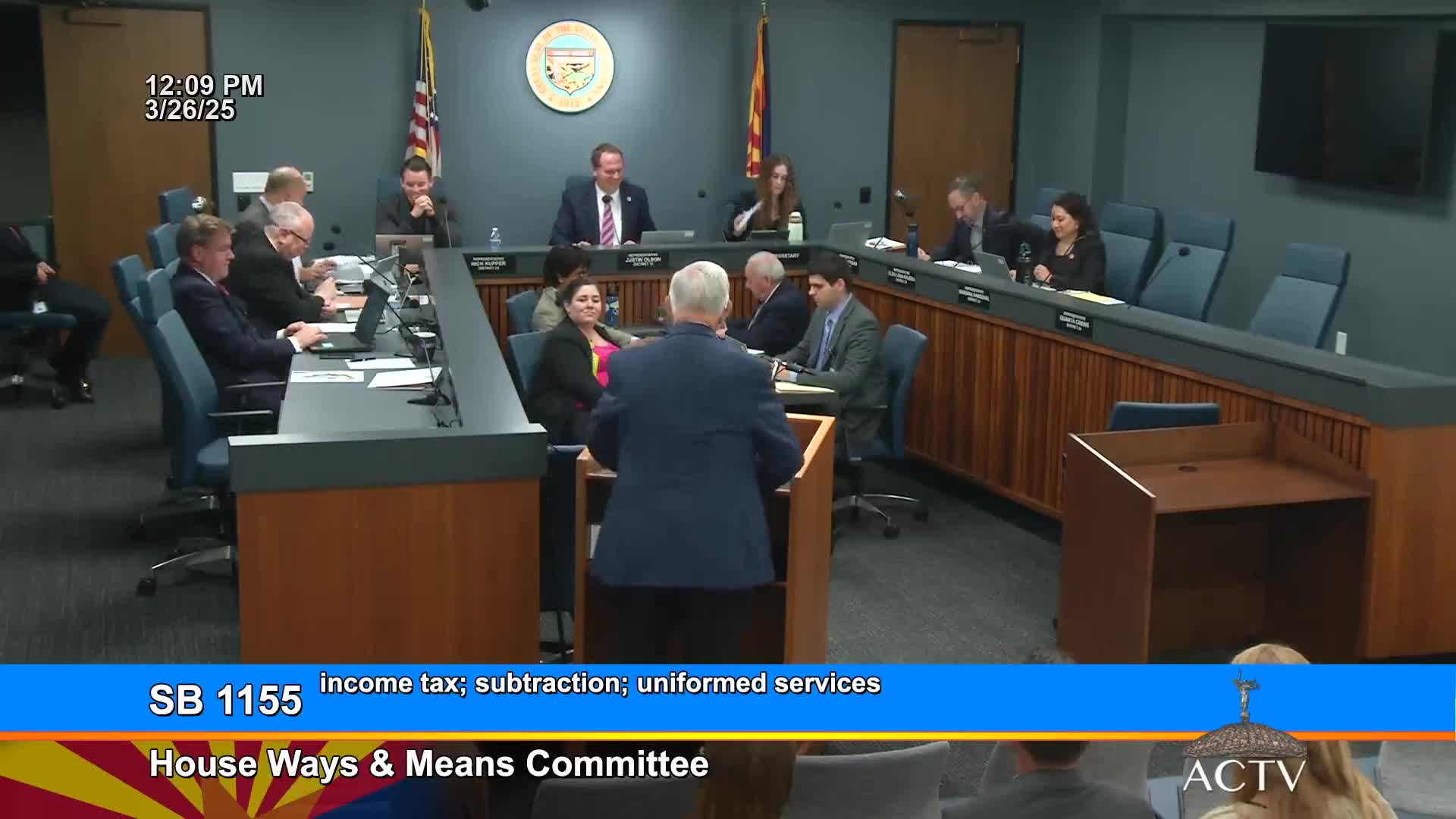
The committee returned Senate Bill 1155 with a due‑pass recommendation to replace the term “armed forces” with “uniformed services” in an active‑service income tax subtraction, extending the state tax benefit to members of the U.S. Public Health Service and other uniformed services.
Senate Bill 1155, which amends the individual income‑tax subtraction for active service by replacing the phrase “armed forces” with “uniformed services,” was returned with a due‑pass recommendation by the House Ways and Means Committee.
The change would align state tax code language with the broader federal categorization of uniformed services and would extend the subtraction to certain uniformed officers not included in the narrower “armed forces” label, principally officers of the U.S. Public Health Service (USPHS) and, where applicable, National Oceanic and Atmospheric Administration officers. Witnesses emphasized on‑the‑ground service in Indian Health Service, tribal clinics and other remote postings in Arizona.
Darren Venters testified in support and described the measure as a correction of an earlier omission: Department of Revenue guidance issued in 2010 had limited the subtraction to armed forces only, excluding some uniformed services even though a 2005 fiscal note had implied they were included. Captain Robert Boyle and family members spoke in support; Boyle described multiple deployments and routine public‑health missions across Arizona’s tribal communities. Emily Boyle described how USPHS assignments brought her family to multiple Arizona communities and urged equal recognition for the public‑health uniformed service.
Committee action: The committee returned SB 1155 with a due‑pass recommendation (tally: yes 7, no 0, absent 2). Members said the change restores parity among uniformed services and fixes a drafting/interpretation inconsistency in prior guidance.
What’s next: The bill advances to the House floor with committee endorsement.