Get AI Briefings, Transcripts & Alerts on Local & National Government Meetings — Forever.
Panel approves expanded court‑ordered intensive treatment services for people with serious mental illness with funding caveat
Loading...
Summary
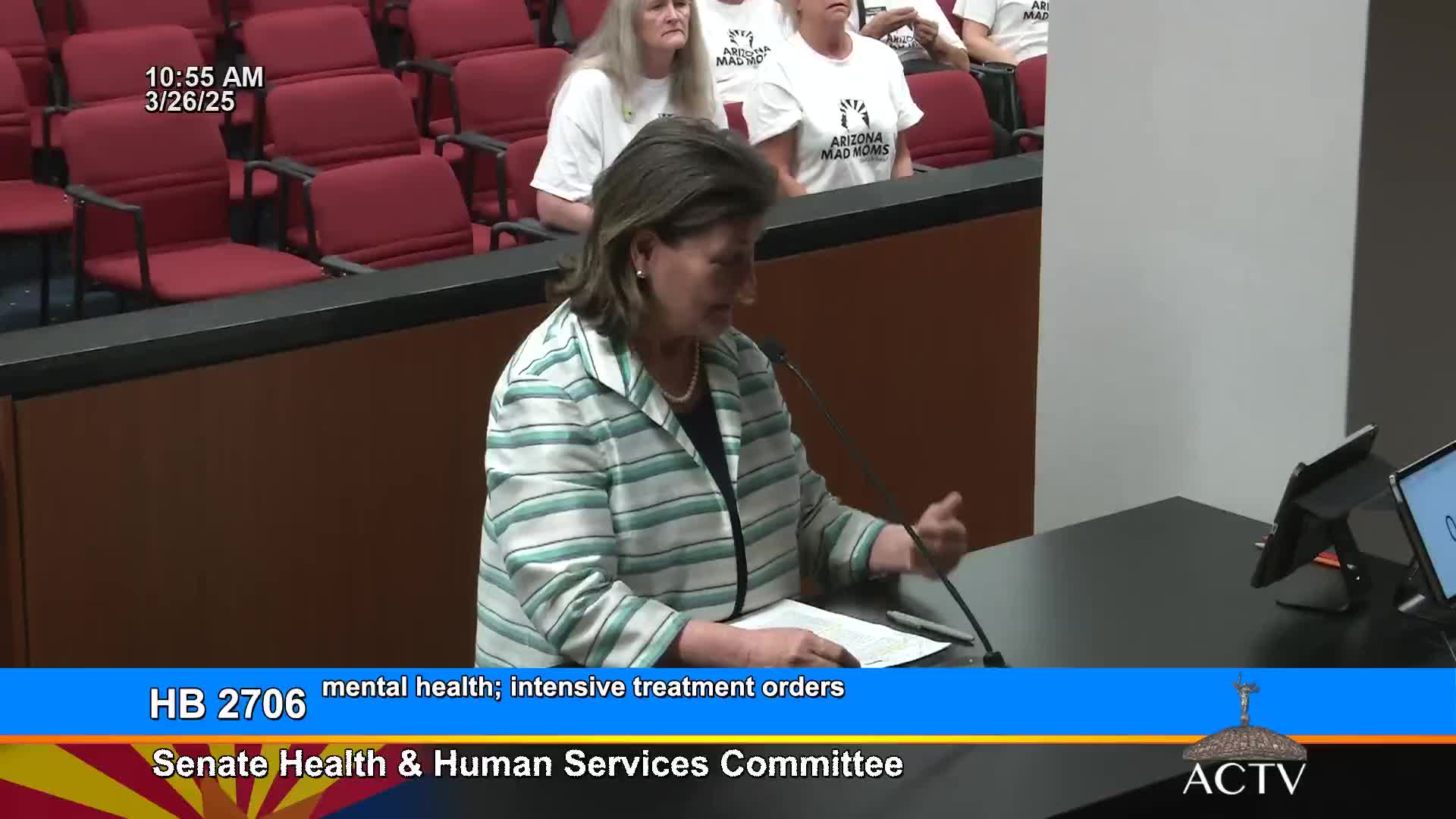
The Senate Committee on Health and Human Services voted 7–0 to advance HB 2706, a bill allowing courts to issue orders for intensive treatment services for people with serious mental illness who are chronically resistant to treatment, after adopting an amendment limiting orders to services with identified funding.
The Arizona Senate Committee on Health and Human Services advanced HB 2706 by a 7–0 vote after adopting an amendment from Senator Gonzales limiting an order for intensive treatment services (ITS) to services for which there is an identified funding source. The bill establishes a process for courts to order ITS for people with serious mental illness who are chronically resistant to treatment, defined by a pattern of refusal or inability to participate in recommended treatment during the preceding 24 months and found by clear and convincing evidence.
Supporters including families and advocacy groups described repeated crises, hospitalizations and instances of decline among adults with severe psychiatric illness and urged additional court‑ordered wraparound services to secure treatment adherence. Holly Giesel and Sharon Barnes — both representing family advocates — said the measure is a narrowly tailored “gap‑filler” that allows courts to order medication management, ACT team services and other community supports when standard treatment engagement fails.
Civil‑liberty groups and defense attorneys raised due‑process concerns and questioned administrative details in the bill. Gene Woodbury of the ACLU and Arizona Attorneys for Criminal Justice urged a no vote, saying the bill’s standards and compliance hearing procedures could be vague in practice and that the bill could impose significant fiscal costs for treatment and hearings. Access Health provided a fiscal estimate to the committee of between $500,000 and $2.8 million per year under certain utilization assumptions.
Sponsors and some members said the Gonzales amendment (limiting ITS orders to services with identified funding) addressed a major fiscal concern and the committee adopted the amendment before recommending the bill. Committee members asked for further drafting clarity on compliance hearings, notice and judicial review. The committee voted 7–0 to advance the measure as amended.
Votes at a glance: HB 2706 — do pass recommendation in committee, 7 ayes, 0 noes.