Get Full Government Meeting Transcripts, Videos, & Alerts Forever!
Get email alerts on the Tax Policy Surplus Refund topic
No spam. Unsubscribe anytime.
Committee backs plan to cut income tax rate by formula tied to structural surplus; critics warn of long‑term risks
Summary
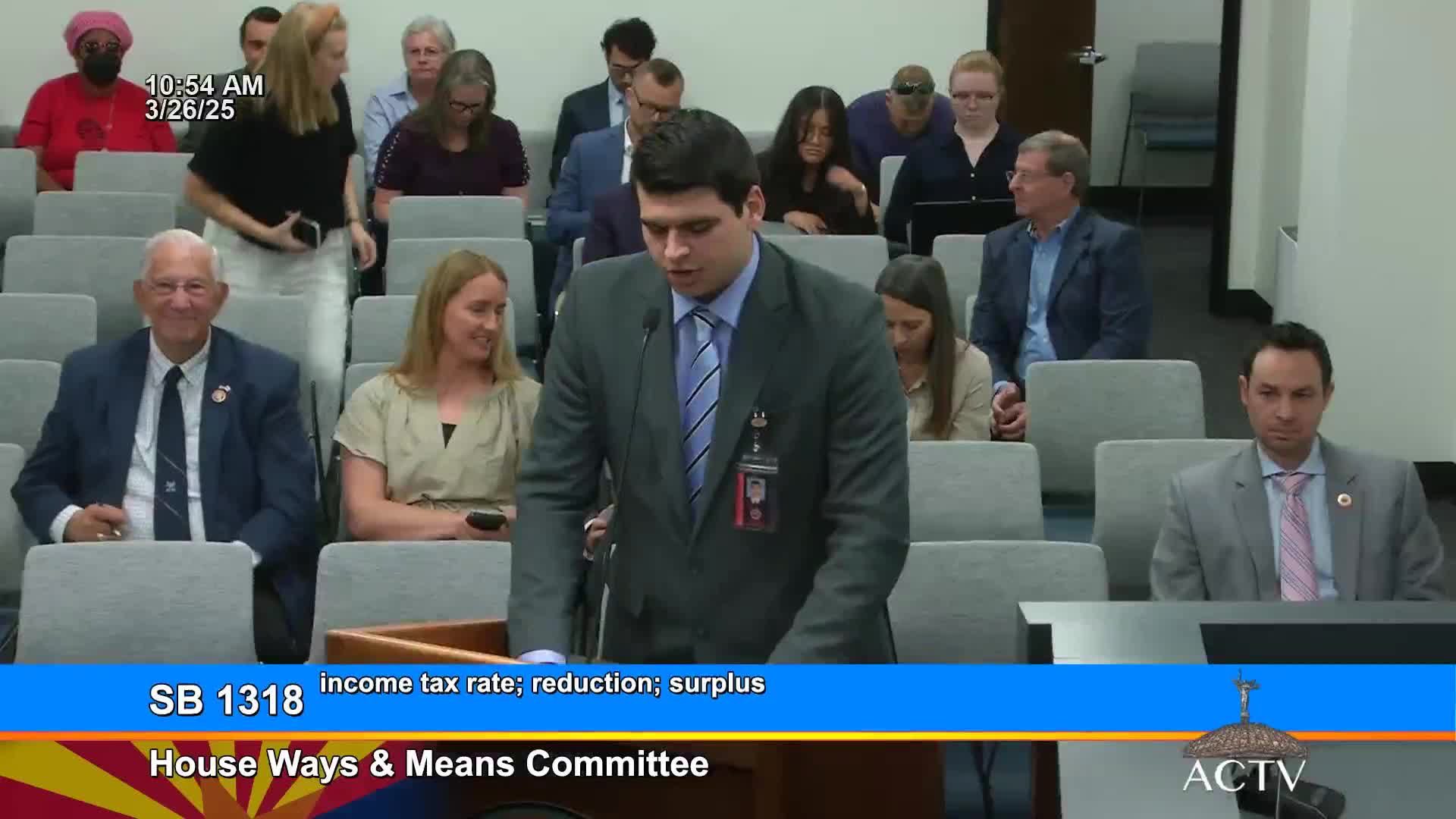
The House Ways and Means Committee returned Senate Bill 1318 and a companion ballot measure, SCR 1014, with due‑pass recommendations after a lengthy debate over a proposal to reduce Arizona’s individual income‑tax rate by half of a defined structural surplus.
The House Ways and Means Committee advanced two related measures — Senate Bill 1318 and Senate Concurrent Resolution 1014 — that would require the state to reduce the individual income‑tax rate by 50% of a defined “structural surplus” beginning in taxable year 2026 (SB 1318) or taxable year 2028 if approved by voters (SCR 1014). The committee returned both measures with due‑pass recommendations.
Sponsor Senator Mesnard framed the plan as a predictable, formulaic approach to return part of structural surpluses to taxpayers while dampening government growth in strong revenue years. He and other supporters said the proposal differs from Colorado’s Taxpayer Bill of Rights (TABOR) because it is narrower: it refunds half the structural surplus, uses a historical high watermark adjusted for population growth and inflation, and does not automatically ratchet down permanent spending in lean years.
Opponents warned the automatic trigger for rate reductions creates fiscal uncertainty and could leave state and local governments short after a downturn. Tom Savage of the League of Arizona Cities and Towns said automatic rate cuts would directly reduce the urban revenue sharing that funds municipal services and argued the legislature should make deliberate choices about tax reductions rather than rely on an automatic formula. Joseph Palomino of the Arizona Center for Economic Progress said income‑tax rate reductions disproportionately benefit higher‑income taxpayers and that the state already has statutory guardrails (including a reference to Arizona Constitution Article 9, Section 17) and a supermajority requirement for tax increases.
The committee heard detailed fiscal and policy questions: witnesses and members discussed the distinction between one‑time and ongoing surpluses, the relationship to the rainy‑day fund and the state stabilization account, and how the bill’s calculation is made in arrears (using realized revenues). The Department of Revenue told the committee it could not produce a precise fiscal estimate because the bill allows more organizations or taxpayers to qualify over time and the number of qualifying entities or taxpayers cannot be predicted.
Economic analysts told the committee that a permanent structural cut of the kind proposed would reduce general‑fund revenue over time; one estimate offered during testimony (an illustrative model, not an official JLBC estimate) suggested a reduction on the order of $1.4 billion if a rate cut from 2.5% to 2.0% were realized, with the top 1% receiving a far larger absolute tax cut than lower quintiles. Supporters said the bill’s design — returning only half of the structural surplus and not ratcheting down spending irrevocably — would provide guardrails that reduce the risk of the most extreme outcomes.
Committee action: SB 1318 was returned with a due‑pass recommendation (tally: yes 5, no 2, absent 2); SCR 1014 (the ballot referral version) was also returned with a due‑pass recommendation (tally: yes 5, no 2, absent 2). Sponsors and opponents said they expected continued debate during floor consideration and noted the measure would change state fiscal rules if enacted or approved by voters.