Get Full Government Meeting Transcripts, Videos, & Alerts Forever!
Get email alerts on the Charitable Tax Credits topic
No spam. Unsubscribe anytime.
House committee advances bill to clarify who qualifies for Arizona charitable tax credits amid foster-care group concerns
Summary
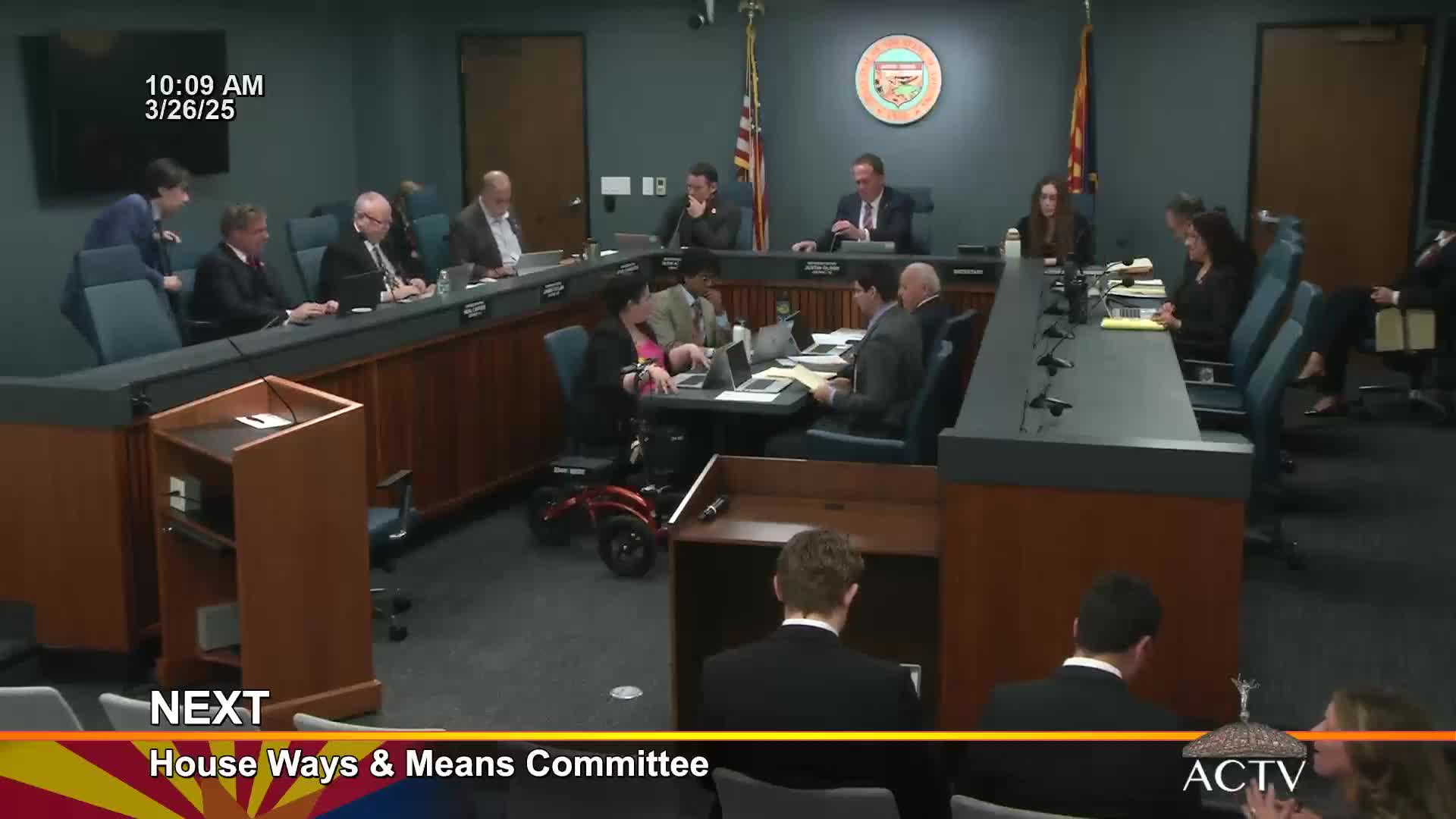
Senate Bill 1496, which would unify the definition of services for two Arizona charitable tax credits, was returned with a due‑pass recommendation by the House Ways and Means Committee after testimony from nonprofit funders, foster‑care charities and the Department of Revenue.
Senate Bill 1496, a proposal to revise the statute that defines services for Arizona’s qualifying charitable organizations (QCOs) and qualifying foster care charitable organizations (QFCOs), was returned by the House Ways and Means Committee with a due‑pass recommendation after a half‑hour of testimony and discussion.
The bill would create a single definition of “services” for both tax credits and add language that requires a qualifying charitable organization to “direct” at least 50% of its budget to certain state residents (recipients of Temporary Assistance for Needy Families, low‑income residents, or individuals with chronic illness or physical disability). Sponsor Senator Mesnard and stakeholders said the measure is intended to restore prior practice after recent Department of Revenue guidance narrowed who qualifies.
Committee members and witnesses said the goal is to preserve access to the credit for groups that have historically participated, while preventing an unintended expansion. Brandy Petrone of Arizona Impact for Good summarized the background: the Department of Revenue began work three years ago to standardize QCO guidance, and the finalized guidance last year left some organizations off the certified list. Petrone said the department gave stakeholders time to seek legislative fixes and the bill aims to prevent long‑standing organizations from losing eligibility under the new guidance.
Delta Dental Foundation testified that it has historically acted as a “pass‑through” or directed grants to local nonprofits and that the department’s clarified guidance now treats that practice as nonqualifying. Delta Dental representative Mark Osborne told the committee his foundation would have to change its operating model to provide services directly rather than fund other nonprofits; he said the intent of the bill is to preserve the foundation’s existing eligibility, not to expand the program.
Several QFCO representatives opposed the bill in its present form. Danica Robinson, president and co‑founder of ASA Now and a long‑time foster parent, testified “I am here today to testify against SB 14 96 in its current form.” Robinson said QFCOs are smaller, serve distinct needs of foster children and rely on targeted services for trauma‑informed care. She said the bill’s changes raise four principal concerns: (1) removal of minimum service thresholds that ensure organizations are serving significant numbers of foster children; (2) allowing umbrella organizations that collect and regrant donations to participate, which she said could dilute funds available to direct service providers; (3) expansion of the list of allowable services (behavioral health, education workforce development, housing and other items); and (4) an inconclusive fiscal note that does not analyze how many additional organizations might qualify or how the general fund would be affected. Robinson said there are 58 QFCOs and about 258 QCOs in Arizona and that taxpayers claimed $84 million in QCO credits in 2024.
Molly Murphy, representing the Department of Revenue, told the committee the finalized guidance led the department to determine that organizations that simply “direct” funds would not qualify under the guidance; the bill’s drafting, she said, would allow organizations that direct funds to qualify again. Murphy said the department had provided technical feedback to stakeholders but did not take a policy position about whether directing should qualify.
Committee Chair and the sponsor emphasized they want a floor amendment negotiated with QFCO stakeholders if necessary. After the hearing the committee returned the bill with a due‑pass recommendation (tally: yes 5, no 2, absent 2). The chair and the sponsor said they will convene stakeholders — including QFCOs, Arizona Impact for Good and Delta Dental — to try to craft amendment language that preserves foster‑care groups’ funding.
What’s next: The bill will proceed to the House floor with the committee’s recommendation while the sponsor and stakeholders seek clarifying amendments. Witnesses urged a post‑committee stakeholder meeting to avoid unintended harm to foster‑care organizations that provide specialized services to children.