Get Full Government Meeting Transcripts, Videos, & Alerts Forever!
Get email alerts on the Foster Care Vaccination Placement topic
No spam. Unsubscribe anytime.
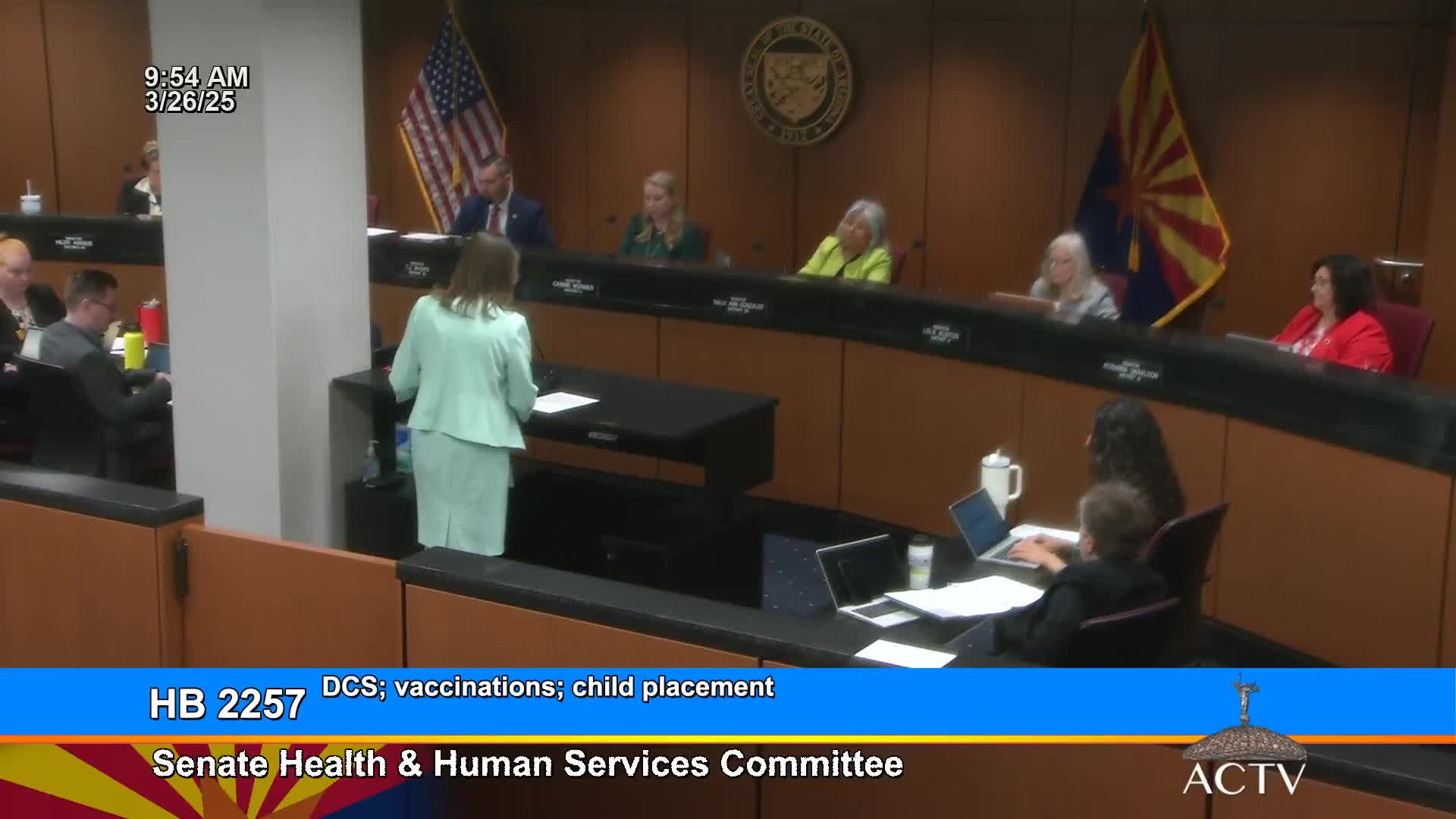
Committee backs bill barring DCS from refusing placements solely over household vaccination status
Summary
The committee recommended HB 2257 do pass after testimony from foster parents, advocates and public‑health opponents. The bill prevents the Department of Child Safety from refusing to place a child with a licensed foster or kinship home based solely on the vaccination status of household members; the committee approved the measure 4–3.
The Arizona Senate Committee on Health and Human Services on March 24 voted 4–3 to give HB 2257 a do‑pass recommendation. Sponsor Representative Lisa Fink said the bill aligns placement policy with existing licensure rules and makes it unlawful for the Department of Child Safety to deny placement solely because household members are unvaccinated.
Foster parents and kinship caregivers told the committee the requirement restricts available homes and forces difficult placement decisions. Anika Robinson, a 17‑year licensed foster parent and president of a foster care charity, said the bill “ensures that the Department of Child Safety cannot refuse to place a child in a foster home solely based on the vaccination status of the child or other children in the home.” Several foster parents described being denied or forced to close licenses because their biological children were not on the state vaccine schedule.
Public‑health and medical witnesses urged caution. Amber Hilliker, executive director of Arizona Families for Vaccines, said infants and toddlers are especially vulnerable and urged retaining DCS policy that favors placing children under 5 with vaccinated households. She told the committee that vaccination schedules for some diseases are not complete until age 4 and that congregate settings pose transmission risks.
Committee members questioned DCS data and placement options in rural areas. Fink said agency data provided to the committee showed 33 children ages 0–5 in congregate care at the time of testimony. Several members urged further coordination between the department and the Vulnerable Adult/child placement stakeholders but supported the bill.
The committee recorded a do‑pass recommendation by 4 ayes and 3 noes; sponsors said the bill would remove a barrier to licensure and placements for willing families while preserving DCS’s ability to evaluate a child’s best interest.
Votes at a glance: HB 2257 — do pass recommendation in committee, 4 ayes, 3 noes.