Get AI Briefings, Transcripts & Alerts on Local & National Government Meetings — Forever.
After debate over federal grants, committee approves transfer of State Broadband Office to ADOA
Loading...
Summary
The committee ultimately approved Senate Bill 13-22 on reconsideration after witnesses warned the transfer could jeopardize hundreds of millions in federal broadband funding and supporters argued the move would improve cross-agency coordination for public-safety and infrastructure planning.
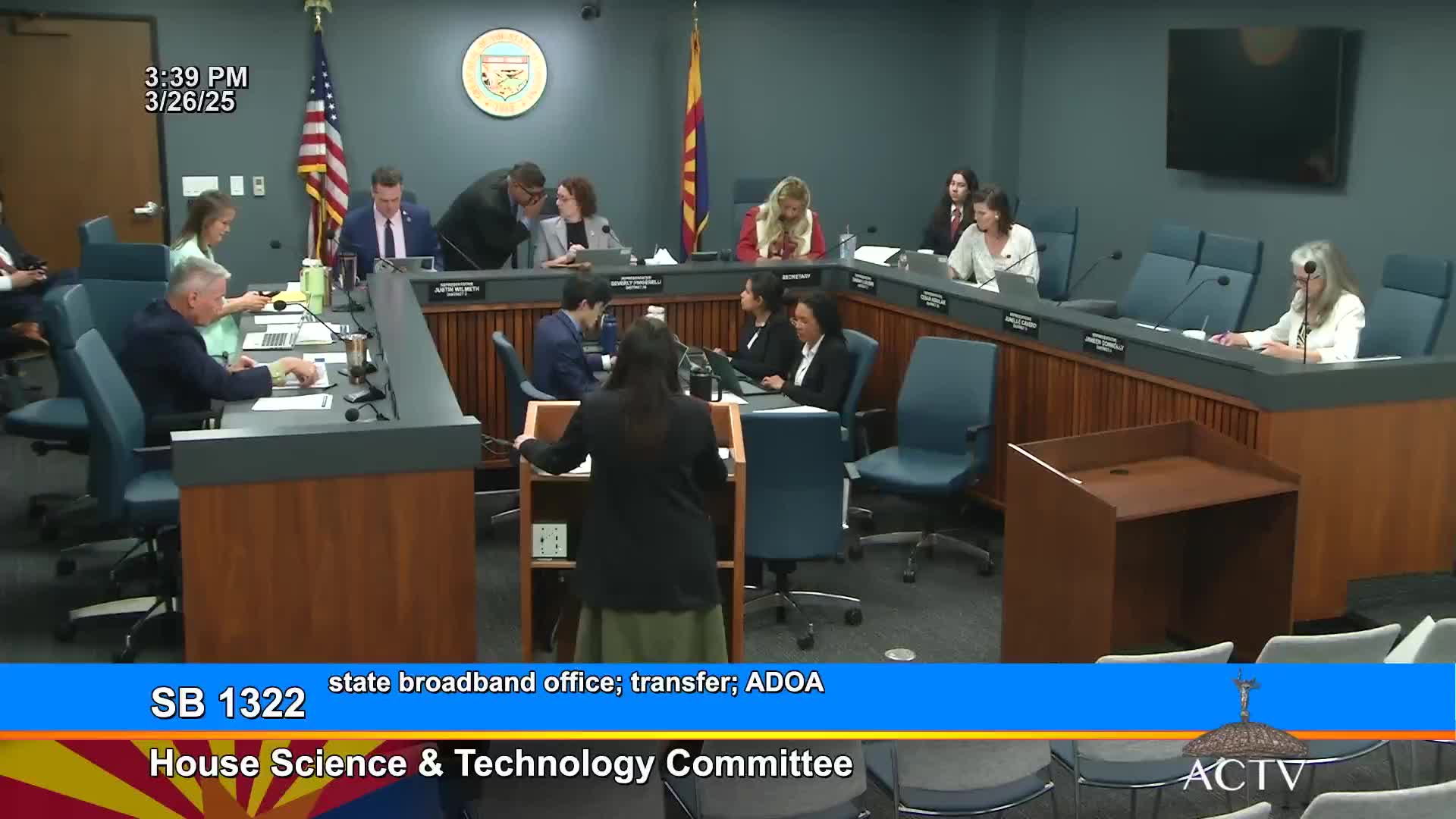
The Arizona House Committee on Science and Technology returned Senate Bill 13-22 with a due-pass recommendation on reconsideration after extensive testimony both opposing and supporting the measure.
Senate Bill 13-22 would transfer the State Broadband Office from the Arizona Commerce Authority (ACA) to the Department of Administration (ADOA). Committee staff summarized the bill, and the agency primarily responsible for broadband grants, the ACA, urged the committee to oppose the transfer, saying the move could disrupt ongoing contracts and risk federal funding currently in procurement.
"Shifting where the State Broadband Office resides at this advanced stage would negate dozens of contracts jeopardizing hundreds of millions of dollars worth of work that's currently underway," testified Keith Watkins, interim broadband director and senior vice president for economic and rural development at the Arizona Commerce Authority. Watkins said ACA has been provisionally awarded about $993 million in federal Broadband Equity, Access, and Deployment (BEAD) funding and is in procurement phases that will require entering dozens of contracts and meeting deadlines; the agency warned the transfer could jeopardize that work.
Representing industry and local stakeholders, witnesses such as Diane McCallister of the Arizona Technology Council and Russell Smoltz, representing electric cooperatives and a fiber provider, urged the committee to keep broadband at ACA because of the authority’s experience administering rural grants and matching funds. "Without the ACA and the broadband office, we wouldn't be able to do that in rural Arizona," Smoltz said, describing projects in Mohave County that relied on ACA grants.
Supporters of the transfer argued ADOA offers stronger cross-agency integration with public-safety and statewide IT functions. Isaac Blake, who identified himself as a chief technologist and first responder, said the move is intended to "place long term leadership of an Arizona broadband strategy in the right organizational home where it can scale effectively, integrate with broader state infrastructure and deliver results to every corner" of Arizona. Blake and other supporters framed the change as improving coordination between broadband planning and 9-1-1/public-safety systems.
Committee debate focused on the risk of disrupting ongoing grants and procurement. Witnesses described ACA’s multi-year grant work: prior grants that funded middle-mile projects resulting in dozens of contracts and an earlier $100 million program that produced 18 projects connecting roughly 24,000 households and 22,000 businesses; the ACA also reported that approximately 180,000 addresses remain unserved or underserved statewide.
The committee initially voted on SB 13-22 and the motion failed (recorded earlier as 3 ayes, 4 nays). Representative Heap moved to reconsider the bill; on reconsideration the committee voted to return SB 13-22 with a due-pass recommendation by a recorded vote of 4 ayes and 3 nays.
Votes and next steps: The committee’s later roll call recorded a 4–3 result in favor of returning SB 13-22 with a due-pass recommendation. Committee discussion left implementation details unresolved, including staff transfers and how ongoing ACA contracts would be assigned if the transfer occurs. Supporters said ACA staff and programs would remain in place while an ADOA overlay would provide cross-agency coordination; opponents warned that contracting and federal deadlines could be disrupted. The bill moves next to the House calendar; committee testimony flagged possible risks to BEAD funding and dozens of active contracts if the transfer proceeds without detailed transition plans.