Get Full Government Meeting Transcripts, Videos, & Alerts Forever!
Get email alerts on the Tribal Identification Ids topic
No spam. Unsubscribe anytime.
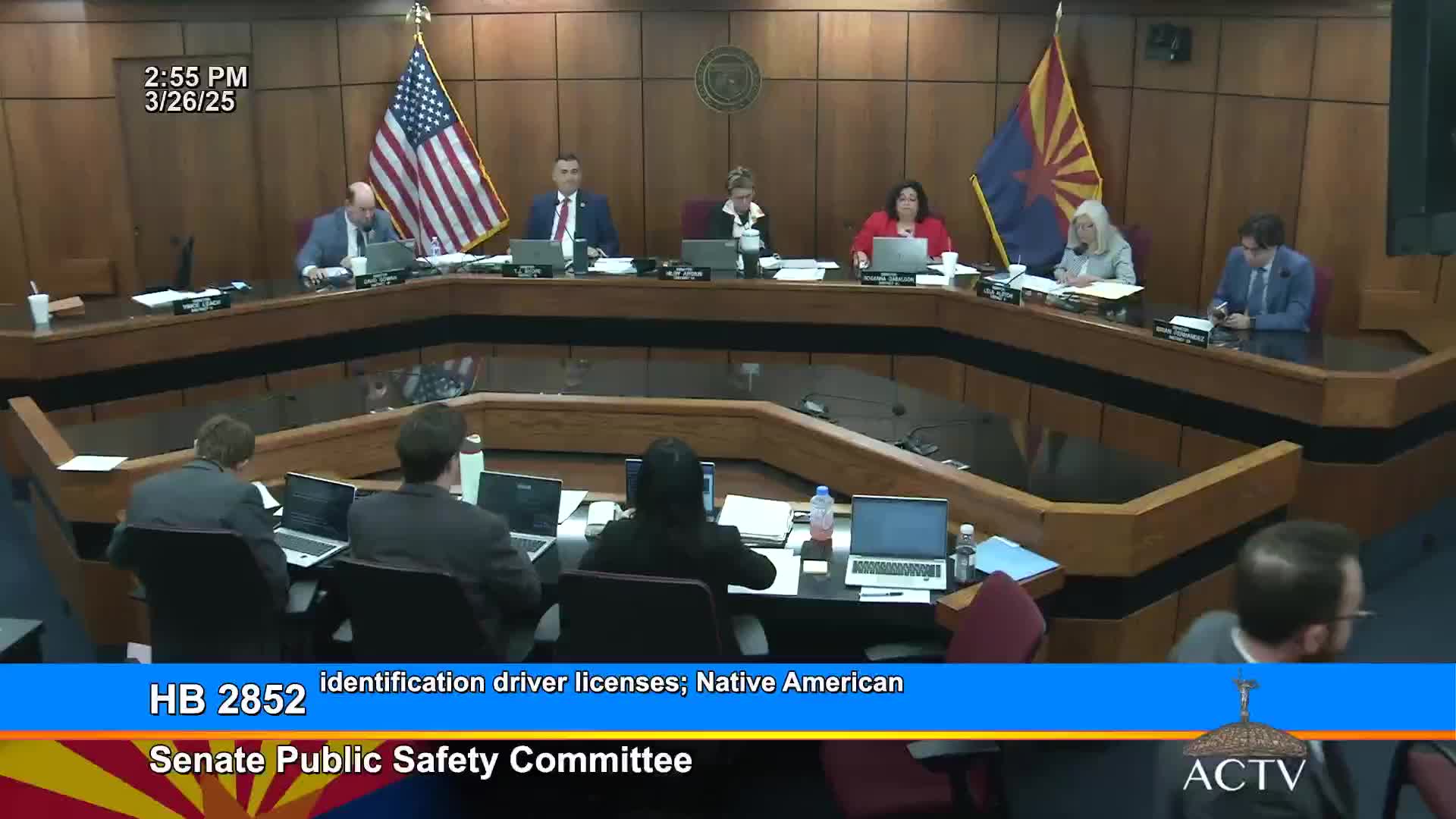
Committee OKs measure allowing compact mark for Arizona tribal members on state IDs
Summary
The committee approved House Bill 2852, which would allow applicants who provide proof of enrollment in a federally recognized Arizona tribe to receive a non‑identifying mark on their driver's license or state ID indicating Native American status; the effective date was moved to Jan. 1, 2026 in an amendment.
The Senate Public Safety Committee gave House Bill 2852 a due‑pass recommendation after testimony from Representative Sosie and discussions with the Arizona Department of Transportation and tribal representatives.
Representative Sosie, the bill sponsor, told the committee the measure was brought forward by tribes including the Navajo Nation and White Mountain Apache to "streamline identification for indigenous peoples" who otherwise need to carry multiple identification documents when traveling. Under the bill, an applicant who submits satisfactory proof of enrollment in a federally recognized Arizona tribe may elect to have a distinguishing mark on a non‑operating identification or driver's license that identifies the licensee as Native American; the mark may not identify a specific tribe or other personal information.
Testimony noted the bill's language was amended in Senator Payne's name to require that an eligible applicant be a member of a federally recognized tribe located in Arizona and to delay the effective date to Jan. 1, 2026. Representative Sosie said the provision was coordinated with ADOT and the governor's office and cited similar systems in other states and among veteran/organ‑donor markers.
Supporters said the mark would ease the need to carry multiple documents such as tribal ID cards, certificates of Indian blood or passports. The committee adopted the amendment and gave the bill a due‑pass recommendation (reported tally 6 ayes, 0 nays, 1 not voting).