Get Full Government Meeting Transcripts, Videos, & Alerts Forever!
Get email alerts on the Property Mineral Rights topic
No spam. Unsubscribe anytime.
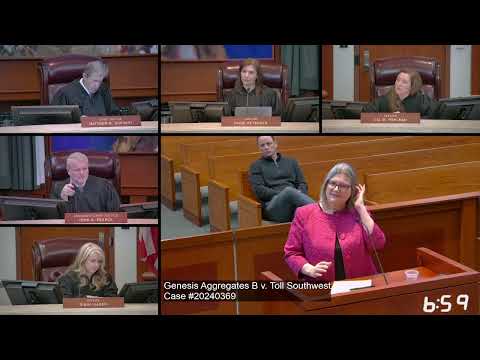
Utah Supreme Court hears dispute over use of reserved sand, gravel and clay on Traverse Mountain
Summary
The Utah Supreme Court heard argument in Genesis Aggregates v. Toll Southwest over whether a developer may use sand, gravel and clay found on a tract when an earlier deed reserved half those deposits to a co‑owner.
The Utah Supreme Court heard argument in Genesis Aggregates v. Toll Southwest over whether a developer may use sand, gravel and clay found on a tract when an earlier deed reserved half those deposits to a co‑owner.
Kara Porter, counsel for the Genesis entities, told the court that Toll Southwest “used our 50% to do that,” arguing the developer removed and deployed the co‑owner’s portion of subsurface materials to construct homes and yards on the tract. Justin Starr, counsel for Toll Southwest, answered that the reservation of sand, gravel and clay does not create an “exclusive right to use” and that Lehi City zoning and ordinances limit any present ability to extract and sell those deposits.
Why it matters: the case turns on how courts treat reservations of sand, gravel and clay in deeds, a question that determines whether surface development that regrades or relocates subsurface material creates liability (and damages) to a separate mineral‑interest owner. The outcome could affect property valuations and development practices across Traverse Mountain and other Utah communities where split estates exist.
Parties’ legal positions and key authorities
Porter pressed the court to read older authority as limiting surface owners’ use when that use “interferes with the mineral owner’s rights,” emphasizing that the developers here removed and used the Genesis entities’ reserved portion to complete grading and backfill. She argued the relevant deed expressly reserved commercial deposits of sand, gravel and clay and that the developer’s conduct made the material unusable for licensing or sale by Genesis.
Starr countered that longstanding precedent (including the Togliotti line the parties debated) protects ordinary surface uses—basements, shafts and grading—and that, absent clearer deed language, a reservation of sand, gravel and clay should not be read to let the mineral owner prevent ordinary surface development. He urged the court to treat the reservation as a right to royalties only if the material is exported or sold off the parcel, and he relied on case law (including cited Washington and Alaska decisions) that declines to treat gravel like deep minerals because extracting it would necessarily destroy the surface.
Bench questioning focused on two technical points: first, the proper scope of the Togliotti language the parties cite (whether that case’s statements are controlling or dicta), and second, whether the Alaska and Washington precedents cited by Toll should guide the court in distinguishing sand/gravel/clay from other mineral estates. Justices also asked about ripeness—whether an actual attempt to extract would be required before a damages claim is ripe—and whether a claim survives summary judgment when direct proof of the material’s origin is contested.
Factual and procedural posture
The dispute centers on a small portion of a larger tract: the complaint targets a 0.225‑acre parcel identified as Plat A, while other transfers (described in briefing and argument as involving tens of thousands of cubic yards) relate to Plat C. Porter told the court her team alleged that 60,000–100,000 cubic yards were conveyed elsewhere during Toll’s development activity; Toll’s witnesses and a 30(b)(6) declaration, Starr said, deny any sand, gravel or clay was moved off the 0.225‑acre parcel at issue.
Porter told the court the district court granted summary judgment before the parties completed expert disclosures; she said discovery failures (missing title reports and withheld records) left disputed inferences about where some material came from. Starr said the undisputed evidence shows nothing was exported from the specific 0.225‑acre parcel and that Lehi’s zoning would block commercial extraction absent a conditional use permit or variance.
Remedies and damages theories discussed
Genesis’s counsel described damages as the value Toll saved by not importing fill—“a penny saved is a penny earned,” Porter said—arguing Genesis lost licensing or sale value when its 50% was extracted and used. Counsel also referenced common law claims such as conversion, unjust enrichment and waste as alternative bases for recovery.
Toll’s counsel acknowledged that if material had been exported and sold to a third party, Genesis would be entitled to a share of proceeds. Toll argued, however, that using subsurface material in ordinary surface development does not automatically create a compensable loss to the mineral owner when the material remains on the parcel and where zoning currently prevents extraction for commercial sale.
What the court may decide
Counsel and the bench repeatedly discussed whether the court should issue a narrow ruling—limited to the facts showing the 0.225‑acre parcel and whether material was exported—or adopt a broader rule about sand, gravel and clay reservations (e.g., royalties only if material is exported). Toll suggested a narrow decision confined to the parcel at issue; Genesis urged a remedy for the claimed loss of commercial value and pointed to discovery and credibility issues that it says should have precluded summary judgment.
The court’s resolution could therefore be either (a) a narrow holding that, on these facts, Genesis failed to prove interference with its rights to the 0.225‑acre parcel, or (b) a broader rule clarifying whether reservations of sand, gravel and clay should be treated like other mineral reservations or limited to export/royalty rights.
Next steps and context
The argument comes amid multiple related cases the parties said are pending or recently litigated involving similar reservations. The court took oral argument after the district court granted summary judgment; the Utah Supreme Court’s written opinion will resolve both the legal standard for sand/gravel/clay reservations and how that standard applies to the contested Plat A/Plat C facts.
Portions of the argument cited by this article include opening statements and extended bench questioning on the parties’ competing readings of Togliotti and Flying Diamond and on whether zoning/permit constraints affect the availability of extraction remedies.