Get Full Government Meeting Transcripts, Videos, & Alerts Forever!
Get email alerts on the Sane Testimonial Confrontation topic
No spam. Unsubscribe anytime.
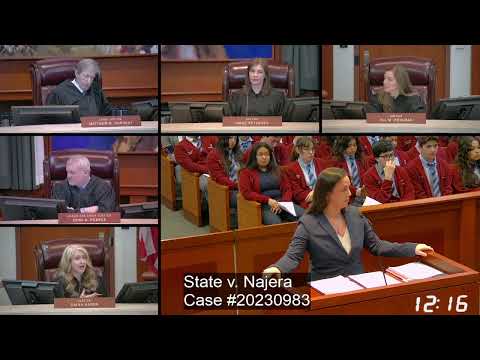
Utah Supreme Court hears argument on whether statements to SANE nurses are testimonial
Summary
At oral argument in Najera v. State, lawyers and justices disputed whether statements made to Sexual Assault Nurse Examiners (SANE) are testimonial for Confrontation Clause purposes, focusing on informed‑consent practices, SANE protocols and access to forensic records.
The Utah Supreme Court on Monday heard arguments over whether statements a sexual‑assault survivor made to a Sexual Assault Nurse Examiner, or SANE, are testimonial and thus subject to the defendant’s Sixth Amendment right to confront witnesses. The issue arose in the appeal of Arthur Najera after the district court admitted the victim’s statements taken during a SANE exam.
Sarah Karlquist, counsel for Arthur Najera, argued that SANE exams in Utah are conducted under circumstances that would lead an objective person to understand the primary purpose is to collect evidence for future prosecution. “Statements are testimonial when the circumstances objectively indicate that their primary purpose is to establish or prove past events for potential future prosecution,” Karlquist told the court, and she urged the justices to treat SANEs’ summary statements as testimonial on that basis.
Daniel Boyer, arguing for the State, urged a different approach, saying the court’s analysis must focus on the primary purpose of the statements as received in the emergency‑room context. “BR statements to the SANE were non testimonial and made for purposes of medical diagnosis or treatment,” Boyer said, asking the court to view the interview through the lens of an injured patient seeking care.
Why the case matters
The dispute centers on where the line falls between medical treatment and forensic investigation. If the court finds statements to SANEs are testimonial, prosecutors generally would need the SANE nurse to testify in person unless another Confrontation Clause exception applies. The parties focused on state protocols, how SANE forms are stored and who can access them, and whether a victim’s informed consent puts her on notice that statements will be provided to law enforcement.
What parties argued and what the record shows
Karlquist pointed to evidence in the record that SANEs follow a standardized form created collaboratively by SANEs, the Department of Public Safety and victim‑advocacy groups, and that the form and the resulting report are stored in a restricted forensic electronic medical record (FEMR). She argued those features support treating the exam as designed to assist law‑enforcement investigations. Karlquist also noted testimony that an alleged victim who restricts a kit and later unrestricts it must authorize release of not only physical evidence but the form containing the victim’s statements.
Boyer emphasized objective circumstances and the defendant’s need to show the victim’s purpose in making statements. He said nurses and experts testified SANEs see the people who come to them as patients and that the primary role of SANEs in the exam is medical care, even if the exam also collects evidence. Boyer added that certain treatment decisions followed from the exam — for example, emergency clinicians ordered a CT scan in response to a reported strangulation and the record reflects provision of preventive antibiotics, a pregnancy test and pain medication — and argued those responses support a medical primary purpose for statements.
Justices’ questions
The justices repeatedly probed whether the court should analyze the interview as a whole or parse statements line‑by‑line for testimonial character. One justice asked whether, even if the SANE exam has forensic aspects, the Confrontation Clause inquiry should ‘‘zero in on the statements’’ themselves rather than the overall purpose of the exam. Counsel for both sides discussed circuit and state cases that have taken differing approaches, including references in the record to State v. Williams, State v. Miller, Davis, Bryant and federal circuit decisions.
Access, informed consent and record storage
Both sides debated what BR, the alleged victim, was told during informed consent and whether the victim would reasonably understand that statements — not only physical items in the rape kit — could be provided to law enforcement. The record contains testimony that the SANE form is available only through the FEMR and that, as a practical matter, hospitals’ ordinary medical charts do not include the SANE report; access to the FEMR is limited to SANEs and law enforcement. Counsel disputed how much law‑enforcement input exists in drafting the SANE templates and whether that involvement, if any, changes the testimonial analysis.
Preservation and trial‑level objections
Counsel debated whether the defense below waived a statement‑by‑statement Confrontation Clause challenge by arguing only that the SANE report as a whole was inadmissible. The state urged that any attempt at a line‑by‑line objection could face a waiver claim at trial and noted interlocutory‑appeal limits, while defense counsel said the record and invited‑error doctrine affect preservation analysis.
Disposition and next steps
After argument the court thanked counsel and said it would take the case under advisement. The justices recessed before hearing the next case.
Ending
No ruling was issued from the bench. The decision in Najera v. State will determine whether — and to what extent — statements made to SANEs in Utah are treated as testimonial under the Confrontation Clause and could shape how sexual‑assault examinations are handled and litigated in future prosecutions.