Get Full Government Meeting Transcripts, Videos, & Alerts Forever!
Get email alerts on the Critical Infrastructure Protection topic
No spam. Unsubscribe anytime.
Committee advances bill to bar certain foreign‑made communications equipment; stakeholders seek clarifications on lidar and auto industry impacts
Summary
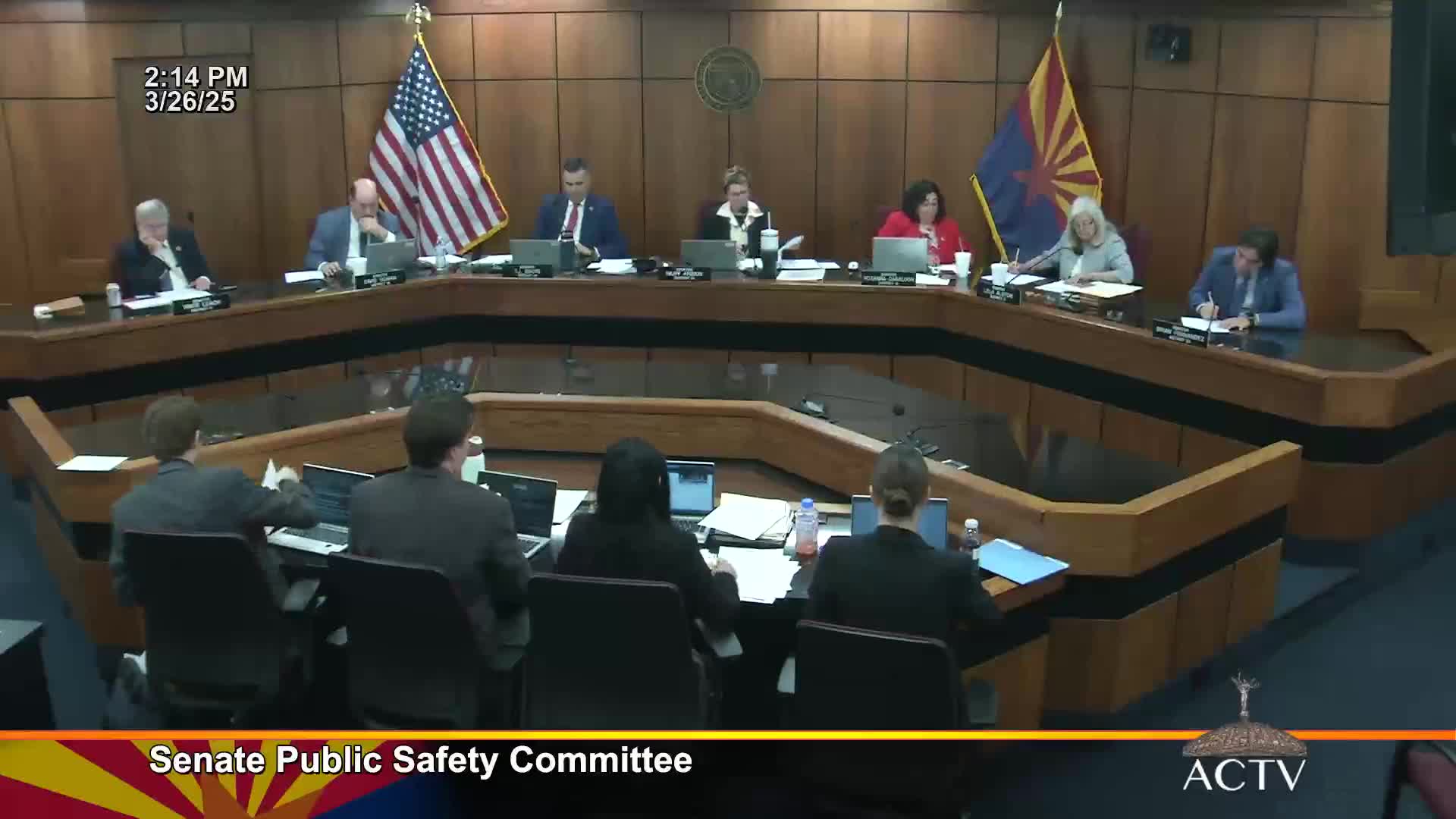
The Senate Public Safety Committee gave House Bill 2696 a due‑pass recommendation after debating how prohibitions on certain foreign‑tied communications and sensor technologies would apply to infrastructure and whether they could unintentionally affect vehicles and other industries.
The Senate Public Safety Committee voted to give House Bill 2696 a due‑pass recommendation after debate over whether the measure’s prohibitions could unintentionally sweep in vehicle systems and other commercial products.
The bill, described to the committee, would establish the Arizona Critical Infrastructure Protection Act. It would bar a governmental entity or a critical infrastructure provider in Arizona from entering into or renewing contracts with vendors of specified technologies when the vendor is owned, controlled by, or under a controlling interest by the government of China, or when the vendor's product includes specified modules tied to Chinese firms. The bill requires the Arizona Corporation Commission to publish a list of prohibited technologies by Dec. 31, 2025, and to create a secure communications channel for critical providers and military installations to reach the commission and governor's office during an emergency.
Representative Nick Kupfer, one of the bill's sponsors, said the bill is "a good common sense bill to take care of Arizona" and described amendments negotiated to add safe harbors and a timetable. Kupfer told the committee that entities would have 90 days to identify prohibited components and a further 90 days to remove or replace them, and that the bill included a "safe haven" allowing retention when removal would be more detrimental than keeping the technology.
Several witnesses urged the committee to clarify how the bill would treat lidar components used in vehicles. Michael Lucci of State Armor argued the measure is necessary to reduce the attack surface from foreign technologies, citing reports about Chinese network‑connected cameras and medical devices. Bobby Sparrow, president of the Arizona Auto Dealers Association, said dealers and manufacturers were not engaged early enough and argued that the bill as written created confusion about whether cars and common vehicle systems would be banned from sale. Sparrow listed major automakers that use lidar in vehicles and urged the committee to exempt vehicles or clarify the language.
Kupfer and supporters said the bill targets vendors of components and modules (for example, vendors that sell lidar modules to infrastructure projects) and not auto manufacturers selling finished cars. Kupfer said, "Car manufacturers are not the vendors of the lidar technology. The car company is not the vendor of the lidar, so that's not who we're going after." He also committed to convening stakeholder meetings to resolve concerns raised by dealers and industry representatives.
After committee discussion and public testimony, the committee reported the bill with a due‑pass recommendation (reported tally 5 ayes, 2 nays). Several senators said they would support the bill if the sponsor holds stakeholder meetings to resolve industry and implementation questions.