Get Full Government Meeting Transcripts, Videos, & Alerts Forever!
Get email alerts on the Utilities topic
No spam. Unsubscribe anytime.
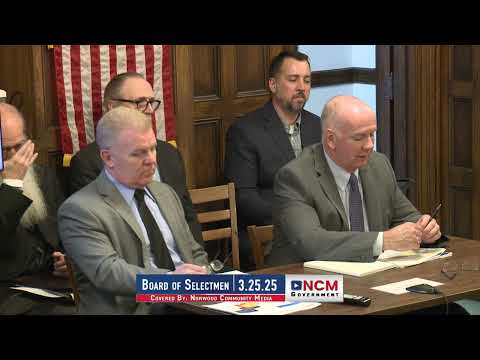
Norwood Light & Broadband present FY26 budgets; board approves budgets and project funding
Summary
Norwood Light & Broadband officials presented FY26 electric and broadband budgets March 25, detailing no planned electric rate increase, a multi‑year underground paper‑cable replacement project and progress on fiber‑to‑the‑home construction; the Board of Selectmen voted to approve the budgets.
Norwood Light & Broadband leaders told the Board of Selectmen on March 25 that the department’s FY26 electric request totals $62,635,000 and the broadband request totals $8,002,650, and the board voted to approve both budgets.
The utilities’ leadership — Kevin Shaughnessy, superintendent of Norwood Light & Broadband; Dan Morrissey, chief operating officer; Jason Haber, who oversees the electric division; and Daryl Hansen, broadband manager — said the electric budget is down about 0.2% from FY25, mainly because debt service is dropping off, and there is no planned electric rate increase for FY26. Shaughnessy told the board the last electric increase was in February 2018 and noted a lower purchase power adjustment that has slightly reduced customer bills.
Why it matters: the electric budget change and the department’s capital choices affect rate stability and service reliability in Norwood. Department leaders said they have hedged a significant portion of power purchases and maintain rate stabilization reserves that could be used if market forces force higher costs.
Officials outlined two major capital efforts. First, a multiyear project to replace decades‑old paper‑insulated underground cable — described as system feeders at risk that cause large outages when they fail — is estimated in the neighborhood of $8–$10 million. Staff said the program has been underway for several years and is roughly half complete; the budget shows a multi‑year transfer of $2 million per year into the project. Jason Haber said replacing underground cable has reduced average outage duration and frequency in 2024 compared with previous years.
Second, the broadband division reported steady progress on a fiber‑to‑the‑home build. Daryl Hansen said contractors are “about 50% constructed,” with roughly 25% of the network built and tested and ready to install service at premises. The team said they hope to begin customer installations in late May or early June and to complete construction by year‑end, with additional months of final cleanup and activation afterward. Staff warned of labor constraints — notably a shortage of qualified fiber splicers — that have caused some schedule shifts but said they add crews when necessary.
Broadband finance and marketing: staff said the board previously authorized interfund lending from electric to broadband and that the FY26 budget includes principal payments back to electric. Hansen and Shaughnessy said the board has permitted an internal loan plan to support fiber deployment and that the broadband operating request increases modestly while capital spending rises to support the build; the broadband request presented was $8,002,650 (a 0.36% increase over FY25). Staff also said the broadband team is working with a marketing contractor and expects to spend more on advertising as neighborhoods are lit for service.
Board action and votes: a motion to approve the electric and broadband budgets was made, seconded and approved by the board. The Selectmen also approved a separate motion to close out completed Light Department capital projects and to approve use of surplus funds for related borrowing/paydown items.
What officials said about reliability and costs: Haber highlighted industry reliability metrics presented to the board, saying Norwood’s system average interruption duration index (SAIDI) for 2024 averaged about 24.8 minutes per customer per outage — substantially below regional averages — and that removing old underground cable has driven that improvement. Shaughnessy and Morrissey emphasized long‑term contracts and conservative hedging as reasons the municipal utility has avoided recent rate shocks that have affected some investor‑owned utilities.
Next steps: staff said they will continue to update the board as the broadband install contractor finalizes pricing and as the town treasurer and accountant advise on borrowing options for capital. Board members asked for clearer visuals on customer bills and for ongoing updates about lead times for transformers and other critical hardware.