Get Full Government Meeting Transcripts, Videos, & Alerts Forever!
Get email alerts on the Transportation topic
No spam. Unsubscribe anytime.
State subcommittee hears that Michigan local roads and bridges face growing shortfalls, new federal mandates
Summary
Presenters from the County Road Association and Michigan Municipal League told the Appropriation Subcommittee on State and Local Transportation that county and municipal road systems face rising repair needs, limited grant slots and a costly federal mandate to expand bridge data and load analyses by 2027. No funding decisions were made.
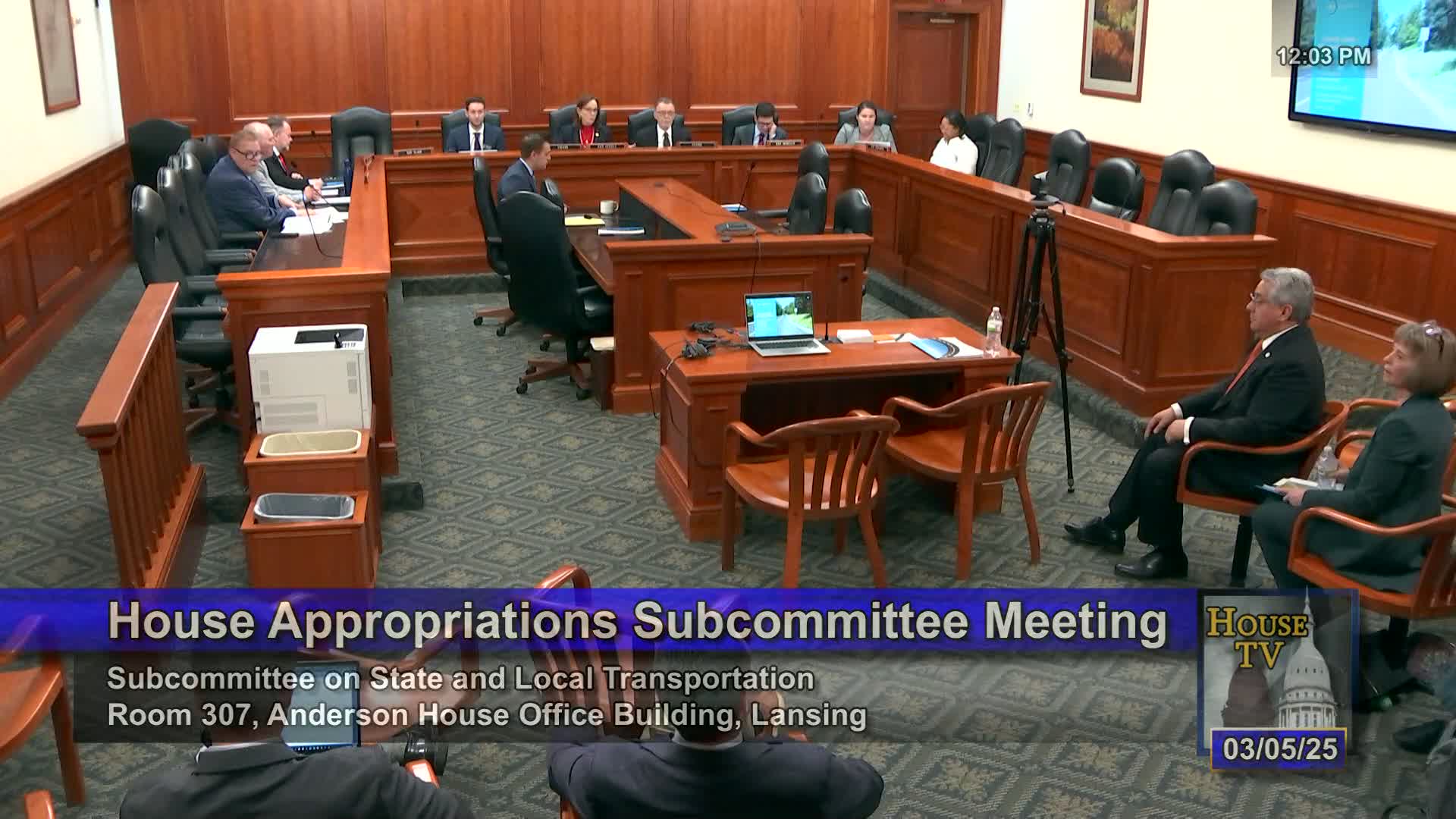
LANSING — At a meeting of the Appropriation Subcommittee on the State and Local Transportation, presenters from the County Road Association (CRA) and the Michigan Municipal League (MML) told lawmakers that Michigan’s locally owned roads and bridges face rising repair needs, constrained federal grant slots and an unfunded federal mandate requiring expanded bridge data and load analysis by 2027.
The presentation to the committee, led by Ed Noyola of the County Road Association and Denise Donahue, CRA CEO, outlined the scope of local responsibility and the gap between available funding and need. "We have 5,868 bridges that equates to 52% of the all the state bridges," Noyola said. Donahue added: "Bridges are assumed to last for 50 years." John LaMacchia of the Michigan Municipal League said municipal road departments’ responsibilities go beyond pavement: "from a city and village level, we do more than just roads."
Why it matters: Counties and local governments own most of the state’s road miles and a majority of its bridges, and the presenters said the current funding flows and program rules leave many local roads and structures underfunded. Those gaps affect everyday travel, local economies and the ability of local governments to maintain services without raising local taxes or special assessments.
Key findings presented to the subcommittee
- Network size and ownership: The presenters said counties are responsible for roughly 90,000 miles of roads, municipalities about 22,000 miles and MDOT about 10,000 miles (the presenters expressed these as jurisdictional approximations). County-owned bridges were reported at 5,868, which CRA said is about 52% of the state’s inventory of bridges.
- Funding sources and limits: CRA described three principal revenue streams for local roads: state funds (derived from the Michigan Transportation Fund and related transfers), local contributions (countywide and township millages, special assessments and other local revenue) and federal aid. Presenters noted countywide millages and special assessments are an important but uneven source of local funds.
- Bridge backlog and grant competition: Donahue said the state has roughly $1 billion worth of closed, critical and weight-restricted bridges in the backlog. For the 2027 call for bridge projects CRA said 401 applications requested about $515 million in work but only about $80 million was available; counties were limited to three applications (CRA said that limit may drop to two in 2028). CRA also warned that culvert upsizing and environmental requirements are increasing project costs and that some large culverts now cross the 20-foot threshold that defines a bridge, moving more assets into the higher-cost bridge category.
- New federal data and engineering mandate: CRA told the committee that Federal Highway has indicated local agencies must collect 54 additional National Bridge Inventory data points and conduct bridge load analyses on all local bridges by 2027. Donahue said the process requires specialized bridge engineers and use of the national AASHTOware bridge-rating software. CRA reported a five‑year estimated cost for collecting and analyzing the local inventory of about $22.5 million, and indicated a state/local match would be required to draw federal aid for the work; CRA said a state match of roughly $4.5 million per year for five years would be needed to meet the local share they outlined.
- Pavement condition and local roads: CRA’s County Road Investment Plan (2023) shows federal‑aid‑eligible primary roads rated about 65% in ‘‘good’’ condition (with a 90% target), while non‑federal local roads are at about 44% ‘‘good’’ condition with a 60% target. CRA estimated the local (non‑federal) system needs about $2 billion to address documented needs and reported that the investment plan found the local need increased by about $487 million from 2021 to 2023.
- Current program capacity: CRA said existing state and federal bridge programs, including a bridge account within the Michigan Transportation Fund, currently fund a small number of critical bridge projects each year. CRA estimated federal and state components together typically support 17–22 bridges a year and described a gap between that annual program capacity and the backlog of critical bridges.
Testimony from municipal perspective
John LaMacchia of the Michigan Municipal League framed the city-and-village view: many roads that matter most to residents — neighborhood and subdivision streets — are not eligible for federal aid and thus rely on state distributions and local revenue. He told the committee that roughly two‑thirds of municipal roads are not federal‑aid eligible and that smaller local governments face wide differences in the revenue raised per mill; not every community can feasibly use property-tax millages or bond measures to fill gaps.
Questions and next steps
Committee members asked about the scope of potential additional funding and how any new revenue would be distributed. CRA representatives said they had discussed possible sources with the chair but did not give a final dollar figure in the meeting, asking to continue discussions outside the hearing. On risks to federal funds, CRA said most projects with federal aid were continuing to move forward and that only those with special environmental or similar conditions may require additional approvals in Washington.
Formal actions and outcome
The committee adopted the minutes of its Feb. 26 meeting by unanimous consent at the start of the session; no other formal funding actions or votes occurred during the hearing.
No formal funding decisions were made at the hearing. Presenters asked for legislative consideration of state matching dollars and other options to address the federal mandate and the local bridge backlog; committee members offered to continue discussions as state revenue proposals advance.
Ending
Presenters left the committee with detailed reports (CRA’s County Road Investment Plan and supporting slides) and asked lawmakers to consider state matching funds and program changes to meet the 2027 federal requirements and to close the gap on local roads and bridges. Lawmakers did not take funding action at the session; staff and presenters indicated they would continue technical and fiscal discussions outside the formal hearing record.