Get Full Government Meeting Transcripts, Videos, & Alerts Forever!
Get email alerts on the Criminal Justice Veterans Court topic
No spam. Unsubscribe anytime.
Commission authorizes county court to spend $348,390 in expected federal funds to start veterans treatment court
Summary
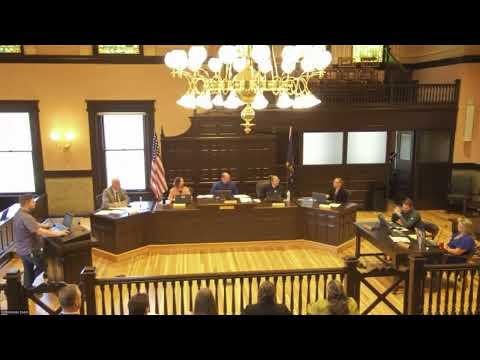
Douglas County commissioners authorized court staff to accept and expend up to $348,390 over four years for a Veterans Treatment Court program after a presentation by District Court Judge Amy Hanley and representatives from the Office of Judicial Administration.
The Douglas County Commission on March 26 authorized county court staff to accept and expend federal grant funds to support a Veterans Treatment Court (VTC), approving a projected county expenditure of $348,390 over four years.
Judge Amy Hanley, Douglas County District Court judge, told commissioners the program’s mission is “to promote public safety and reduce recidivism by specifically targeting the unique challenges facing veterans who suffer from mental health and or substance abuse issues that are related to their military service and to provide them a treatment strategy.” She said the court will emphasize early intervention and intensive treatment and partner with the U.S. Department of Veterans Affairs and local providers for services and mentoring.
The grant award — $1,000,000 from the Bureau of Justice Assistance (BJA) — is held by the Office of Judicial Administration (OJA). OJA will act as the federal award recipient and pay many program costs directly; Douglas County’s share is the smaller, reimbursable portion Judge Hanley presented: roughly $348,390 over four years, a figure that includes a 15% contingency for unanticipated costs.
OJA staff described the grant as a reimbursement-model award: the county will submit invoices and documentation for expenditure and OJA will draw down federal funds to reimburse the county. Amy Deckard, OJA chief financial officer, said reimbursements are processed when the county submits invoices; the county intends to submit monthly requests to reduce timing risk.
Commissioners pressed for details on who the VTC will serve and how the program will be evaluated. Hanley said an October 2024 District Attorney report identified 56 defendants flagged by the VA as having military service and that monthly jail bookings showed between five and 20 veterans per month; court services currently supervises six veterans on probation. Dawn Huddleston of OJA described standardized performance indicators the state is using with other Kansas VTCs and said OJA will collect and can share the metrics. Hanley added that OJA has also pursued funds for a statewide evaluator to assist with performance assessment.
Commissioners also discussed the county’s near-term cash flow and the reimbursement risk if federal funds become unavailable. OJA and county staff told the commission that the program would pause if federal drawdowns stop; county expenditures already made would be subject to reimbursement availability. Hanley emphasized there is no obligation for the county to provide funds beyond the four-year award period.
Moved by Commissioner Reed and seconded by Commissioner Dorsey, the motion to authorize acceptance and expenditure of the grant passed 5-0.
The county will now proceed to hire a grant coordinator under the OJA structure and finalize protocols for eligibility, reporting and local service-provider partnerships. OJA and judge Hanley said they will provide more detail to the commission on evaluation measures and on any health-care cost metrics that can be tracked locally via VA or partner data.