Get Full Government Meeting Transcripts, Videos, & Alerts Forever!
Get email alerts on the Education Budget And Policy topic
No spam. Unsubscribe anytime.
State superintendent touts gains under Michigan's Top 10 strategic plan; House analyst outlines MDE budget
Summary
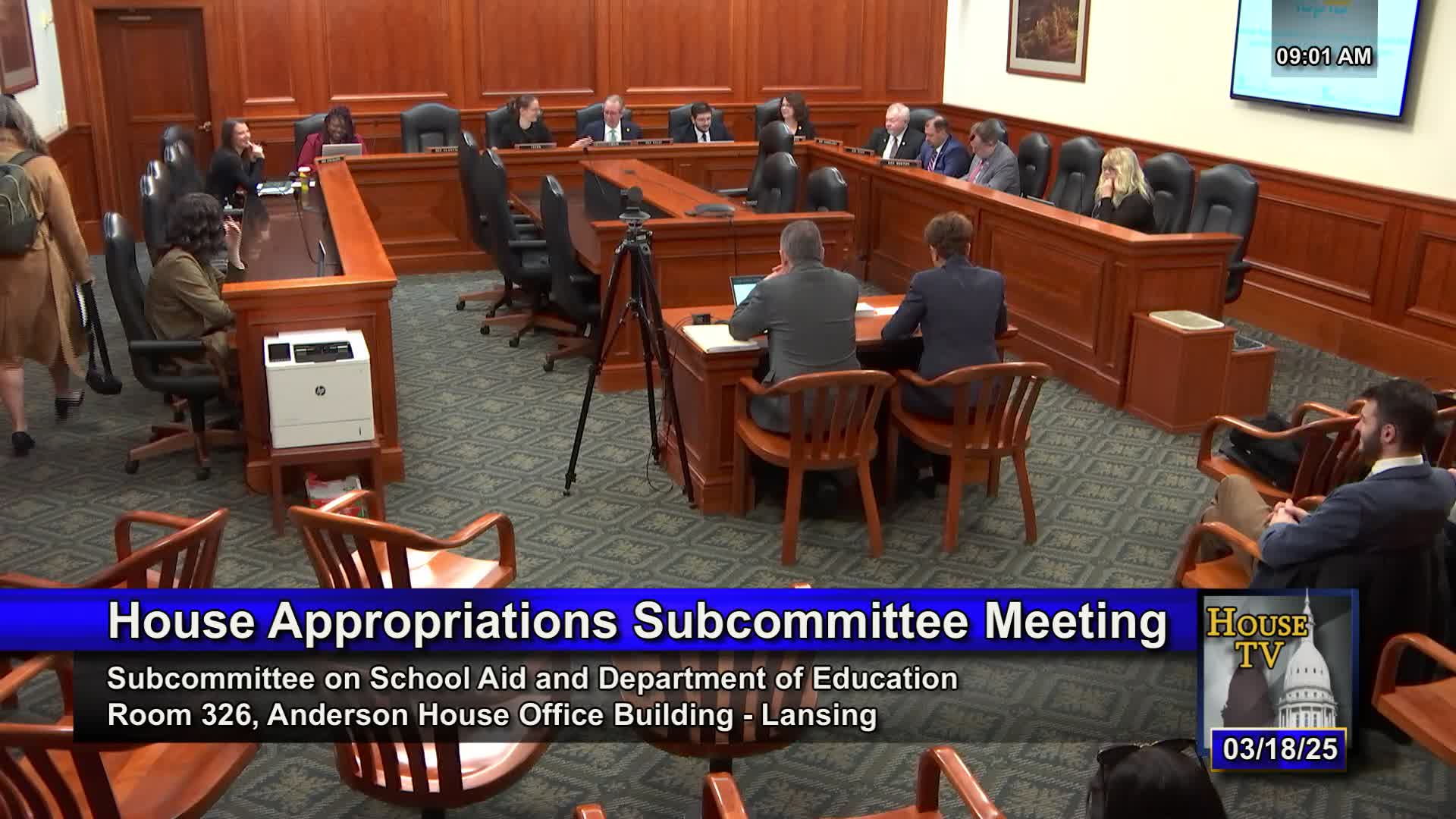
Dr. Michael Rice, state superintendent of the Michigan Department of Education, told the House Appropriations Subcommittee on School Aid on March 11 that Michigan has made historic gains on several Top 10 strategic education metrics but asked lawmakers to adopt additional, recurring funding for CTE equipment, early literacy materials and school meals.
LANSING, Mich. ' Dr. Michael Rice, state superintendent of the Michigan Department of Education, told the House Appropriations Subcommittee on School Aid and Department of Education on March 11 that Michigan has made historic gains on several metrics in its Top 10 strategic education plan but needs additional, recurring funding to sustain progress.
Rice presented statewide data showing higher graduation and postsecondary credential rates, increased career and technical education (CTE) participation and gains in Advanced Placement (AP) access and scores. He urged lawmakers to approve executive budget requests including $20 million for CTE equipment upgrades and a broader $125 million, five'year proposal to reduce CTE opportunity gaps.
"Our 2024 four'year graduation rate improved to the highest level in state history," Rice said, noting the rate rose from 80.6 percent when Rep. Kelly last served in the Legislature to 82.8 percent currently. He highlighted a 51.8 percent share of adults with postsecondary credentials (the governor's "60 by 30" goal), record CTE completer totals (52,625, up 19 percent in three years) and increases in AP participation and performance.
Rice said AP participation is up 21 percent in the number of students taking at least one AP exam and the number of AP tests taken is up 26 percent; students scoring 3'5 increased 31 percent and exams with scores of 3'5 rose 37 percent in the last two years. He also said dual enrollment participation and early middle college enrollment are at historic highs.
Rice framed several Top 10 goals as "upstream" priorities that affect broader outcomes: expanding early childhood education, improving early literacy, addressing the teacher shortage and securing adequate, equitable school funding. He pressed for sustained funding for Great Start Readiness Program (GSRP) slots, noting the governor had announced roughly 47,000 children in GSRP, and for making recurring a $125 million supplemental the department received in fiscal year 2025.
On early literacy, Rice said literacy/dyslexia legislation enacted in 2024 (Public Acts 146 and 147 of 2024) requires districts to choose approved dyslexia screeners and high'quality instructional materials and to provide intervention and educator training. He said 3,600 educators have completed LETRS training and another 6,400 are working toward completion; the department has received roughly $34 million for that work over the past three and a half years.
Rice also described investments to address the teacher shortage. He said the state funded $575 million in fiscal 2023, about $448 million in fiscal 2024 and $140 million in fiscal 2025 for programs that include fellowships and scholarships, grow'your'own initiatives, student teacher stipends, loan repayment, and mentoring and induction. He noted the department counted a 71 percent increase in teacher preparation enrollments over six years.
Rice urged recurring support for the Michigan School Meals Program and codification of the program to avoid year'to'year funding uncertainty, and asked the subcommittee for continued support for helping professionals (nurses, counselors, social workers, psychologists), citing an addition of roughly 1,700 such positions statewide over five years.
After Rice's presentation, Noel Benson, fiscal analyst with the House Fiscal Agency, gave the subcommittee a line'item overview of the Michigan Department of Education budget. Benson said the MDE operating budget totals $164,975,100; about half (roughly $82,600,000) is federal funding, approximately $63,900,000 is state general fund, about $10,100,000 is state restricted revenue (including certification fees), and roughly $8,400,000 is private and local funding.
Benson said major appropriation areas include library operations (the largest single area), educator supports and educator excellence (about $30.9 million), schools for the deaf and blind (about $20.1 million), school support services, assessment and accountability, and special education administration. He noted the MDE budget declined from earlier years primarily because the Office of Early Childhood Education and child development and care scholarship funding moved to a different department.
On libraries, Benson said the statutory per'capita funding goal of 50 cents was reached in fiscal 2022 and has risen to an estimated 54 cents per capita with recent investments, but state funding represents only about 3 percent of total public library operating revenue.
Committee members asked questions about dual enrollment and the effect on the foundation allowance, the scope of the $20 million CTE equipment request, whether the CTE equipment funding would cover subscription renewals and software, and the status and aims of efforts to reduce chronic absenteeism and expand helping professionals. Rice said the department does not collect per'district data on how much districts pay colleges for dual enrollment and that the $20 million (section 61c) is specifically for equipment upgrades; Rice said he would check whether subscription renewals are covered by that line.
The subcommittee approved the minutes from the March 11 meeting without objection before the presentations.
The hearing record contains no final appropriations votes on the department's executive budget recommendation; Rice and Benson both urged lawmakers to consider making several one'time or supplemental investments recurring to sustain the noted gains.