Get Full Government Meeting Transcripts, Videos, & Alerts Forever!
Get email alerts on the School Aid And Education topic
No spam. Unsubscribe anytime.
Analyst warns Title I distribution and Medicaid enrollment changes could create at‑risk funding cliff for Michigan schools
Summary
Craig Theel of the Citizens Research Council told the House Appropriations Subcommittee on School Aid that inequities in federal Title I allocations combined with a 7.5% drop in students identified as economically disadvantaged will produce sharp, uneven cuts to state at‑risk funding for many districts in 2025–26.
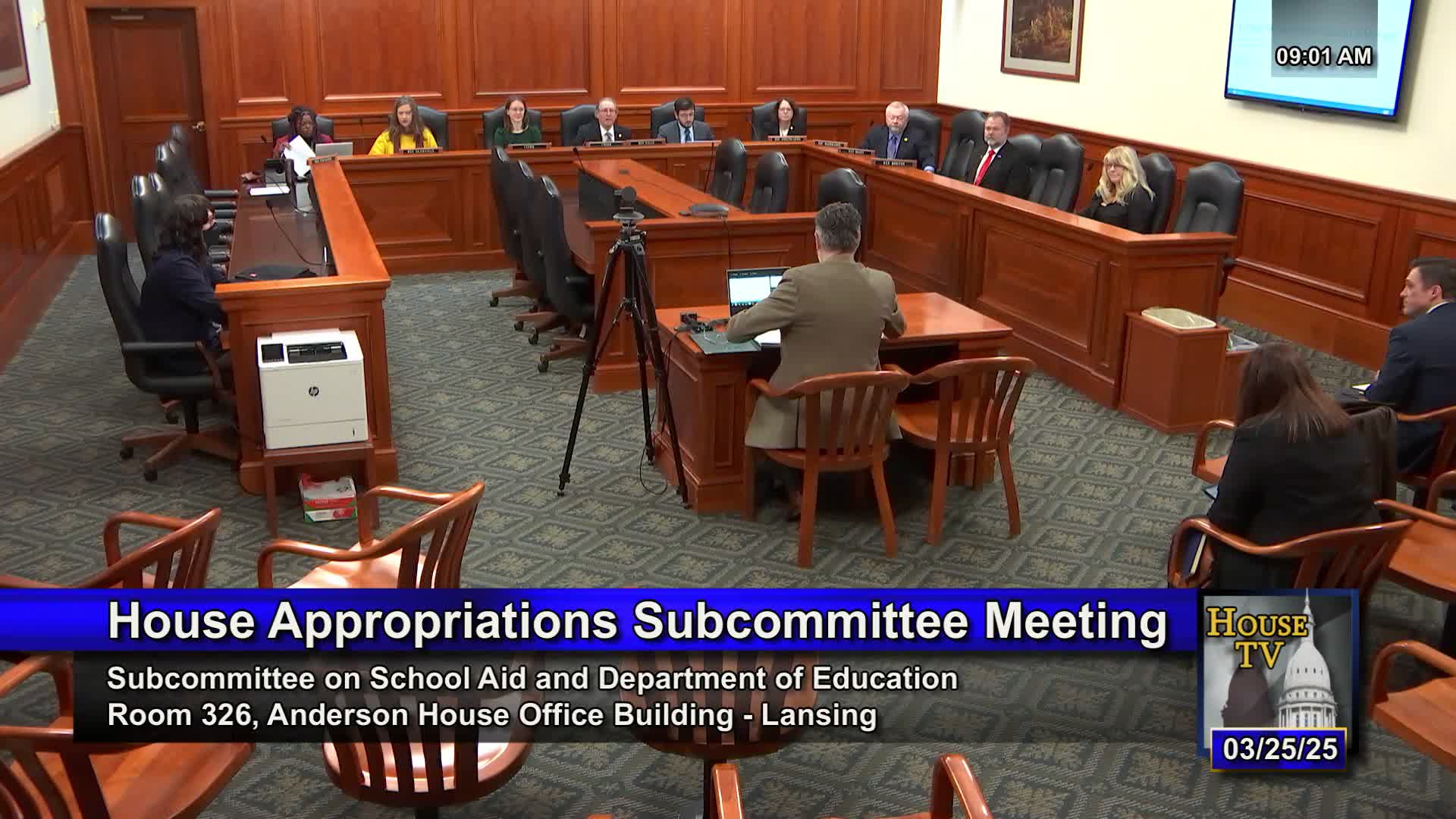
Craig Theel, research director at the Citizens Research Council, told the House Appropriations Subcommittee on School Aid and Department of Education that recent federal and state enrollment shifts have created an "at‑risk funding cliff" for Michigan school districts.
Theel said Michigan’s state at‑risk program (Section 31A) and the Opportunity Index set targets—up to about 47% of the foundation allowance for highest‑poverty districts—but federal Title I allocations are distributed under a separate formula that produces wide differences among districts with similar poverty concentrations. "Congress has failed to address the inequities of Title I, so Michigan lawmakers should step in," Theel said, citing his organization's report on the distribution of Title I dollars.
Why it matters: the end of pandemic‑era Medicaid continuous enrollment contributed to a 7.5% statewide decline in students counted as economically disadvantaged in the October 2024 count, Theel said. That decline reduces the student counts used to divide a largely fixed state appropriation, producing a situation where state per‑pupil payments rise while total funding to individual districts can fall sharply depending on local enrollment changes.
Theel showed statewide charts and district examples to illustrate the effect. In his analysis a Livonia Public Schools enrollment decline will reduce that district’s total at‑risk funding by roughly $1.5 million — the equivalent, he estimated, of about 10 teacher positions — even though higher per‑pupil payments in the governor’s 2026 recommendation would add roughly $500,000 back. In Westwood Heights (Genesee County), he estimated a roughly $356,000 net reduction in at‑risk funding, or about three teacher equivalents.
Theel traced the problem to the interaction of federal and state programs. Section 31A is state‑controlled; Title I is a federal program administered under the Elementary and Secondary Education Act. "The challenge," he said, "is that Title I is kind of working at cross purposes with the at‑risk funding. You have no control over the federal formula. You do have total control over Section 31 at‑risk funding." He recommended the subcommittee consider using state at‑risk dollars to partially equalize the disparities created by Title I.
Committee members asked clarifying questions about whether the enrollment change reflected students leaving districts or a change in eligibility. "I want to make it very clear," Minority Vice Chair Representative Yousef Glanville said during questioning, "these students did not leave the state ... They are still enrolled in your districts. They're just not being identified as economically disadvantaged, which means they're not generating the funding for your districts." Theel agreed and reiterated that the fall 2024 counts reflected a policy change in Medicaid certification rather than a mass exodus of students.
Theel outlined possible state responses the subcommittee could consider, including switching from a single‑year enrollment count to a multi‑year or blended count to smooth sharp year‑to‑year funding swings. He left the committee a written analysis and recommended the subcommittee examine ways to use state 31A allocations to mitigate the Title I inequities.
The presentation materials and the report titled “Congress has failed to address the inequities of Title I, so Michigan lawmakers should step in” were left with the committee clerk and made available on the Citizens Research Council website, Theel said.
The subcommittee did not take formal action on policy changes during the meeting; Theel said the data and recommendations were for the committee’s consideration as it develops the 2026 school‑aid budget.