Get Full Government Meeting Transcripts, Videos, & Alerts Forever!
Get email alerts on the Transportation topic
No spam. Unsubscribe anytime.
MDOT briefs appropriations subcommittee on how Michigan plans, builds and maintains roads
Summary
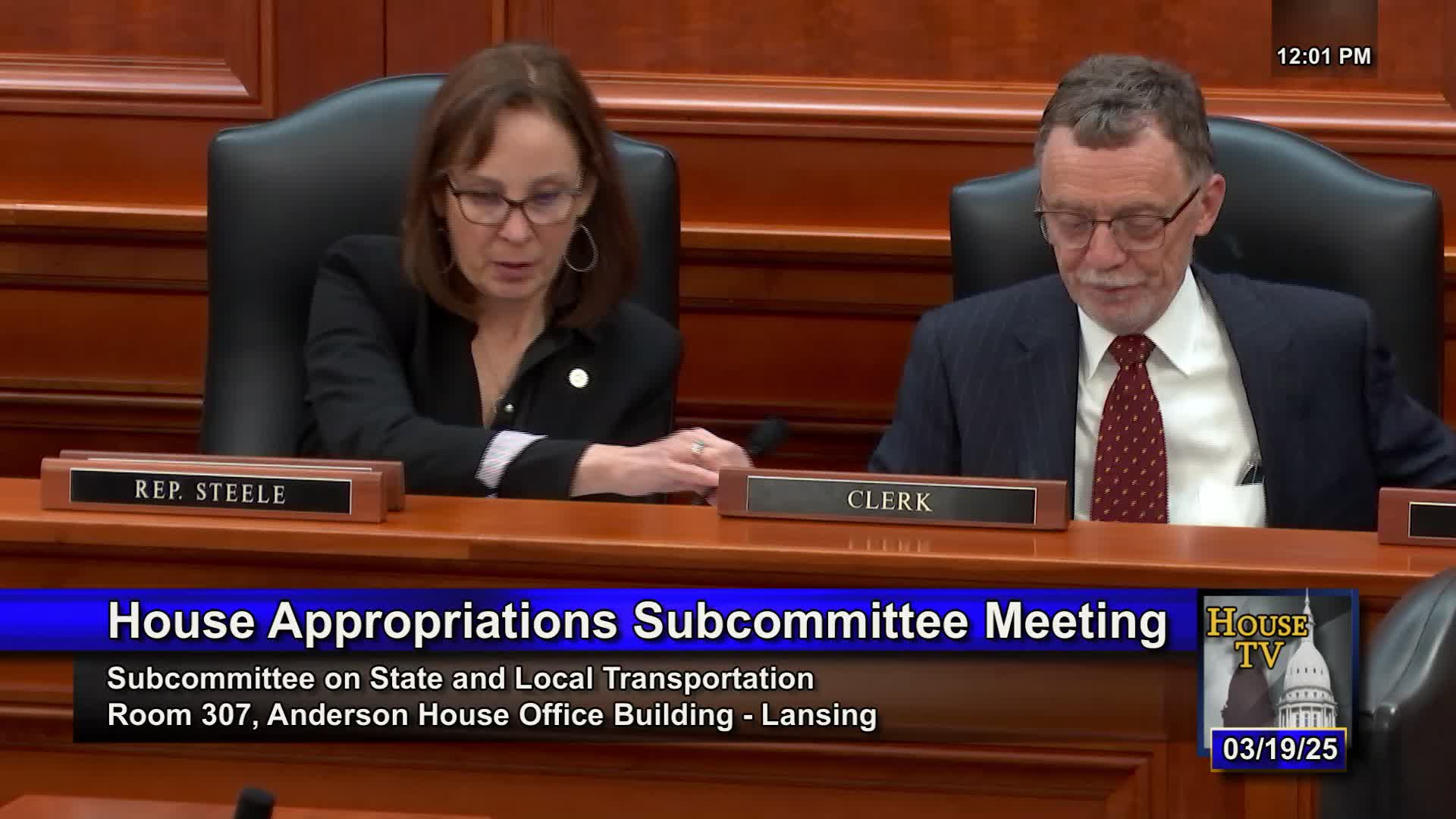
Greg Bruner, Michigan Department of Transportation chief operations officer and chief engineer, told the Appropriations Subcommittee on State and Local Transportation at a committee meeting that MDOT organizes statewide planning, design and construction through five bureaus and seven regional offices and that the agency runs a roughly $3.8 billion Michigan Transportation Fund supplemented by federal aid.
Greg Bruner, Michigan Department of Transportation chief operations officer and chief engineer, told the Appropriations Subcommittee on State and Local Transportation at a committee meeting that MDOT organizes statewide planning, design and construction through five bureaus and seven regional offices and that the agency runs a roughly $3.8 billion Michigan Transportation Fund supplemented by federal aid.
Bruner said the department oversees about 10,000 miles of state routes and nearly 4,800 bridges and that Michigan’s overall road network is extensive — roughly 122,000 miles of roads and almost 12,000 bridges statewide — with large freight volumes passing through the state. “About $944,000,000,000 in freight is moved each year through Michigan” across highways, rail, air and water, he said.
The overview sought to explain why the department uses specific procurement, permitting and maintenance practices and how MDOT coordinates with local governments and outside agencies. That matters because MDOT-controlled routes carry a disproportionate share of commercial traffic and because the department’s choices affect travel safety, freight movement and the timing of local repairs and projects.
Bruner outlined MDOT’s project life cycle: multi-year scoping and local engagement, design, a public advertisement period for bids (typically six weeks), award to the low bidder and field inspection through construction to project closeout. “We use a low bid system,” Bruner said, and explained that contracts are broken into pay items — for example, dollars per ton of asphalt — with specifications that contractors must meet. He said the department performs an “unbalanced bid review” to check individual line items against engineer estimates before awarding work.
Responding to a lawmaker’s concern that low bids can sacrifice quality, Bruner said the low-bid approach is tied to clear, enforceable specifications and prequalification: “From a quality standpoint, we set what those specifications are they have to meet,” he said, adding that if work does not meet specifications, the contractor must remove and replace it at its own cost. He also noted that MDOT uses quality-based selection for certain “innovative” contracts, such as design-build procurements.
Bruner described permitting as a routine part of planning and singled out the State Historic Preservation Office (SHPO) and the Michigan Department of Environment, Great Lakes and Energy (EGLE) as the two agencies MDOT engages most for environmental and cultural-resource reviews. He said MDOT works with those agencies during project development to set construction schedules that avoid sensitive periods — for example, fish-spawning or bird-nesting seasons — and observed that such seasonal restrictions cause delays only “not too often.”
On maintenance, Bruner said Michigan takes a hybrid approach: MDOT maintains some roads directly from its garages, while county road commissions perform routine maintenance on many state routes under contract. He described MDOT’s capital preventive maintenance (CPM) program — a “keep-it-together” approach that focuses on timely, lower-cost fixes such as crack sealing or thin overlays to extend pavement life rather than waiting for worst-condition reconstruction. “We don’t necessarily use a worst-first approach,” he said.
Representative Morgan pressed whether local agencies are adequately compensated for maintaining state roads; Bruner said maintenance arrangements vary by contract and by locality and that available dollars constrain what can be done. He advised that locals contact their transportation service center for specific maintenance assignments and emphasized that short-term pothole repair is not a substitute for planned capital maintenance and reconstruction.
Bruner described a number of MDOT practices and programs by name: the department issues a five-year program of projects, uses a life-cycle cost analysis to choose pavement material (projects with pavement costs over $1.5 million are subject to a formal analysis and, if materials are within 10%, may be alternately bid), maintains roughly 5,000 project warranties to date (about 600 active) and reports that about 12% of warranty cases require corrective action. He said roughly half of MDOT’s design and construction oversight work is performed by private consulting firms and that MDOT’s final project costs historically have been, on average, within about 1% of original estimates.
Bruner also described technology pilots and innovation efforts. He said MDOT moved to an electronic construction document system (“eConstruction”) about a decade ago, is piloting smart-road and connected-workzone technologies with private firms including Cavnue and HOS Alert, and is participating in intelligent-transportation-system programs nationally. “We are very involved in new technology of the roadways,” he said, citing pilots around automated-vehicle infrastructure and wrong-way-driver alerts in metro Detroit.
Representative Slaugh asked how often permitting from SHPO or EGLE forces extended pauses in construction; Bruner said MDOT works with those agencies in design to set schedules that generally avoid seasonal restrictions and that prolonged stops for permitting are “the exception rather than the rule.”
The committee’s formal business was limited. Representative Robinson moved to adopt the minutes of the March 5 meeting; the motion prevailed by unanimous consent.
The presentation closed with committee members thanking Bruner and inviting MDOT to return for further briefings on the agency’s programs and innovations.