Get Full Government Meeting Transcripts, Videos, & Alerts Forever!
Get email alerts on the Charter Review topic
No spam. Unsubscribe anytime.
Palestine Charter Review Committee delivers final recommendations including liquor-sale rule changes and election/timing edits
Summary
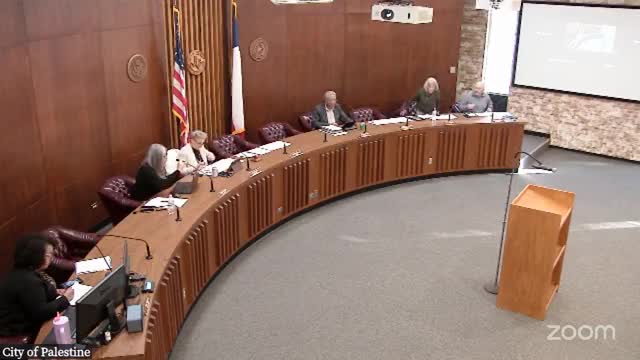
The Palestine City Council received the final report of the Charter Review Committee at a January 2025 workshop.
The Palestine City Council received the final report of the Charter Review Committee at a January 2025 workshop, laying out proposed changes to the city charter that the committee recommends the council consider placing before voters.
Charter Review Committee Chair Dan Botchler presented the report and said the group focused on three broad areas: legal changes, city processes and vacancies. "It's a privilege to be able to be a part of that because you really learn a lot of things," Botchler said, describing the committee's year-long work and thanking staff and legal counsel for assistance.
The committee recommended shifting some of the charter's language about where distilled spirits may be sold so the city gains more flexibility to regulate alcohol sales through zoning rather than the charter. A city staff member advising the committee said removing the language from the charter would "give one more flexibility" and allow regulation to keep pace with how the city grows. The committee chair emphasized the recommendation was intended to prompt a broader discussion about downtown revitalization and retail site location, not an immediate instruction to relocate businesses.
Other notable committee recommendations included: proposed increases in compensation (the document presented to council shows suggested increases from $800 to $1,200 for council members and from $1,200 to $1,800 for the mayor); standardizing or reserving sections of the charter to avoid renumbering problems; and reconciling inconsistent language about the city depository (one section currently references a 2–5 year selection period while another limits the term to 2 years).
The committee also proposed changes to vacancy and election procedures. That package would extend the time for council to make an appointment from 10 days to 30 days, allow council deliberation in closed session about candidate qualifications while keeping interviews public, and adjust special‑election timing language (the committee recommended the council be able to call a special election with a 14‑day notice while acknowledging elections can only be held in May or November). The report would add a "resign‑to‑run" style provision mirroring language from the Texas Constitution so that an officeholder who declares for another office would resign the seat they currently hold.
Council members raised several clarifying edits during the workshop. One council member pointed out inconsistent wording between Article 7, section 7.16 (which says a city depository is selected for 2 to 5 years) and Article 8, section 8.10 (which says not more than 2 years); the council agreed to remove or reserve the duplicate clause in section 8.10 to maintain consistency. Another councilmember suggested that proposed pay increases be placed on the ballot as a separate proposition because a similar combined amendment failed at a previous charter election.
Timing and next steps: council members and staff discussed the legal and procedural timeline for placing charter amendments on the ballot. Staff advised that ballot language must be finalized and submitted in time for printing and election scheduling; the group cited a February deadline for calling an election if the changes are to appear on a May ballot. A staff member also noted an estimated additional cost of roughly $15,000 for a citywide special election if council elects that route.
No formal council vote was taken at the workshop. Council members scheduled further work sessions (noted in the workshop as planned for Jan. 27 and Feb. 10) to review recommended edits in sections and to identify which proposals, if any, the council will order onto a ballot for voter approval.
The Charter Review Committee's report will now be reviewed by council, legal staff and city administration to draft precise ballot language; council must decide which amendments to place before voters and whether to proceed on the May ballot or to delay to a later election.