
Norwood panel adopts $65.3 million FY26 budget; Latin high‑school course cut, elementary specialist schedule reworked
Get AI-powered insights, summaries, and transcripts
Subscribe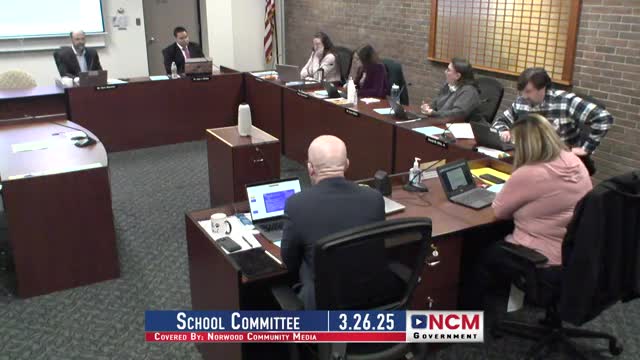
Summary
The Norwood School Committee voted 5–0 on March 26 to adopt a $65,292,117 FY26 budget that shifts staff and restructures elementary specialist scheduling to fit the district’s fiscal constraints.
Norwood — The Norwood School Committee voted 5–0 on Wednesday to adopt a $65,292,117 fiscal‑year 2026 budget that reassigns staff and restructures elementary specialist schedules to reduce costs while preserving core services.
The unanimous vote followed hours of presentation and public comment and a budget subcommittee review that led administrators to propose a block schedule for elementary “specials” (art, music, physical education and library) and a set of staff transfers to staff the new middle school. "Based on everything that we were able to, come up with and discuss, everything we presented previously with is still what we are recommending," said a motion moved by School Committee member Theresa Stewart before the vote. The motion passed 5–0.
Why it matters: Committee members said their priority was limiting reductions to student‑facing instruction while balancing a budgetary environment that town leaders asked be built with reduced reliance on one‑time free cash in future years. The administration said the new model increases time for art, music and PE in most elementary grades, reduces library minutes, and creates efficiencies that administrators say are needed for equitable service across six elementary schools and to staff the new middle school.
Key decisions and changes - Budget total: $65,292,117 (FY26), adopted 5–0. The vote followed budget subcommittee meetings and additional work by district staff to refine schedules and staffing. - Latin program: The high‑school Latin position will be moved to the middle school and the district is pursuing an online alternative (Edmentum) to allow students to complete Latin coursework next year. Superintendent Tim Luff said the online option the district has vetted would cost roughly $8,000 for the coming year. Laura Jordan, a parent and Latin teacher who spoke during public comment, urged the committee to preserve the course. "What is our town thinking getting rid of a subject as crucial as Latin?" Jordan asked at the microphone, describing Latin as a class where students felt they belonged. - Elementary specialist scheduling: Administrators presented a block model that pairs specialist teachers with two schools to reduce non‑teaching “open” periods and create common prep time for grade‑level teams. The district says art, music and PE minutes would increase from about 1,440 minutes to roughly 1,800 minutes annually in K–3 under one proposed rotation; library minutes would be reduced. Dr. Munoz, who led schedule work, acknowledged travel time and space constraints and said staff are refining versions that reduce daily travel and preserve planning time. - Special education and multilingual learners: The budget includes staff movements to staff the new middle school and to maintain required services. The district will transfer two related‑service positions to funding through Medicaid/MassHealth revenue streams rather than the operating budget; administrators said those staff will remain employed by the district but funded differently. - Staffing counts called out by administration in presentations: two elementary librarian positions reduced; 12 grade‑5 classroom teachers moving into the middle school cohort (to staff the middle‑school model); four special‑education teachers moving with fifth graders to the middle school; new middle‑school hires included art, music, an ELE (English Learner) teacher and a Freshman Academy position at the high school.
What administrators said Superintendent Tim Luff framed the budget as a balance between preserving student services and reacting to the town’s fiscal limits. He said the district has been working since December to craft schedules that serve instructional needs and address increases in multilingual and special‑education enrollments. "We will continue and have been working with our folks to make sure that we have a schedule that works for everybody," Luff said, noting ongoing meetings with specialists and principals.
Dr. Munoz, who presented sample schedules, said the initial status‑quo staffing model created a large number of non‑teaching periods once fifth grade moved out of elementary schools. The block schedule pairs specialists with two schools to create more efficient teaching blocks and more common prep time for classroom teachers, he said, while acknowledging concerns about travel time and library reductions.
Public concerns and committee discussion Public comment centered on curricular impact — especially the Latin program — and on the process of shifting staffing. Laura Jordan urged the committee to save Latin, saying students find community and challenge in the class. Committee members pressed administration for an explicit inventory of student‑facing impacts and for assurances that any further line‑item changes would come back to the committee before being finalized.
"Before those moves become final, can we get both the budgetary and the impact presented to us for approval?" Committee member Joan (last name not specified) asked. Administration agreed to return with detailed, building‑level impacts if further changes are needed.
Votes at a glance - FY26 Norwood Public Schools operating budget, $65,292,117 — Motion to approve moved by Theresa Stewart, seconded by Keith (last name not specified); outcome: approved 5–0.
What comes next Administrators said they will continue to refine specialist schedules with principals and staff to reduce travel and preserve prep time. The district will also pursue the online Latin option for students and examine whether an AP pathway or exam preparation can be supported; administrators said availability of AP‑level content on the proposed online platform had not been confirmed. The school committee and administration also noted the exercise of building a FY27 budget will start sooner and could include both a level‑services scenario and a worst‑case scenario without free cash.
Ending: The committee framed the vote as a difficult but necessary step to maintain educational services this year while preparing for tougher budget conversations ahead. "We are trying to get in front of that challenge," Dr. Munoz said of staffing and scheduling. "If it's a disaster, you go back to the drawing board and change it."