Get Full Government Meeting Transcripts, Videos, & Alerts Forever!
Get email alerts on the Short Term Rentals topic
No spam. Unsubscribe anytime.
Bastrop staff propose $25 short-term-rental registration, cite life-safety and tax tracking
Summary
City staff outlined a proposed ordinance to require short-term rental (STR) owners inside Bastrop city limits to register annually, pay a $25 fee and meet safety, parking and tax-reporting requirements; implementation would be handled in-house by Development Services with a three-step appeals path.
City of Bastrop staff told a packed town-hall meeting that they plan to seek an ordinance requiring owners of short-term rentals within the city limits to register with Development Services, pay a $25 annual fee and meet a set of safety, parking and tax-reporting requirements.
A Development Services staff member said the proposal is driven first by life-safety concerns — to create a local database and a 24-hour contact so officials can reach someone during evacuations or other emergencies — and second by the need to ensure hotel-occupancy taxes (HOT) are collected and routed to local community assets. "This is just an opportunity for us to educate the public," the staff member said, explaining the registration would also require a statement of compliance with existing fire and building codes.
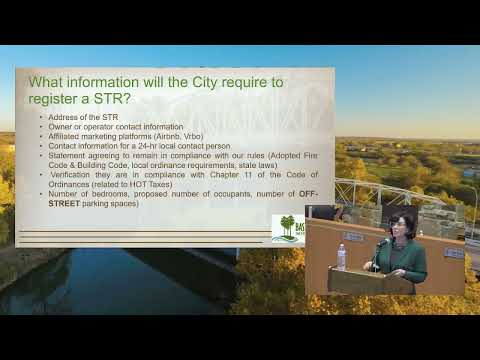
Under the proposal, an STR is any lodging accommodation rented for fewer than 30 consecutive days. The registration would ask for the property address, owner/operator contact information, any affiliated marketing platforms, a 24-hour local contact, the number of bedrooms, proposed occupant limits and the amount of on-site off-street parking. Registrants would post a registration number at the front facade; the city plans to publish a map of registered STRs on its website to help visitors find properties.
Safety requirements described at the meeting include functioning smoke and carbon monoxide detectors, at least one Type ABC portable fire extinguisher with a valid inspection tag, working bedroom egress windows and a posted floor plan showing exits and evacuation routes. The fire extinguisher must carry an annual certification from a qualified company, and the fire department will inspect STRs as part of the registration process. "They're safe," the presenter said of the detector/egress requirements, framing them as life-safety measures.
Staff emphasized that registration is intended to be straightforward and customer-focused. Registrations and renewals would each carry a $25 fee; staff said the fee is not intended to be revenue-generating but to support tracking and compliance. Registration would be completed online through the city’s myGov permitting software or at a kiosk in Development Services; staff will assist residents who lack technology access.
The city provided current STR tax figures in the presentation: for fiscal year 2024, 42 STRs reported and $54,204 in HOT collections; fiscal year 2025 to date showed 24 registrants and $10,424 collected. Staff said the city receives roughly 7 percent of those taxes back. The presenter noted that the state sets HOT collection rules and that the city is not creating the tax but is seeking to ensure compliance with existing law.
Staff described an in-house implementation plan: the town hall is the first public step, then the city would move the ordinance to adoption and give property owners 60 days after adoption to complete registration and remedy any issues (for example, obtain a certified extinguisher or correct egress windows). Registrations may be denied for false information or if current-year HOT taxes are unpaid; repeated code violations could lead to denial. The presenter outlined an appeals path: first to the director of Development Services, then to the city manager, with City Council as the final appellate body.
On parking, staff said the city will apply the recent citywide requirement that each bedroom have an on-site parking space; a two-car garage counts as two parking spaces. The presenter said the certificate of occupancy (CO) process differs from the proposed registration: CO inspections typically occur when a structure is built or when a commercial change occurs, whereas the STR registration offers a one-time touchpoint for residential properties that may not have been inspected since original construction.
Questions at the meeting addressed inspection frequency, fire-extinguisher certification, the potential effect on homestead exemptions and how the city will identify unregistered listings. James Cowey of Development Services said staff will monitor listing platforms and contact properties whose listings appear inside city limits. Edie, the city chief financial officer, described how the city reconciles collections reported by a third-party tax platform with bank receipts.
Residents raised liability and tax-collection concerns. A resident noted that platforms such as Airbnb and VRBO may collect state occupancy taxes but not city or county taxes; staff said collection frequency and thresholds (for example, monthly versus quarterly reporting) are governed by state rules and platform practice. Regarding property appraisal, staff relayed guidance from the appraisal district that a home’s homestead exemption is not affected unless the property is rented more than 50 percent of the year.
Staff repeatedly described the proposal as a low-burden registration intended to improve safety and compliance while offering technical help to registrants. The presenter invited further questions and said the city will hold public hearings before adopting any ordinance.