Get Full Government Meeting Transcripts, Videos, & Alerts Forever!
Get email alerts on the Urban Forestry Tree Ordinance topic
No spam. Unsubscribe anytime.
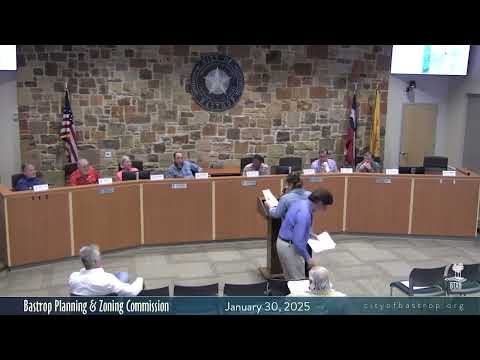
Bastrop planning commission approves multiple tree protections, sets replacement rules and sends fee proposal to legal review
Summary
The Bastrop Planning and Zoning Commission voted unanimously Jan. 30 to lower the protected-tree caliper threshold, require tree surveys and set minimum replacement sizes and perpetual maintenance; the commission tabled a separate mitigation-fee schedule for legal review after debate.
Bastrop Planning and Zoning Commission members on Jan. 30 approved a package of amendments to the city’s tree protections, including lowering the ordinance caliper threshold to match state minimums, adding a required tree survey and new enforcement language, and setting minimum sizes and maintenance rules for replacement trees. Commissioners voted unanimously on each amendment; one related item — the detailed mitigation-fee schedule and specific penalty amounts — was tabled for city legal review.
The changes amend section 6.3.004 of the city code, staff said, and include a required tree survey and a clearer enforcement path. The commission approved language that replacement trees “shall be a minimum of 2 inches in diameter measured 12 inches above the ground and 5 feet in height when planted,” and that replacement trees must be maintained “in perpetuity” unless otherwise modified through the city’s variance process. The roll calls on the final motions recorded all seven commissioners voting yes: Ishmael Harris, Christopher Toth, David Barrow, Gary Moss, Patrice Parsons, Keith Alborn and Jeffrey Estes.
Why it matters: The package changes how development projects account for trees during site plans and plats. Requiring a tree survey and specifying replacement size and ongoing maintenance shifts more long-term responsibility to property owners and gives staff a clearer enforcement standard, staff said. The commission’s action aims to protect larger heritage trees while making replacement requirements realistically survivable, staff and outside arborists told commissioners.
Staff presentation and the commission’s debate
Sylvia (city manager) told the commission the state law sets a 10-inch minimum for protected trees and that the city’s current ordinance used a 13-inch threshold. She told the commission the proposed edits would bring the city code in line with state law and add procedural clarity. Staff also explained that the tree-survey requirement would allow the city to document existing trees and determine replacement obligations and mitigation credits.
Local arborists and park board members spoke at length during public comment. Resident Luke Thompson, who identified himself from Bastrop and spoke as an arboriculture expert, said smaller transplants tend to survive better, arguing that “2 will survive better than the larger ones.” Parks liaison Terry Moore summarized the parks board’s earlier recommendation that the commission adopt a smaller replacement caliper (the parks board had recommended 3 inches) and explained the board’s preference for a size that improves survivability.
Scott Harris, who identified himself as an arborist and longtime Bastrop County resident, urged removal from the preferred-plant list of nonnative, invasive species such as Chinese pistache and Chinese elm; staff confirmed those species were moved to an invasive list in the updated preferred-plant table.
Open questions and fee/penalty debate
Commissioners discussed two distinct enforcement approaches presented in staff materials: a civil mitigation-fee approach for applicants that work with the city and a stricter penalty framework aimed at “bad actors” who remove trees without approval. Staff described the mitigation fee as the mechanism used when a developer cannot meet caliper-for-caliper replacement and must pay into a mitigation fund. By contrast, penalties were envisioned for cases of illegal clearing or for applicants who fail to obtain required permits.
Commissioners and staff debated specific dollar figures repeatedly in public remarks: staff said the current baseline in the code equates to roughly $150 per caliper inch under the existing language; the parks board had recommended raising mitigation to $250 per caliper inch and discussed still-higher amounts. Commissioner comments cited examples in other Texas cities (staff noted Austin’s fees when comparing scales). The commission did not adopt final fee figures on Jan. 30; after extended discussion it voted unanimously to table the fee schedule and penalty language for review by the city attorney and to return a clearer civil/criminal penalty proposal that can withstand legal challenge.
What the ordinances now require (as amended)
- Protected-tree threshold adjusted to align with state law (minimum referenced in staff presentation: 10 inches). - Section 6.3.004 amended to add a required tree survey and to add procedural detail for credits, diseased-tree treatment and enforcement steps. - Replacement-tree minimum: 2 inches caliper (measured 12 inches above ground) and 5 feet in height at planting; replacement trees must be maintained in perpetuity unless legally altered through variance or a new approved development plan.
Quotations
“The 2 inch…will survive better than the larger ones,” Luke Thompson told the commission during public comment.
“The park board recommended 3,” Terry Moore said when summarizing the parks board’s recommendation.
“We now have Denton Navarro as our law firm. Amanda Padilla is a planner with the law firm,” Sylvia told the commission when introducing staff and legal support present for code review.
Ending
The commission’s actions narrow the zone for uncertainty in tree mitigation and replacement but leave the specific mitigation-fee schedule and some penalty mechanics for further legal and staff work. Staff said the item will return after the city attorney provides recommended statutory language and clearer civil/criminal penalty options.