Get Full Government Meeting Transcripts, Videos, & Alerts Forever!
Get email alerts on the Land Use topic
No spam. Unsubscribe anytime.
Planning commission recommends 1-acre minimum in P2, one-third-acre in P3 to curb dense infill
Summary
The Bastrop Planning and Zoning Commission voted to recommend minimum lot sizes of 1 acre for P2 (rural) and one-third of an acre for P3 (residential) to the City Council, citing concerns about drainage, infrastructure strain and protecting historic neighborhood character.
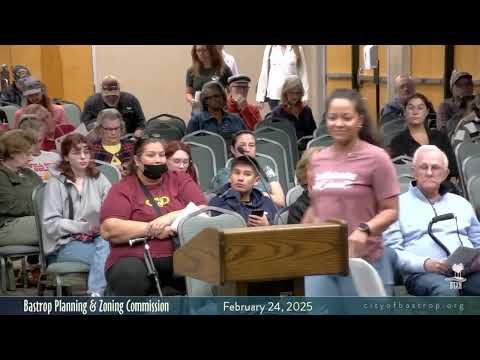
The Bastrop Planning and Zoning Commission on Feb. 24 recommended that City Council adopt minimum lot sizes of 1 acre in P2 zones and one-third of an acre in P3 zones, a change commissioners said is intended to preserve neighborhood character and reduce infrastructure and flooding risks.
Commissioners and residents raised repeated concerns about the current form‑based code, under which some new developments have no minimum lot sizes. Sylvia (City Manager) told the commission the existing code “created on the guise of walkability … a code that did anything but protect authentic Bastrop.” She and other commissioners argued the proposed minimums mirror the existing built environment and give neighbors predictability about what can be built next door.
Public commenters, including Heather Green of Pecan Street and Pablo Serna (11 04 Hill Street), said they feared very dense infill and cited a specific unresolved application they said would put more than 40 tiny homes on about 4.25 acres near the railroad tracks. Several residents asked the commission to slow the process to allow more public review and staff briefings before public hearings.
Commissioners discussed alternatives including quarter‑acre minimums and noted administrative reliefs for small, pre‑existing lots. Commissioner Jordan Scott said plan‑development district tools remain available for large projects that want smaller lots in exchange for public benefits. After debate, a motion to recommend one acre in P2 and one‑third of an acre in P3 passed 6–1.
Commissioners said the change is intended to be a baseline, not an absolute ban on future projects that go through the Plan Development District (PDD) process. Staff noted some lots now in the extraterritorial jurisdiction (ETJ) may remain governed by prior approvals and that final implementation requires council action.
The commission instructed staff to include relief language for legitimately constrained, historic or already‑subdivided lots and to clarify how administrative variances will work for property owners who need relief.
The recommended changes will be forwarded to City Council for first reading on the March 4 special agenda.
Ending: The recommendation now goes to City Council. If adopted, the change will become the citywide baseline for new, raw subdivisions; commissions and staff said many existing lots will be unaffected because they are grandfathered or already vested under prior approvals.