Get Full Government Meeting Transcripts, Videos, & Alerts Forever!
Get email alerts on the Land Use And Housing topic
No spam. Unsubscribe anytime.
Council adopts minimum lot sizes, setback rules and bans duplexes in P2/P3 on first reading
Summary
Council approved a package of B3 code changes on first reading that set minimum lot sizes (1.0 acre for P2, 0.33 acre for P3), added build-to/setback rules tied to neighboring properties, and removed duplexes as an allowable building type in P2 and P3; the measures passed unanimously and will return for final reading.
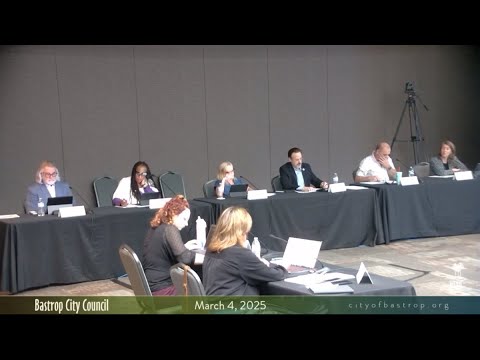
The Bastrop City Council voted unanimously on March 4 to approve on first reading a set of amendments to the B3 form-based code that set minimum lot sizes, clarified setbacks/build-to lines, and removed duplexes as an allowable building type in P2 and P3 zoning areas.
City Manager Sylvia summarized staff's approach as seeking predictability for residents while preserving tools for developers. For minimum lot sizes the ordinance sets an average 1.0-acre lot standard for P2 neighborhoods and a 0.33-acre standard for P3; staff said those figures reflect existing lot-size averages and infrastructure capacity. "We did the math," Sylvia told council, saying a third-acre matched current wastewater and drainage infrastructure without costly rehabilitation.
On setbacks and build-to lines staff recommended a rule that new construction match the built environment on adjacent lots, plus or minus 5 feet; for vacant lots with no adjacent built neighborhood the recommendation was a 25-foot primary setback. Resident and surveyor commenters raised practical questions about how to measure and verify neighboring setbacks; staff said the city could use available tools (pictometry, GIS, plat records and field measurement) and proposed adding a clearer definition for "undeveloped lots" in code language.
The council also moved to remove duplexes from P2 and P3. Planning staff and several council members said allowing duplexes under a conditional-use regime would be difficult to enforce in a form-based code because a conditional permit authorizes an enduring structure; once built, enforcement of conditions (such as parking or hours) would rely on nuisance and code enforcement rather than reversing construction. Council members and public commenters discussed ADUs (accessory dwelling units) repeatedly; staff said ADU policy will be revisited separately and will include standards for parking, drainage and impervious cover before broader allowances are adopted.
Supporters of the amendments argued the package preserves neighborhood character and gives neighbors predictability about future infill. Opponents and several residents urged more targeted geographic protections (overlay districts) to preserve historic downtown character; staff said overlays for Old Town and other character districts are forthcoming.
The ordinances passed on first reading and will be scheduled for second readings on March 11.