Get Full Government Meeting Transcripts, Videos, & Alerts Forever!
Get email alerts on the Elections topic
No spam. Unsubscribe anytime.
Researcher tells committee that large nonprofit voter‑registration networks have partisan ties and big payments to political firms
Summary
The House committee heard from Parker Thayer, a researcher with the Capital Research Center, who said nonprofit voter-registration networks have large funding flows and pay substantial sums to political consulting firms, and that those arrangements should be examined to ensure compliance with 501(c)(3) rules.
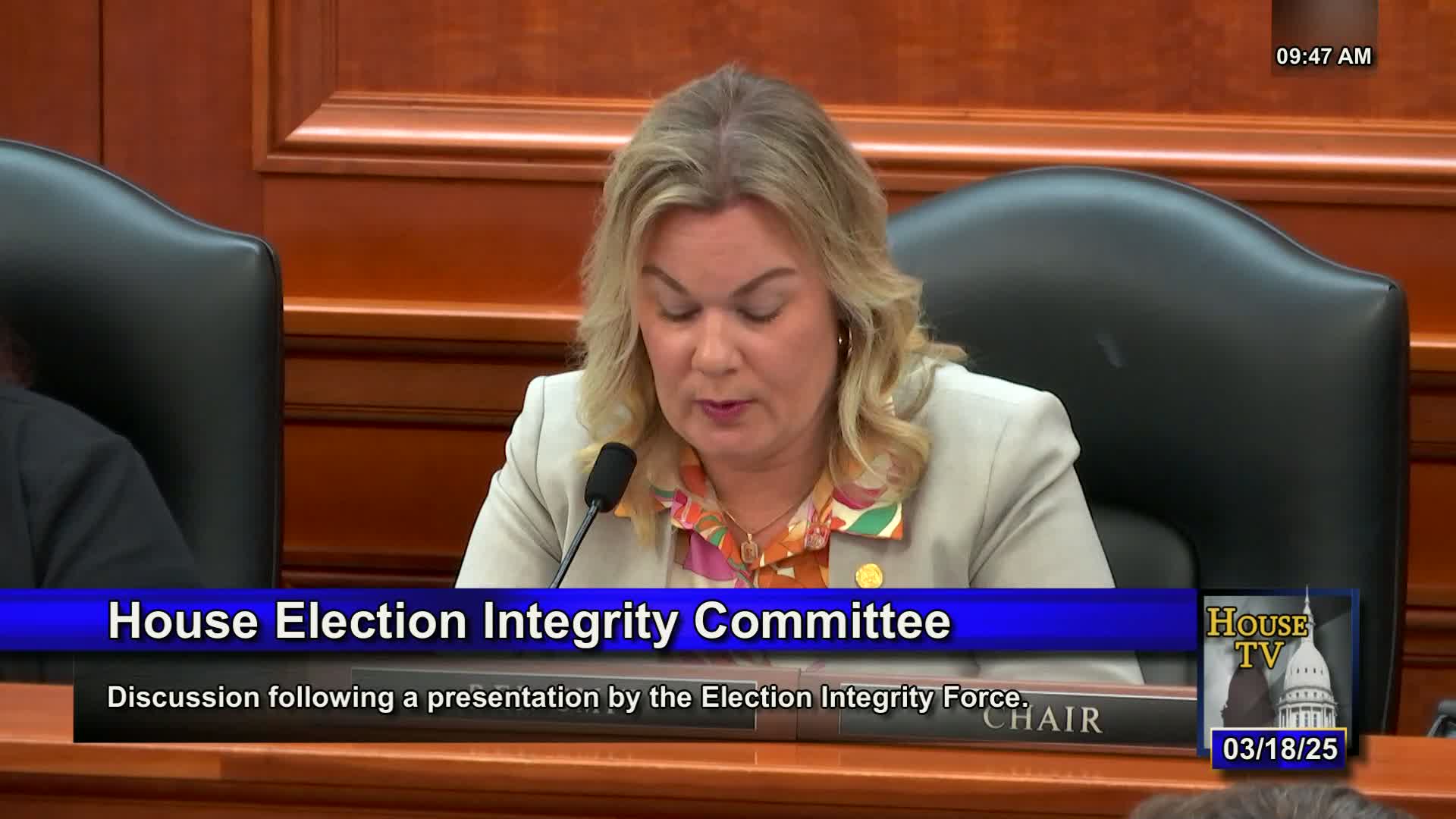
The House Election Integrity Committee also heard testimony from Parker Thayer, a researcher with the Capital Research Center, who presented research alleging that a national industry of nonprofit voter-registration groups has substantial partisan links and large monetary flows to political consulting firms.
Thayer told the committee he studies the “nonprofit voter registration industry” and presented industry‑level estimates and specific case studies. He said published estimates put the national ecosystem that self-identifies as voter registration and education at roughly $760 million in 2022; based on his research he said the full national total could be closer to $1 billion.
Thayer outlined a history and network of organizations he described as central to large-scale voter-registration efforts. He said the Voter Registration Project (VRP), the Everybody Votes campaign and the Voter Participation Center (VPC) together form a network that in 2023 raised tens of millions of dollars and contracted substantial work to commercial canvassing and consulting firms. Thayer cited a 2020 IRS Form 990 in which the Voter Registration Project reported paying GBI Strategies about $2.5 million for voter-registration consulting.
Thayer summarized portions of internal planning documents and emails he said show political intent behind early plans that later were rephrased to fit 501(c)(3) descriptions. He described internal drafts and tracked changes that, he said, convert language about changing election outcomes into language about “participation” or “competitiveness.” He also cited a leaked memo from a Democrat-aligned fundraising vehicle that he said urged donors to channel funds to Everybody Votes and VPC because those organizations were effective at generating net Democratic votes.
Using public filings and reporting, Thayer identified specific financial flows in Michigan: he said the Michigan Center for Election Law and Administration reported receiving about $12 million in 2020 from the Center for Election Innovation and Research (a grantmaker funded in part by Mark Zuckerberg) and that most of that money, he said, was paid to firms he described as Democratic political consultants (he named Waterfront Strategies and Alper Strategies as vendors in those filings). He presented those payments as an example of how nonprofit voter‑registration funds were routed to partisan firms.
Thayer also referenced other investigations and enforcement actions in other states: he noted local inquiries into suspicious registration forms tied to GBI Strategies in Muskegon in 2020 and ongoing reporting on registration irregularities in several counties tied to Everybody Votes–funded contractors; and he cited a January administrative fine assessing $300,000 against the New Georgia Project for partisan electioneering in Georgia.
In committee questions, Representative Song asked whether Thayer’s proposal to bar all charitable organizations from doing voter-registration work would harm voter participation. Thayer replied that political parties, PACs and private actors can conduct registration work and that his concern was the fungibility of funds and apparent partisan practice among some taxpayer-subsidized charities; he said private and political actors have sufficient incentives to register voters without 501(c)(3) tax-subsidized activity.
Representative Fox and others asked whether the Everybody Votes network’s claim of registering 7,000,000 voters over its lifetime indicates fraud; Thayer said he had no direct evidence that every claimed registration was fraudulent but said the scale and the payments merit closer scrutiny and that some contractors have been the subject of local investigations. Thayer offered to provide documentation to the committee and told members he would respond to written questions.
The committee did not vote on legislative changes at this hearing. Thayer urged lawmakers to consider tighter restrictions or greater enforcement of existing IRS/charitable-sector rules and to require greater transparency about nonprofit funding and vendor contracts that support voter-registration activity.