Get Full Government Meeting Transcripts, Videos, & Alerts Forever!
Get email alerts on the Elections topic
No spam. Unsubscribe anytime.
Election Integrity Force tells House committee it found registration and absentee-ballot irregularities in Michigan
Summary
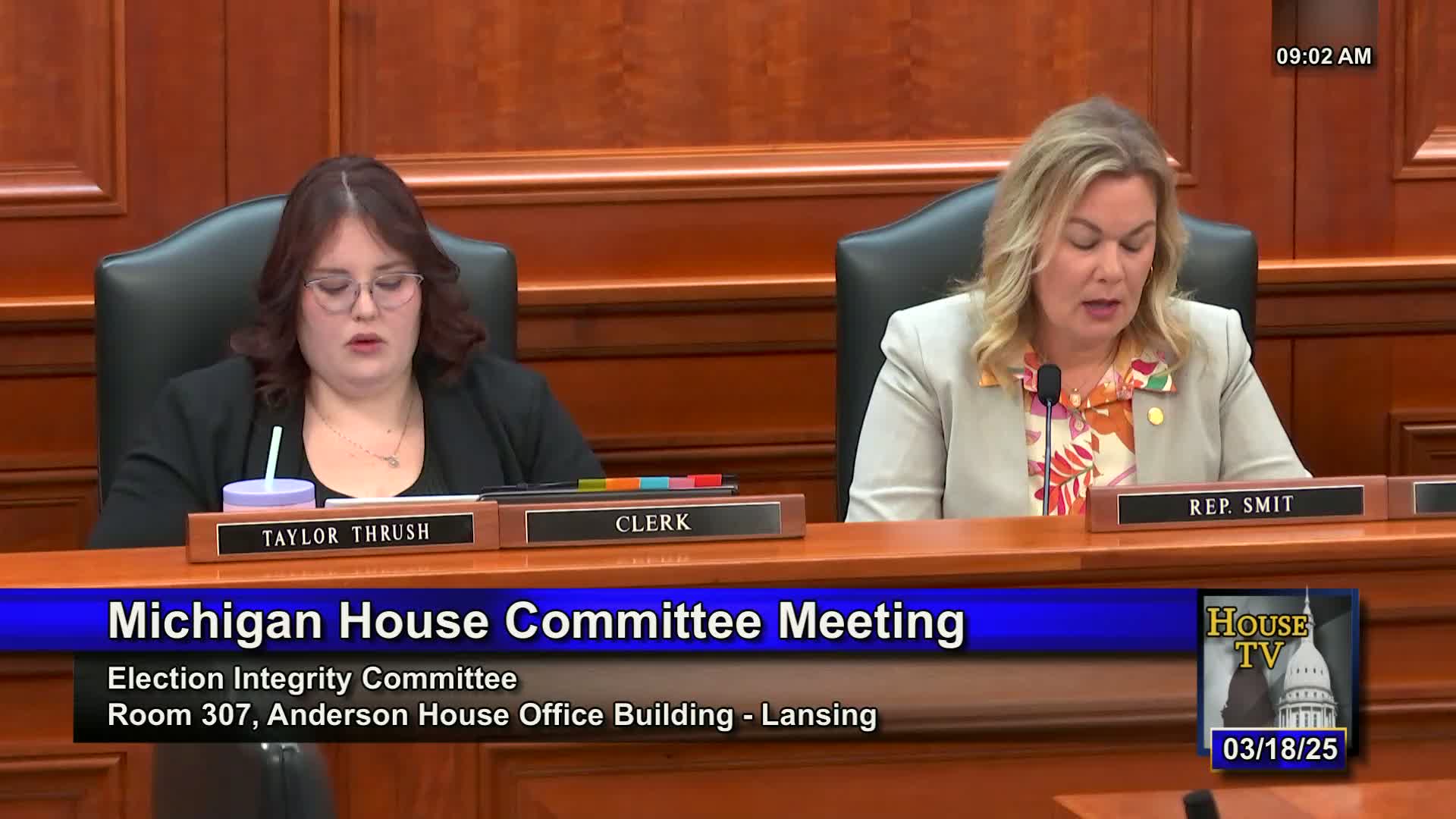
The House Election Integrity Committee heard from Chris Kayala, a representative of Election Integrity Force (EIF), who told the committee on Zoom that his volunteers’ analysis found what he described as widespread irregularities in Michigan’s Qualified Voter File (QVF) and in absentee voter records.
The House Election Integrity Committee heard from Chris Kayala, a representative of Election Integrity Force (EIF), who told the committee on Zoom that his volunteers’ analysis found what he described as widespread irregularities in Michigan’s Qualified Voter File (QVF) and in absentee voter (AV) ballot records.
Kayala said EIF is a statewide, unpaid volunteer group that conducts canvassing and data analysis to check election records. “We don't care who gets elected, what we care about is whether the process is good,” he told the committee during his presentation, adding that his group’s work focuses on “transparent and trusted elections.”
Kayala said his analysis found a large and unexplained increase in registrations in multiple counties after 2020, and characterized many registrations on the QVF as “dead wood” that should be cleaned from the rolls. Using Muskegon County as a case study, he said the county’s registration file showed a gain of roughly 17,000 registrations in 2020 that he and local canvassers judged implausible given the area’s population growth. He said EIF could not account for roughly 6,000 voters reported as having voted in 2022 whose records later appeared to be missing from the county’s history file.
Kayala described several specific data problems he said the group documented: records with birth years in the 1800s; registrations that moved with a voter to another county so that local history files no longer reflected where people voted; and records showing multiple addresses for a single voter ID. He said clerks sometimes cannot or do not obtain full QVF details that would let local officials reconcile those discrepancies.
Kayala told the committee that in the 2024 election his team observed about 108,000 voter IDs that were associated with more than one AV ballot (he gave a “grand total” of 208,000 ballots affected across the state). He said the largest county-level counts in the data he showed were about 34,000 in Wayne County, about 20,000 in Macomb County and about 17,000 in Kent County, and that smaller counts appeared across most counties. He said state staff attributed the issue to a “programming glitch.”
On access and oversight, Kayala urged the committee to seek QVF transaction logs and LDF files (user/login audit files) that would show who entered or changed records in the state system. He said third parties such as ERIC and several nonprofit groups have read/write access to parts of the state voter file, and that the combination of shared administrative logins and external access makes tracing edits difficult. He said the Michigan State Police investigated alleged suspicious registration activity tied to a private canvassing firm and that some matters were referred to the FBI.
Committee members asked questions during and after the presentation. Representative Sarah Colazar (state representative) noted that numerous audits after 2020 found no evidence of widespread fraud and asked whether Kayala accepted the 2020 results. Kayala replied, “I accept the results of it,” and said his concern is that audits and recounts did not look in the places his team identified as problematic. Representative Song asked whether the 2024 results were unreliable given the duplicate-AV-ballot figures; Kayala limited his response to the data shown in his presentation and said the duplicates warranted corrective action and transaction-log review.
Kayala also told lawmakers he had been denied routine access to electronic poll-book snapshots and a consistent, timely QVF export. He said the secretary of state’s office changed the way it delivers QVF data and that EIF members and some clerks have been unable to obtain the same reports on schedule in recent years.
The committee earlier adopted the minutes for its March 11 meeting by unanimous consent on a motion from Representative Outman. The committee received a second presentation after Kayala’s testimony and then adjourned.
What Kayala asked lawmakers to do included obtaining transaction logs and user audit files from the state QVF (which he said would show who made changes), documentation on AV ballots that were issued and any corrective actions taken, and access to electronic poll-book data for reconciliation. He said those materials are necessary, in his view, to determine whether the observed anomalies reflected administrative errors, programming issues, or worse.
The presentation was largely an appeal for further investigation and for greater transparency in how the QVF and AV reporting are managed. Kayala repeatedly emphasized clerks’ workload and funding constraints while pressing for access to system logs and poll-book exports he said would let volunteers and local officials reconcile anomalies.