Get Full Government Meeting Transcripts, Videos, & Alerts Forever!
Get email alerts on the Professional Licensure Compact Ot topic
No spam. Unsubscribe anytime.
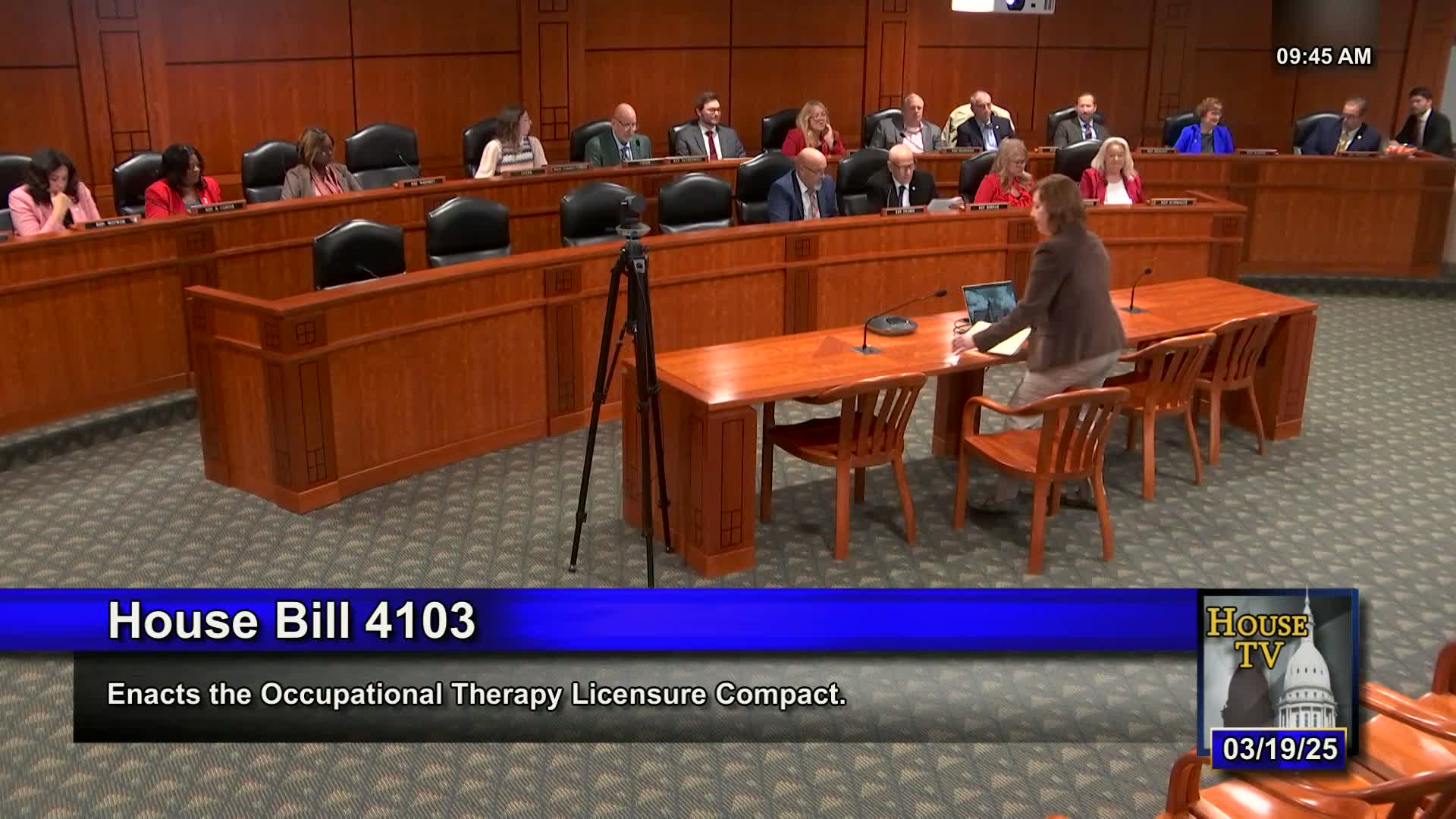
House hearing on occupational therapy compact highlights workforce and rural access issues
Summary
House Bills 4103 and 4104 would authorize Michigan to join the Occupational Therapy Licensure Compact to give occupational therapists and assistants privileged practice across member states. Supporters said the compact would reduce long wait times in specialty areas, support telehealth and help military families; no committee vote recorded.
Representative Lori Rogers presented House Bills 4103 and 4104 to the Michigan House Health Policy Committee, seeking authorization for Michigan to join the Occupational Therapy Licensure Compact so occupational therapists (OTs) and occupational therapy assistants (OTAs) with an unrestricted home‑state license could obtain compact privileges to practice in other member states.
Rogers, who practices physical therapy part time and testified from that perspective as well, said the compact would help hospitals and post‑acute providers manage discharge planning and reduce delays tied to workforce shortages. “The OT Compact is an interstate professional licensing compact for occupational therapists and assistants, which will address licensure portability,” Rogers told the committee.
Denise Hoffman, legislative and advocacy director for the Michigan Occupational Therapy Association and a practicing occupational therapist, described specialty shortages and long waits in some areas. Hoffman said the compact could reduce delays—for example she cited up to eight‑month waits in some areas for infants and children needing specialty feeding therapy—and would also help military families and telepractice options. “The OT compact protects quality of care and access to services,” she said.
Mechanics and oversight: Witnesses and a representative from the National Center for Interstate Compacts said the OT compact preserves state regulatory authority, requires participation in a shared data system for disciplinary reporting, and provides an alternate path to licensure through compact privileges. Committee members asked about jurisprudence exams and continuing‑education implications; testimony cited examples (some states use a short modified statement or acknowledgement about state requirements) and said each compact state retains authority to require state‑specific compliance.
No roll‑call vote on the bills was recorded at the hearing. Several academic programs and professional groups filed written or not‑speaking support for the measures.