Get Full Government Meeting Transcripts, Videos, & Alerts Forever!
Get email alerts on the Professional Licensure Compact Pt topic
No spam. Unsubscribe anytime.
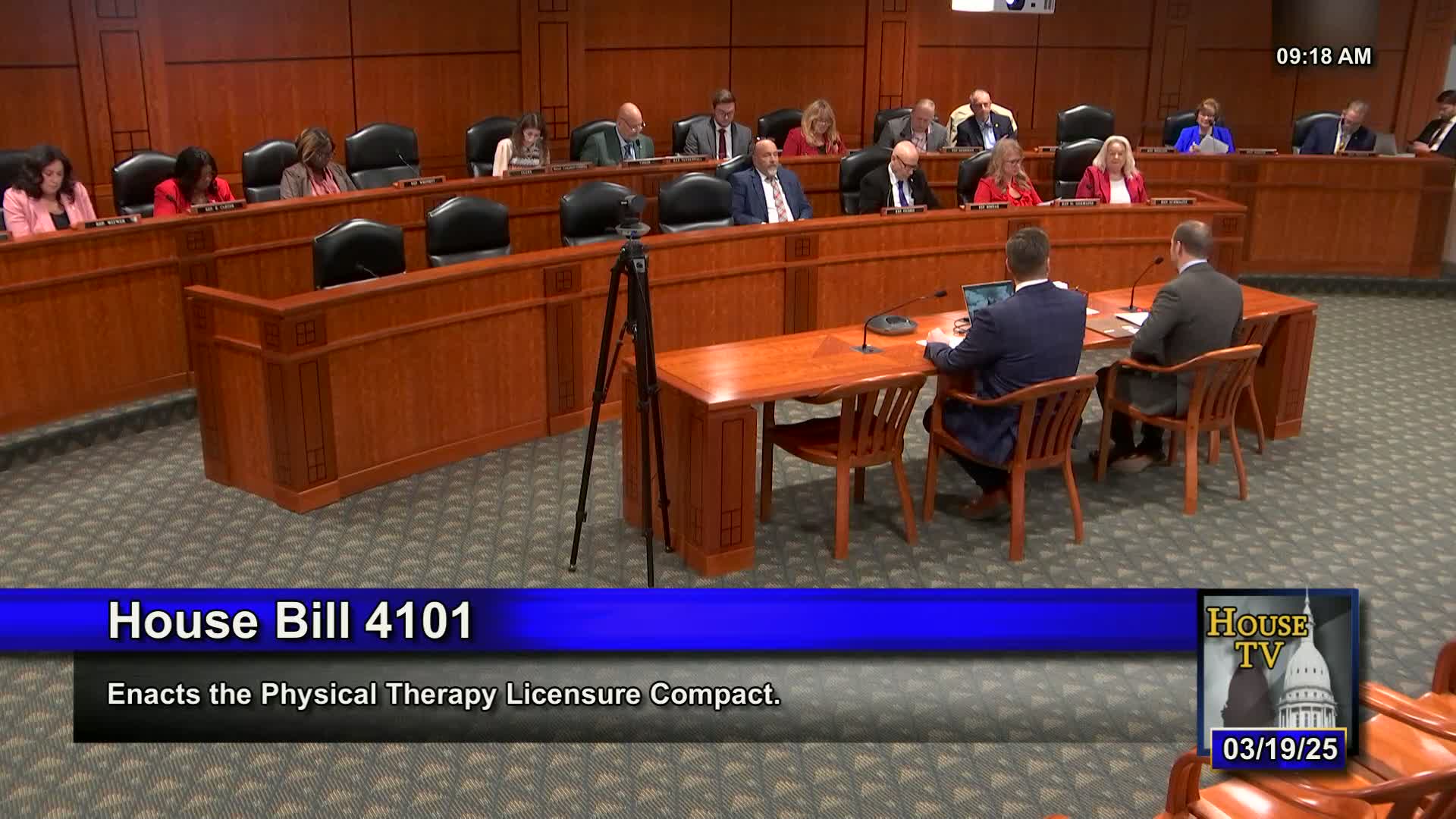
Committee hears bipartisan bills to join physical therapy licensure compact
Summary
Representatives Rob Beierlein and Fitzgerald asked the House Health Policy Committee to approve legislation joining Michigan to the Physical Therapy Licensure Compact, which would let eligible physical therapists and assistants obtain compact privileges to practice across member states without a separate license in each state.
Representatives Rob Beierlein and Fitzgerald (sponsors) and patient- and profession-level witnesses told the Michigan House Health Policy Committee that House Bills 4101 and 4102 would authorize Michigan to join the Physical Therapy Licensure Compact so licensed physical therapists (PTs) and physical therapist assistants (PTAs) may obtain compact privileges to practice in other member states without securing a separate full state license.
Brian Gilbert, president of the American Physical Therapy Association of Michigan and a former state licensing-board chair, said joining the compact would ease workforce constraints and be “a recruitment tool” for bringing clinicians to Michigan and helping recent graduates remain in the state. Jeff Rosa, administrator for the Physical Therapy Compact Commission, described the compact as “an alternate pathway for physical therapy providers who meet the eligibility requirements to obtain that privilege to practice in another state within a matter of minutes instead of the traditional days, weeks, or months associated with the licensure process.”
Why it matters: Supporters said compact membership expands provider availability in rural areas (via telehealth and cross-border practice), preserves state regulatory authority over practice and discipline, and reduces administrative burdens for clinicians who practice in multiple states. Witnesses noted border regions (Wisconsin, Indiana, Ohio) already include member states, and practitioners who live near state lines frequently seek cross‑state practice authority.
Costs and mechanics: Witnesses told the committee the compact requires participation in a data system and that states sometimes incur a one-time technology or integration cost; compact fees for individual practitioners include a commission privilege fee (and states may impose an additional state fee). Jeff Rosa said the Compact Commission funds operations through privilege sales and has not assessed member states an annual charge to date. Committee members asked about jurisprudence or state‑specific exams; witnesses said states retain authority to set and enforce state rules and that some states use a short acknowledgement or modified jurisprudence statement focused on state law.
Questions and concerns: Committee members asked about the timing and measurable impacts observed in other states, continuing education/jurisprudence requirements, and how discipline or adverse actions would be handled. Rosa explained that Michigan would retain the ability to take action against a compact privilege for conduct in Michigan and that actions against a compact privilege in one state can terminate privilege(s) elsewhere.
No roll‑call votes on the bills were recorded at the hearing. Several professional organizations and academic programs filed support cards.