Get Full Government Meeting Transcripts, Videos, & Alerts Forever!
Get email alerts on the 340b Program topic
No spam. Unsubscribe anytime.
Health centers, rare-disease advocates urge state action on 340B restrictions and contract pharmacy limits
Summary
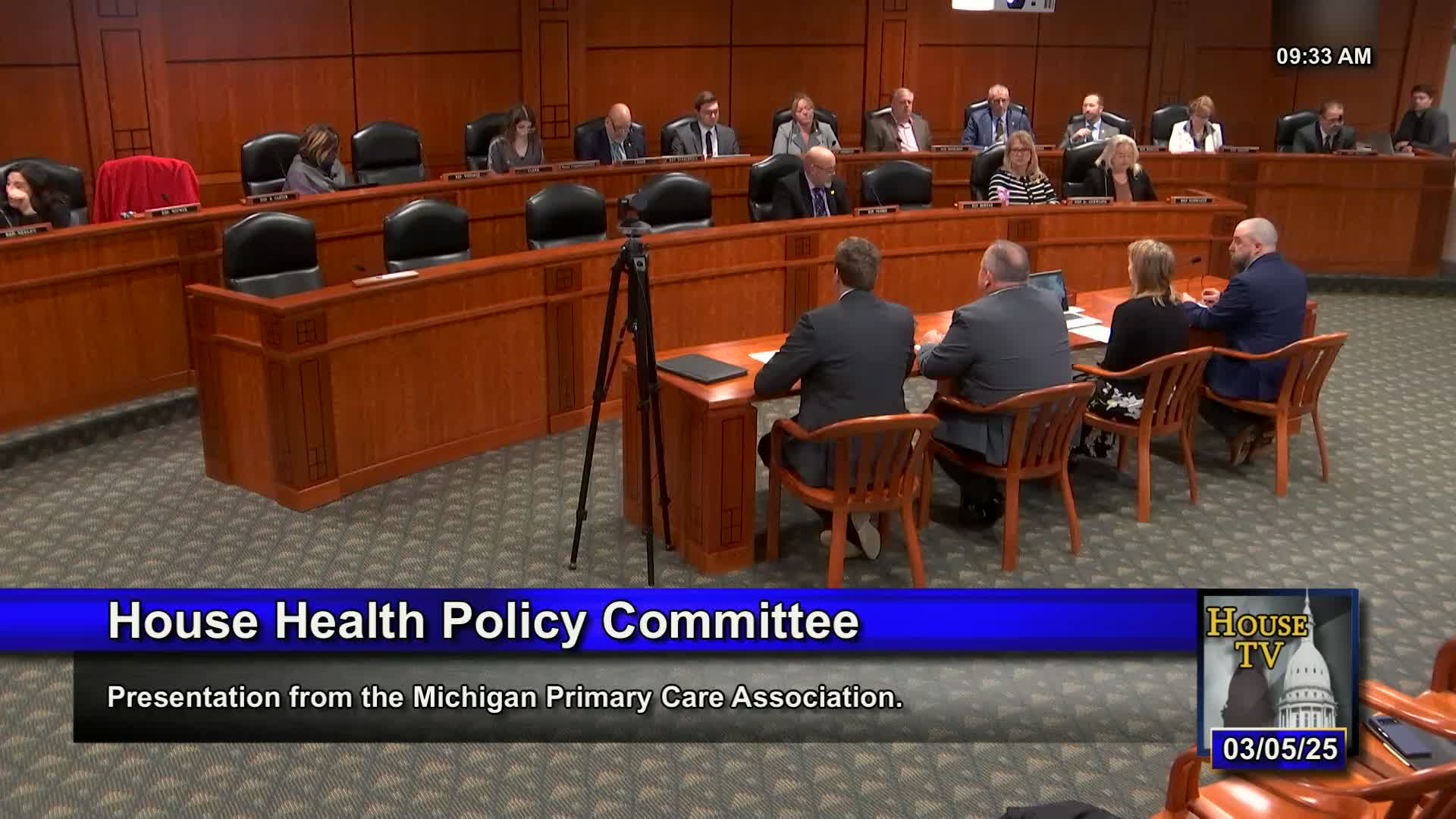
Representatives of Michigan's federally qualified health centers and rare-disease advocates urged the House Health Policy Committee on Tuesday to address manufacturer-imposed limits and contract-pharmacy restrictions on the federal 340B drug-pricing program, saying the limits reduce revenue that funds nonreimbursable services.
Representatives of Michigan's federally qualified health centers, hospitals' community clinics and rare-disease advocates urged the House Health Policy Committee on Tuesday to address manufacturer-imposed limits and contract-pharmacy restrictions on the federal 340B drug-pricing program, saying the limits reduce revenue that health centers use to provide nonreimbursable services.
Frank Waters of the Michigan Primary Care Association told the committee that Michigan has 41 health centers with about 400 locations serving close to 700,000 residents and that centers use 340B savings to support services such as transportation, dental care, behavioral health and discounted prescriptions.
Michael (Mike) Wieses, CEO of Hackley Community Care in Muskegon, said 340B savings helped offset operating losses: he reported a combined medical and dental operating loss of $2,600,000 in 2024 and that his center provided about $1,000,000 in medication assistance through a sliding-fee program. Wieses said manufacturer restrictions and contract-pharmacy policies have forced his center to add staff to monitor 340B and that continued restrictions could force staffing cuts, reduced mobile and outreach services, and delayed capital projects.
Kelly Pardee, pharmacy business director at Great Lakes Bay Health Centers, described practical effects: the center provided about 244,000 visits last year to 56,000 patients across 16 counties and operates four pharmacies plus contract pharmacies. She said contract-pharmacy rules often force health centers to choose a single physical location that is eligible for 340B savings, which undermines centers serving broad rural regions and prevents savings when patients fill prescriptions at other pharmacies.
''''Witnesses described a fragmented manufacturer reporting regime: Pardee and others said manufacturers each publish separate contract-pharmacy policies and frequently change them, adding administrative burden. Committee members asked what changes the centers wanted; speakers said the primary state-level remedies would be limiting or removing contract-pharmacy restrictions and standardizing reporting requirements.
Rare-disease advocates from the Michigan Rare Coalition and the Amyloidosis Foundation said they also support reforms and called for greater transparency and accountable reporting from hospitals participating in 340B. Leslie Baldwin of Michigan Rare Coalition said current reporting does not clearly show how hospitals and other 340B entities pass savings to low-income and vulnerable patients; Kathy Lewis of the Amyloidosis Foundation said many rare-disease treatments lack generic alternatives and that patients face high travel and care costs.
Committee members asked about trends and scale. Health-center witnesses said their 340B savings have fallen in recent years despite patient increases; Hackley reported a substantial year-over-year negative change in operating results and said manufacturers are issuing restrictions almost weekly. Witnesses asked legislators to consider state-level remedies because they do not expect immediate federal action.
Closing: witnesses urged the committee to convene stakeholders, including patients, hospitals, manufacturers and health centers, to craft reforms that preserve program benefits for vulnerable patients while reducing burdensome and inconsistent administrative requirements.