Get Full Government Meeting Transcripts, Videos, & Alerts Forever!
Get email alerts on the Health Data Utility topic
No spam. Unsubscribe anytime.
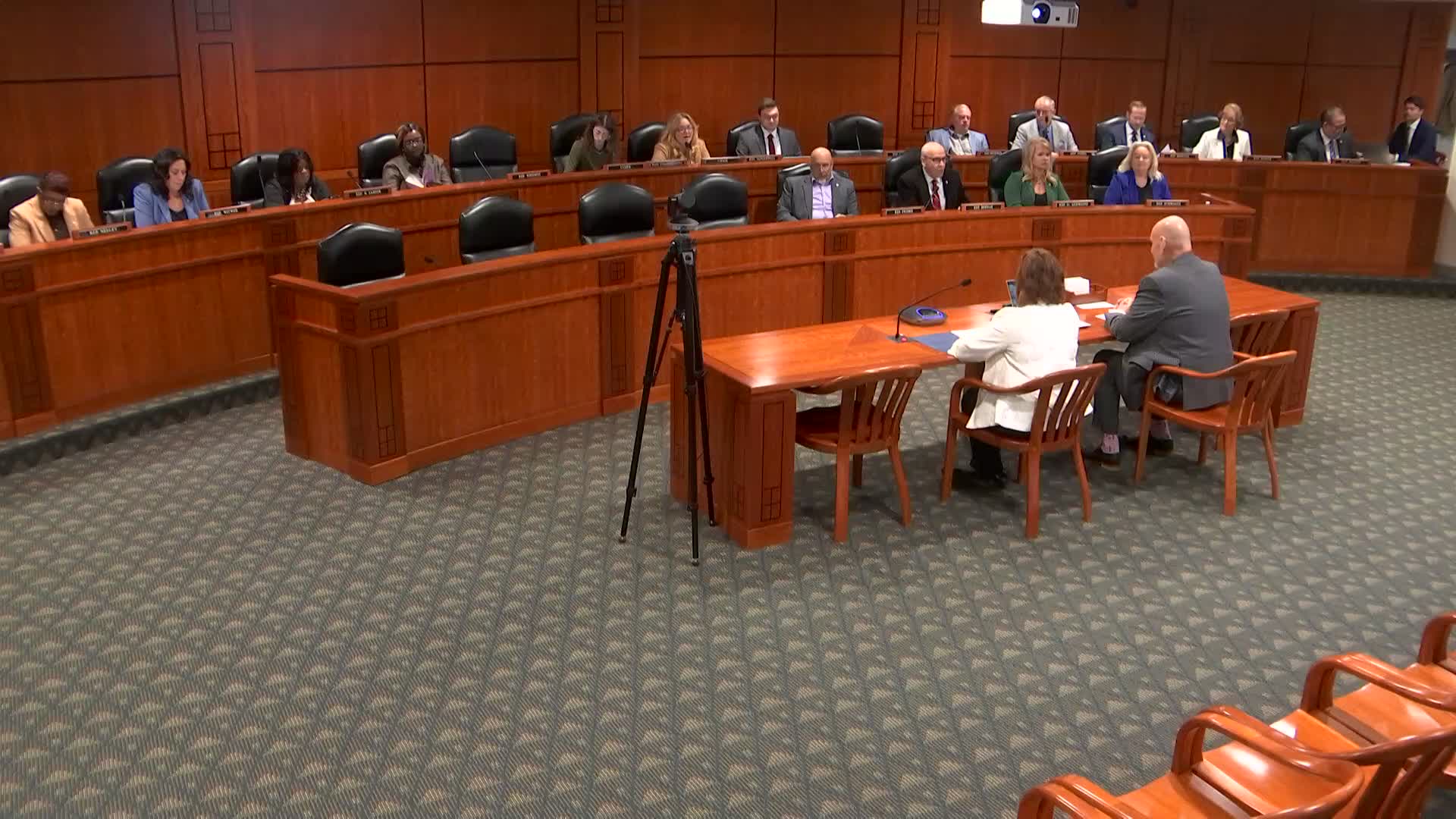
House Health Policy Committee hears testimony on bills to create Michigan Health Data Utility and fund it through insurance assessment
Summary
Representatives Julie Rogers and Chair VanderWaal, MIHAN officials, physicians and family members testified on House Bills 4037 (establish HDU) and 4038 (funding), addressing data sharing, privacy, opt‑in rules and a proposed funding stream of $6M→$7M→$8M.
The House Health Policy Committee heard testimony on House Bills 4037 and 4038, a package to establish a Michigan Health Data Utility and fund it through the Insurance Provider Assessment Act, during a committee meeting where lawmakers asked about privacy, patient control and costs.
Representative Julie Rogers, D-41 of Kalamazoo, told the committee HB 4037 would create a statewide health data utility (HDU) to combine, enhance and exchange electronic health data for treatment, care coordination, quality improvement and public health. Representative Rogers said the bills are reintroductions of legislation that passed the House in the prior term but did not reach a Senate vote. She described a family member’s case in which a medication omission between settings contributed to pressure wounds and urged lawmakers to adopt the HDU to reduce duplicative testing and improve clinical decision-making.
The nut graf: supporters say the HDU would expand existing health information exchange (HIE) infrastructure to include non‑traditional partners such as schools, foster care and community organizations; opponents and some committee members focused questions on who controls access, whether participation is mandatory and how the system will be funded and secured.
MIHAN officials and clinicians described technical, legal and operational safeguards. Kim Batchelder, vice president of state programs for the Michigan Health Information Network (MIHAN), and Dr. Isabelle Pacheco, MIHAN’s chief administrative officer, said MIHAN currently connects hospitals, payers, pharmacies and the Michigan Department of Health and Human Services and that an HDU would build on that work to link additional sites. They described the HDU as vendor‑agnostic “data plumbing” that would not replace electronic medical records (EMRs) but would provide standardized, read‑only clinical feeds (for example ADT notifications and continuity of care documents) to authorized providers.
On funding, Representative VanderWaal, sponsor of the funding bill HB 4038, said the proposal would allocate $6,000,000 in the first fiscal year, $7,000,000 in the second and $8,000,000 in the third year (adjusted thereafter for inflation) from the Insurance Provider Assessment Act. MIHAN testimony said the current HIE is supported by state general funds (with federal match) and participant fees; the HDU funding in HB 4038 would replace the general fund appropriation with a restricted insurance fund and would not increase taxes, testimony said.
Committee members pressed presenters on patient control and data accuracy. Panelists repeatedly said participation for patients is opt‑in at the point of care (through standard HIPAA/treatment, payment and operations forms) and that patients may opt out later; they also said medical providers remain responsible for medication reconciliation and the accuracy of information they transmit. MIHAN officials described access controls such as an Active Care Relationship Service that limits data views to providers with a verified care relationship and said only “trusted data sharing organizations” that sign legal agreements and meet federal and state requirements would receive data.
Security and breach risk drew questions. MIHAN witnesses said data are encrypted in transit and at rest, that MIHAN participates in statewide cybersecurity partnerships, that staff undergo annual training and that MIHAN has no history of a data breach. MIHAN also cited DirectTrust and other certifications and described a “garage‑door” model to halt exchanges if a breach is detected.
Lawmakers also asked how nontraditional partners (for example food banks or transportation services) would receive information. MIHAN and clinicians said the HDU would not transmit full medical records to community partners; instead, with patient consent the system could share limited flags (for example, a referral for food assistance or transportation) and minimal contact data so community partners can connect patients to services.
Clinicians including Dr. Kevin Bosack, executive medical director for population health management and a MIHAN board member, supported the bills and said improved data flow reduces redundant testing, prevents medication errors and helps coordinate transitions of care. A parent, pharmacist Larry Wagenet, described his son’s repeated blood draws and urged passage to avoid “unnecessary pokes.”
No formal committee vote on HB 4037 or HB 4038 occurred during the hearing; the committee took testimony and asked clarifying questions. Several written testimony cards were read into the record supporting the bills from medical and professional associations.
The bills’ sponsors and MIHAN representatives said a competitive procurement process would select the HDU operator and that the HDU would be required to meet high security standards, vendor security frameworks and legal rules governing health data. Committee members signaled further follow‑up questions on definitions (for example, “trusted data sharing organization”), implementation timelines and how small or rural providers would be connected without undue cost.
Supporters said the HDU would create state infrastructure for broad data sharing to improve care coordination and public health reporting; critics and some members sought statutory clarity about who may receive data, notification mechanisms if participation rules change, and whether the funding mechanism ensures long‑term sustainability.
The committee recessed for later business after the testimony concluded.