Get Full Government Meeting Transcripts, Videos, & Alerts Forever!
Get email alerts on the 340B Drug Pricing Program topic
No spam. Unsubscribe anytime.
House committee hears hospital testimony on 340B drug-pricing program as panel reports House Bill 4032
Summary
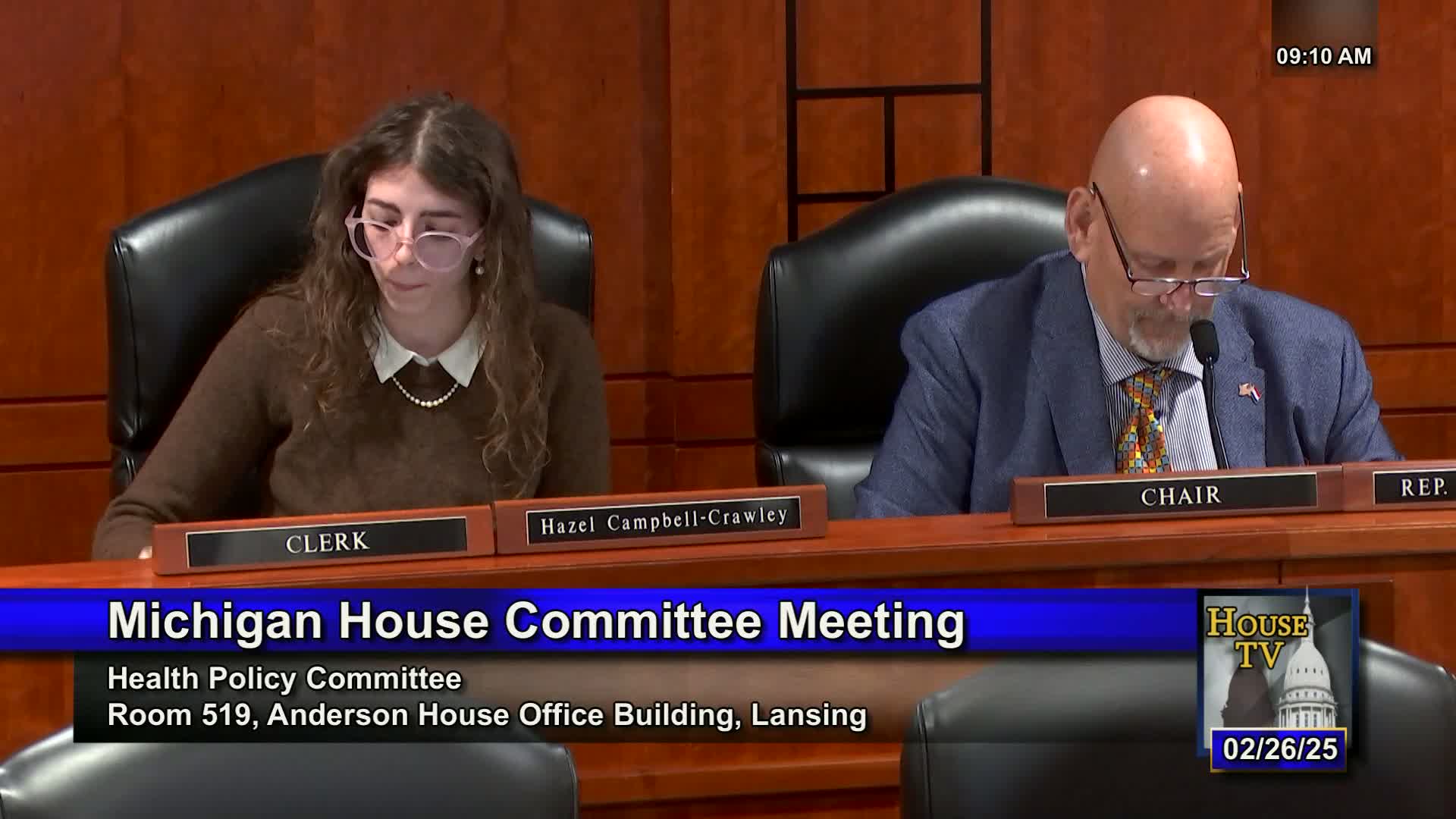
At a meeting of the Michigan House Health Policy Committee, hospital leaders and a pharmaceutical industry representative delivered competing views of the federal 340B drug‑pricing program and its local impact; the committee also voted to report House Bill 4032 with recommendation.
At a meeting of the Michigan House Health Policy Committee, hospital leaders and a pharmaceutical industry representative delivered competing views of the federal 340B drug‑pricing program and its local impact; the committee also voted to report House Bill 4032 with recommendation.
The 340B program "is an essential safety net program that supports access for vulnerable communities and healthcare providers that care for them," Elizabeth Cutter of the Michigan Health & Hospital Association said in testimony. Cutter said 340B is "a non taxpayer funded program" and described it as one way hospitals keep local services such as cancer care, labor and delivery and community‑based programs operating.
Why this matters: Witnesses from multiple hospital systems described services—rural obstetrics, oncology infusion, behavioral health units, charity care and medication assistance—that they said rely on savings from 340B. Pharmaceutical‑industry testimony warned that state measures intended to protect those services can produce other effects, such as higher costs for employers and state purchasers, and raised concerns about the program’s rapid growth, especially in contract pharmacy arrangements.
Hospital testimony
Representatives from McLaren Healthcare and Memorial Healthcare described how they use 340B savings locally. Deidre Wilson, senior vice president of government relations and public policy for McLaren Healthcare, said the system’s covered hospitals use savings "based on local community needs," including support for rural clinics, patient assistance funds and free distribution programs such as Narcan in emergency departments.
Maureen D'Agostino, McLaren’s vice president of accreditation and regulatory programs, said McLaren operates nine hospital organizations that participate in 340B and that the system used program savings to provide 3,870 prescriptions in 2024 through a patient assistance fund that she said contributed about $1,450,000 in locally retained support. D'Agostino also said McLaren saw an estimated $41,000,000 reduction in 340B savings in 2024 because of manufacturer restrictions and an additional $3,900,000 loss in the first quarter of 2025.
Ben Frederick, associate vice president for advocacy and government relations for Memorial Healthcare, described his hospital—an independent community hospital centered in Owosso in Shiawassee County—as the county’s only provider of behavioral health inpatient services and the only local obstetrics unit. Frederick said 340B helped preserve local chemotherapy and infusion services and allowed patients to receive care close to home.
Dr. Joe Monroe, Memorial’s director of pharmacy and 340B compliance lead, outlined the program’s federal compliance requirements, including monthly internal audits, annual external audits that follow Health Resources and Services Administration (HRSA) regulations and the risk of repayment or program dismissal for noncompliance.
Questions from lawmakers
Representative Thompson asked what would happen to the services hospitals fund with 340B savings if manufacturers continued to restrict access to program benefits. Cutter replied that reductions in 340B benefits lead hospitals to cut services such as rural obstetrics, saying, "If we no longer have the benefit, that goes away, unfortunately." McLaren witnesses offered the rural OB program in the Thumb region as an example of a service that could be lost, saying it serves nine counties and that the nearest alternative could be 90 miles away.
Several committee members pressed for data and program history. Witnesses said the program has grown since its 1992 origin, that changes in eligibility (including additions of critical access hospitals and sole community hospitals) expanded participation in 2010, and that program growth has tracked drug‑price increases. McLaren and Memorial emphasized narrow operating margins for hospitals and the compliance burdens required to participate.
Pharma testimony and state‑level cost concerns
Kelly Ryan, deputy vice president for state policy for Pharma (joining by Zoom), said the 340B program was created to help safety‑net providers but has "changed dramatically," becoming a $66 billion program in net discounted purchases and accounting for a large share of spending in certain settings. Ryan highlighted the growth in contract pharmacy relationships—from about 1,700 in 2010 to roughly 212,000 in 2024—and said Minnesota and other state analyses show a portion of gross 340B revenues flow to third‑party administrators and contract pharmacy entities rather than staying with safety‑net providers.
Ryan cited a Minnesota analysis finding third‑party administrators and external parties received about $16 per $100 in gross 340B revenue and an IQVIA analysis that estimated Michigan employers pay an additional $272,000,000 in health costs tied to foregone commercial rebates associated with 340B‑priced prescriptions; she also cited a separate state employee estimate of roughly $34,000,000. Ryan and pharma witnesses urged caution about state legislative fixes that would "lock in" subregulatory practices and warned that some proposed limits on data use could undermine audits and program integrity.
Transparency, audits and contract pharmacies
Hospital witnesses said 340B entities must submit claims data for HRSA auditing and that both internal and external audits are routine parts of compliance. Pharma testimony noted HRSA’s limited audit capacity, saying fewer than 20 HRSA audits of Michigan providers occurred in the last five years (witnesses cited this figure during questioning). Witnesses on both sides emphasized differing concerns: hospitals stressed local community benefits that arise from savings; pharma representatives pointed to evidence that some program growth has been accompanied by expanded use of higher‑priced drugs, reduced biosimilar uptake, and diversion of some 340B value to third parties.
Votes at a glance
- Adoption of minutes for Feb. 19 meeting: Representative Debord moved to adopt the minutes; the motion passed (no roll‑call names recorded for that motion in the transcript). Outcome: approved by unanimous consent (motion prevailed).
- House Bill 4032 (report with recommendation): Representative Schmaltz moved to report House Bill 4032 with recommendation. Roll call recorded 15 ayes, 0 nays, 0 passes. Outcome: reported with recommendation.
Discussion vs. decision
The committee’s substantive exchanges on 340B were testimonial and exploratory; no bill linked to 340B policy was taken or passed in the hearing. The two formal committee actions recorded in the transcript were procedural (adoption of minutes) and a separate bill (House Bill 4032) reported with recommendation. Committee members requested follow‑up briefings and additional data from witnesses.
What’s next
Members and witnesses agreed to return for more detailed follow‑up testimony. Several lawmakers requested written citations and state‑level fiscal analyses referenced by the pharma witness; hospitals said they would provide additional data on community benefit and program impacts.
Sources: oral testimony and question‑and‑answer exchanges recorded at the Michigan House Health Policy Committee hearing (transcript), including witnesses from the Michigan Health & Hospital Association, McLaren Healthcare, Memorial Healthcare, and Pharma.