Get Full Government Meeting Transcripts, Videos, & Alerts Forever!
Get email alerts on the Death Certification topic
No spam. Unsubscribe anytime.
Legislators hear bills to require physicians to certify death records electronically, clarify medical examiner role
Summary
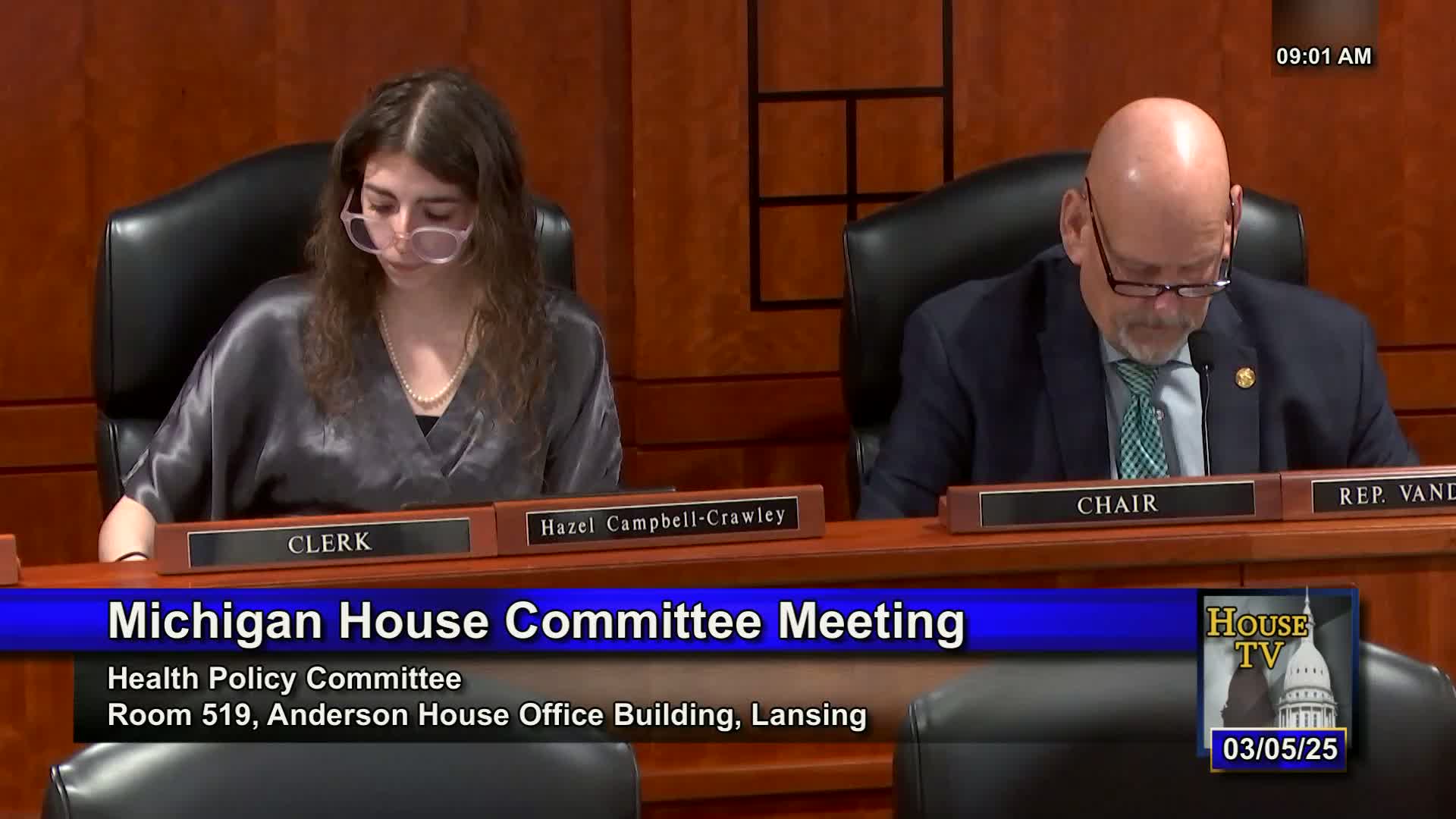
The Michigan House Health Policy Committee on Tuesday heard testimony on House Bills 4077 and 4078, which would require physicians to enter cause-of-death determinations and certify death records in the state's electronic death registration system (EDRS) and clarify when county medical examiners must sign certificates.
The Michigan House Health Policy Committee on Tuesday heard testimony on House Bills 4077 and 4078, which would require physicians to enter cause-of-death determinations and certify death records in the state's electronic death registration system (EDRS) and clarify when county medical examiners must sign certificates.
Supporters told the committee the measures aim to shorten delays that grieving families face when funeral directors and county clerks must wait for physician signatures before burial, cremation or settlement of estates. Representative Will Rogers, sponsor of House Bill 4077, said the bills were developed with the Michigan Department of Health and Human Services and professional groups and are a reintroduction of measures that passed the full House last session.
''''Representative Rogers said the bills would require physicians to enter the cause-of-death determination and certify records directly into EDRS and would replace the existing misdemeanor penalty for not complying with medical certification requirements with medical license sanctions.
Sarah Jensen Vatter, owner and funeral director at Palmer Jensen Bush Funeral Homes, described operational delays funeral homes face when physicians do not use EDRS. She said her firm tracks completion times and that only about a dozen physicians in the Greater Lansing area use EDRS; the rest return hand-signed certificates that funeral staff must re-enter into EDRS, sometimes after a fax delay.
'''''''''''''''''''''''''''''''''''''''''''''''''''''Jared Rozicky, director of government relations for the Michigan Funeral Directors Association, and funeral directors said faster electronic certification reduces duplicate data entry, lowers clerks' workload and shortens wait times that can conflict with religious requirements for timely burial or cremation.
Representative Jeremy Mueller, sponsor of House Bill 4078, said his bill clarifies timing: under current law a physician must complete their portion of a medical certification within 48 hours of being presented; his bill would allow attending physicians who have seen a patient within a year to sign, reducing cases that are routed to medical examiners solely because of timing ambiguity.
Carl W. Hawkins, MD, immediate past president of the Michigan Association of Medical Examiners, told the committee that medical examiners support the bills because examiner offices are currently handling many cases that do not require their investigative resources. Hawkins said medical examiners should focus on nonnatural and unexplained deaths, while attending physicians who know patients are often best positioned to certify natural deaths.
Committee members asked about training and authentication. Sarah Jensen Vatter said training and a revised EDRS are expected from MDHHS; she cited department plans for an updated EDRS (referred to in testimony as EDRS 2) and described the system's login and authentication process for electronic signatures. Committee members also cited statistics shared by witnesses: representatives of funeral directors told the committee that DHHS vital-records staff reported roughly 75% of death certificates over the past five years were not medically certified within the 48-hour statutory window.
No committee vote on House Bills 4077 or 4078 was recorded during the hearing. Committee staff read in statements listing support from DHHS and the Michigan State Medical Society.
Closing: Committee members thanked witnesses and said they would return to further questions with other presenters later in the hearing.