Get Full Government Meeting Transcripts, Videos, & Alerts Forever!
Get email alerts on the Capital Planning topic
No spam. Unsubscribe anytime.
Alpine School District outlines capital priorities, recommends targeted boundary studies
Summary
District staff presented a three‑area capital plan tied to the upcoming reconfiguration, recommended targeted boundary studies and urged the incoming boards to prioritize transportation complexes, auxiliary gyms and satellite classrooms as enrollment shifts.
Alpine School District staff presented a high‑level capital plan on March 25 that breaks the district into three newly created areas — South, Central and West — and recommended immediate study and staged action on transportation facilities, auxiliary gyms, boundary adjustments and short‑term classroom satellites.
Eric Woodhouse, the district’s executive director of operations, told the board the presentation was intended as a “30,000‑foot view” and that staff would provide more detailed estimates if the board asks for deeper study. “We identify critical capital needs throughout each newly created district — one that we can potentially act on now, but two that we need to study further,” Woodhouse said.
Staff said the South District projection (29 schools) would serve roughly 23,683 students and listed immediate needs including a district office, a transportation complex (estimated 12–15 acres with four bays and space for about 72 buses) and consideration for specialized schools such as Polaris or Summit. Woodhouse told the board that auxiliary gym space is a key constraint if ninth graders are moved up into high schools: “If you have the ninth graders in there, you really need the third auxiliary gym,” he said, noting the board’s 2020 bond included gym construction that was not completed.
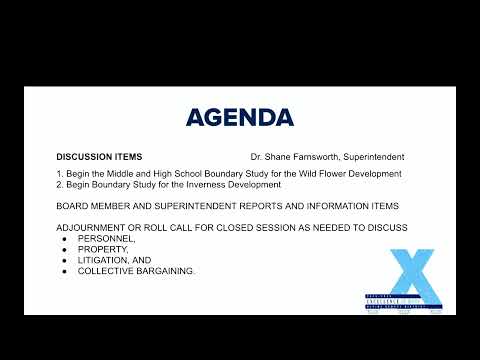
The Central District presentation covered 37 schools and an anticipated 34,468 students, with a similar list of assets and needs (district office, facilities/warehouse and sites such as Cold Springs identified as possible new school builds). Woodhouse recommended opening a boundary study for the Inverness development now, because the area is not yet occupied and an early study would avoid the emotional complexity of relocating already set‑in residents.
For the West District (about 24 schools and roughly 24,503 students in staff presentation), staff recommended breaking ground quickly on planned projects at Mount Saratoga and Saratoga High School and evaluating satellites — temporary classroom modules — to relieve near‑term enrollment growth until permanent brick‑and‑mortar buildings can be built.
Woodhouse and other operations staff provided prototype cost references during discussion: two auxiliary gyms were described in the meeting as roughly "5 and a half million" dollars each; Woodhouse said two gyms would be on the order of about $10–11 million combined. He emphasized that final price estimates depend on site selection and whether the district reuses existing buildings or builds new facilities.
Board members pressed staff about operational tradeoffs. Board member Mark asked whether consolidations could be delayed until auxiliary gyms are built; Woodhouse and other staff said campuses could probably “limp along” for a few years but that athletic scheduling and program needs would be more constrained without additional gym space. Staff also stressed that shifting ninth grade into high schools reverberates through feeder junior highs and elementary boundaries and that any change will require coordinated boundary work.
Woodhouse recommended specific next steps: a deeper elementary and secondary boundary study in affected neighborhoods (including the Wildflower/Black Ridge area and Inverness/Micron area), an infrastructure study for a transportation/facilities complex, and development of more detailed cost estimates to present to the incoming school boards. He also proposed a public timeline: start boundary work this fall to allow adjustments in time for the 2026–27 school year where feasible.
The presentation included a range of operational details used by staff to model options (school counts by area, projected enrollment declines in some older neighborhoods, and alternatives such as converting junior highs to middle schools if the board wishes). Woodhouse told the board staff will make slide decks and underlying analysis available to the public and to new board members for follow‑up.
Less urgent items that staff flagged for future study included the location of district offices, the fate of certain leased properties, and satellite classrooms as a stopgap when construction lead times require interim capacity.
Board members expressed support for giving new board members material in advance and for starting some studies before the new governance begins. Superintendent Shane Farnsworth said staff would respond to clarifying questions and produce cost and phasing options if the board asks.
For now, staff recommended beginning formal boundary studies for the Wildflower/Black Ridge area and the Inverness area (near Micron) because those areas are experiencing or are expected to experience rapid build‑out and boundary changes done earlier will be less disruptive to students.
The report did not enact any policy changes; Woodhouse said final decisions on closures, boundary lines or construction timelines would come back to the board or to the successor boards during the reconfiguration process.