Get Full Government Meeting Transcripts, Videos, & Alerts Forever!
Get email alerts on the Public Transit topic
No spam. Unsubscribe anytime.
Grant Transit Authority outlines service area, ridership and zero‑emission plan
Summary
Grant Transit Authority General Manager Eric Loomis presented an overview of GTA operations to Moses Lake council, including ridership, budget sources, facility upgrades and a fleet transition plan that considers battery electric and hydrogen vehicles.
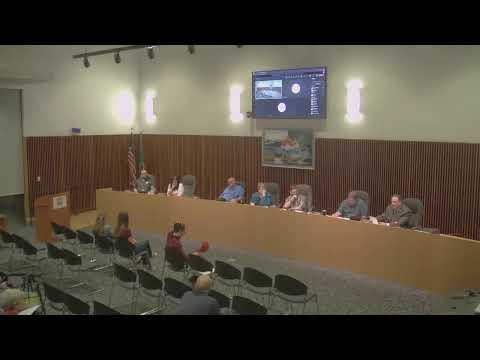
Eric Loomis, general manager of the Grant Transit Authority, told the Moses Lake City Council that GTA serves roughly 2,700 square miles of Grant County and that moving people is “a critical type of infrastructure.”
Loomis said the authority’s service area covers about 100,000 residents and nearly 40,000 jobs. He gave a year‑over‑view of 2024 ridership and operational figures, saying GTA provided more than 37,000 fixed‑route rides, about 5,000 rides on rural demand services, and roughly 35,000 Americans with Disabilities Act (ADA) trips through a contract with People For People.
The presentation outlined GTA’s history and operations. Loomis said the system began as a 1995 demonstration project and became a Public Transportation Benefit Area (PTBA) after a 1996 vote. GTA now has a 10‑member board that includes “Councilman Myers” representing Moses Lake and other elected officials from the county. The agency brought fixed‑route operations in‑house in 2013 after opening a maintenance facility near the airport in 2011, and opened a multimodal transit center in Moses Lake in 2017.
Why it matters: most GTA routes originate in or connect to Moses Lake, so changes to fleet, schedules or facilities affect local riders, employers and pedestrian/highway planning.
Loomis reviewed capital and operating finance. He said the PTBA sales tax (0.2 percent) remains unchanged since 1996, provides roughly 67 percent of operating revenue and allows GTA to leverage federal and state grants. He reported operating revenue “just over $12,000,000” for 2025 and said annual capital spending varies with grant awards and projects.
On fleet and facilities, Loomis described a 2023 system analysis and a zero‑emission vehicle transition plan that models battery electric buses for shorter, Moses Lake–based routes and hydrogen for longer rural runs through 2035. He said GTA has added four battery electric buses and is upgrading its maintenance facility — with walls recently erected and charging infrastructure planned — with a completion target in October. Loomis gave cost ranges discussed in the study: “a clean diesel bus is about $600,000 to $700,000, whereas a hydrogen bus is about $1,200,000 to $1.5 [million],” noting higher upfront hydrogen costs but possible lifecycle benefits.
Loomis also described rider‑facing technology and safety efforts: live bus tracking on GTA’s website and mobile app, driver‑safety and vehicle monitoring software for the rideshare program that alerts staff to seat‑belt use, harsh braking and speed and helps schedule preventative maintenance. He said the rideshare program logged 21,336 passenger trips and about 165,000 miles in 2024.
Loomis closed by asking for stronger communication and partnership with Moses Lake city staff and the council to align stops, crosswalks and passenger amenities with transit service changes. “I don’t like to be on the cutting edge and bleeding edge” of vehicle technology, he said, adding that GTA plans to learn from other agencies before wider hydrogen deployment.
Loomis took questions from council members after the presentation; council members and staff discussed potential coordination on stops and amenities but no formal city action was requested at the meeting.
The presentation provides the council with a finance and planning snapshot that the city can reference when considering land use, pedestrian safety and future capital requests related to transit services.