Get Full Government Meeting Transcripts, Videos, & Alerts Forever!
Get email alerts on the Elections Voting topic
No spam. Unsubscribe anytime.
Georgia senators debate bill to require hand‑marked paper ballots as election officials and voters raise cost, access and audit questions
Summary
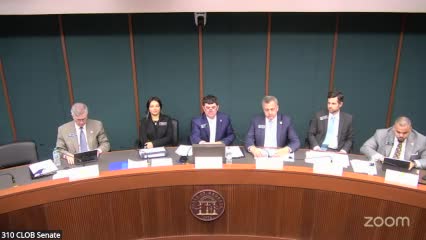
A Georgia Senate committee on Tuesday heard hours of questions and public comment on Senate Bill 214 (LC 473679S), a proposal to require hand‑marked paper ballots statewide, combined with ballot‑on‑demand printers and optical scanners.
A Georgia Senate committee on Tuesday heard hours of questions and public comment on Senate Bill 214 (LC 473679S), a proposal to require hand‑marked paper ballots statewide, combined with ballot‑on‑demand printers and optical scanners.
The sponsor, Sen. Barnes, told the panel the bill “requires that all votes are cast on a hand marked paper ballot, and that that paper ballot is then optically scanned and tabulated.” He said the bill would replace electronic ballot‑marking devices (BMDs) with a print‑on‑demand approach that gives each voter a human‑readable ballot to mark by hand and then scan for tabulation.
The bill would, according to its text and the sponsor’s presentation, (1) mandate hand‑marked paper ballots that are optically scanned and imaged; (2) authorize the secretary of state to run pilot programs; and (3) require that each polling place be equipped with at least one electronic ballot marker to accommodate voters with disabilities. “The secretary of state is authorized to conduct pilot programs,” the sponsor said, and the measure also contemplates state provision of uniform optical scanning and ballot‑on‑demand printing systems.
Why it matters: supporters and some election officials said a hand‑marked paper ballot is the most auditable physical record of voter intent; opponents and several county election officials warned the committee there is no fiscal note yet, that procurement and certification would be complex, and that accessibility and rural‑precinct logistics need clearer answers before a rollout.
What proponents said
Speakers who urged the committee to adopt a hand‑marked paper‑ballot standard said it would improve auditability and voter confidence. Brad Carver of the Georgia Republican Party told the committee a hand‑marked ballot is “an authoritative physical record that blends efficiency with security,” and noted that “over two‑thirds of the U.S. states use hand marked paper ballots.” Several public commenters, including poll workers and county GOP officials, said voters must be able to visually verify what they marked.
What election officials and other critics said
County and state election officials and voting‑rights advocates cautioned against rushing an implementation without a fiscal note and a procurement timeline. Joseph Kirk, an election supervisor and president‑elect of the Georgia Association of Voter Registration and Election Officials (GAVRIO), said the proposed system is “a viable option,” but stressed that “a change of magnitude is complicated” and that officials need time for training and testing.
Multiple speakers raised cost estimates and equipment questions. The sponsor said per‑printer estimates he had heard ranged from “as low as a thousand to upwards of $7,000 per unit,” and witnesses pointed to higher real‑world prices: advocates cited examples in which counties spent thousands to tens of thousands of dollars per printer model to avoid failures. The committee heard an inventory figure of approximately 2,696 precincts statewide; speakers said per‑precinct procurement multiplies into tens of millions of dollars even under conservative scenarios.
Accessibility, custody and verification
Committee members pressed the sponsor on how the bill would preserve access for voters with disabilities and how a voter can be sure the candidate they selected was counted. The bill retains an explicit accommodation: the text requires “at least one electronic ballot marker” at each polling place for voters with disabilities. Sen. Jackson asked whether the new printers would provide ballots in Braille; the sponsor responded that voters needing special accommodations would use an alternative voting method and that federal accessibility requirements would continue to apply.
On verification, the sponsor emphasized that voters would see their selections on a paper ballot before scanning it and that tabulation would rely on an optical image and retained paper ballots to enable post‑election audits and hand counts. “You physically see your selections on the ballot,” the sponsor said. Several members, however, said voters often want assurance after scanning that the scanner recorded the same candidate and asked how that confirmation would be provided operationally.
Procurement, certification and timing
The measure says the state shall furnish a uniform optical scanning and ballot‑on‑demand printing system and authorizes the secretary of state to pilot systems, but the committee did not yet have a fiscal note. Committee members repeatedly requested a cost analysis before moving the bill forward; the sponsor said a fiscal note is needed and that, if passed, the bill would not be eligible for final consideration until the next legislative session in 2026, giving time for study.
Public comment: divided views
Public testimony spanned hours. Supporters — including county GOP chairs, poll workers and grassroots groups favoring hand‑marked ballots — argued the change would enhance security and public trust. Opponents, including voting rights groups and some election‑administration professionals, warned that an immediate mandate could break the state’s current vendor contract and impose high, immediate costs on counties; they urged a slower, evidence‑driven transition and a full fiscal note.
Committee process and next steps
Committee members asked the sponsor to continue refining draft language and to work with colleagues overnight on clarifications for accessibility, ballot‑tampering penalties and procurement language. A committee member urged colleagues to provide amendments and suggested the bill could return for further consideration. No formal committee vote or final action on SB 214 was recorded in the hearing.
Ending note
Throughout the hearing, speakers repeatedly returned to three themes: (1) hand‑marked ballots provide a human‑readable record and enhance auditability; (2) the state and counties need clearer, vetted cost estimates and procurement timelines before a mandate; and (3) any change must preserve access for voters with disabilities and protect chain‑of‑custody procedures in small and rural precincts. The committee recessed with instructions to continue drafting and a plan to reconvene.