Get Full Government Meeting Transcripts, Videos, & Alerts Forever!
Get email alerts on the K12 Education topic
No spam. Unsubscribe anytime.
State superintendent describes K–12 strategic goals, teacher pay gains and initiatives to boost literacy and restore classroom focus
Summary
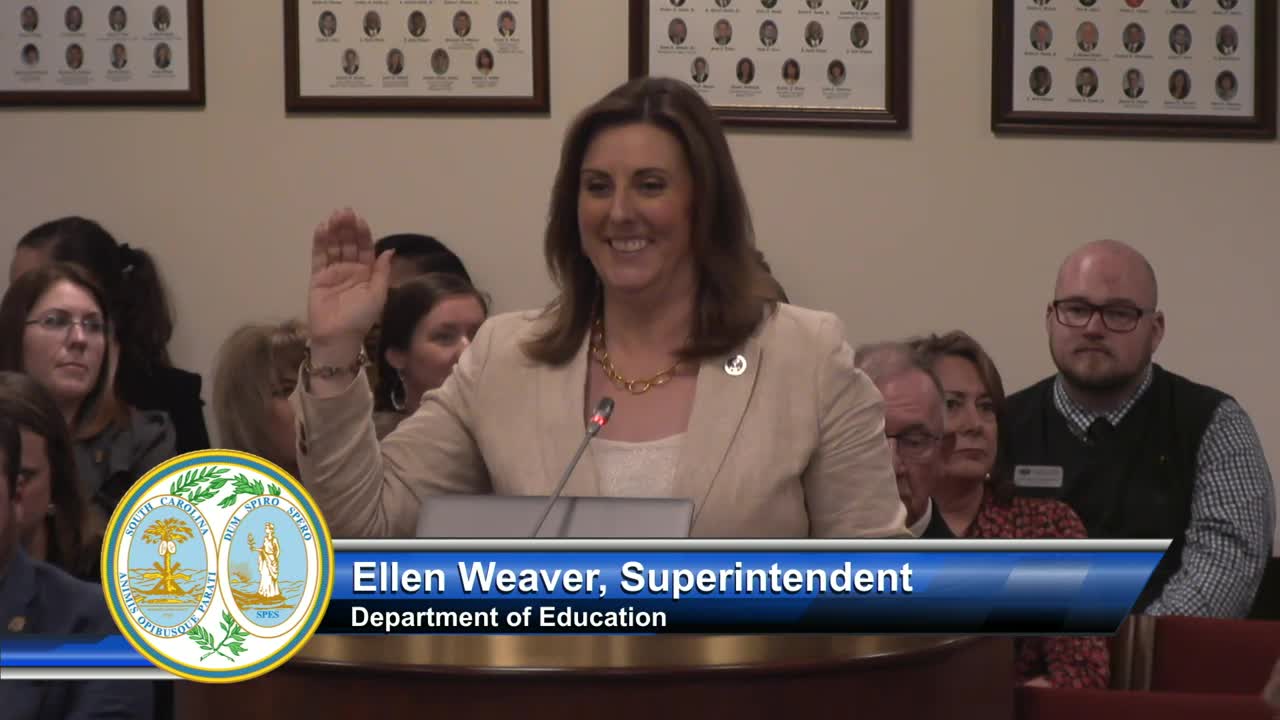
State Superintendent Ellen Weaver told the oversight committee the Department of Education is focused on early literacy, teacher recruitment and a 2030 goal that at least 75% of students perform at or above grade level.
State Superintendent Ellen Weaver briefed the House Government Efficiency and Legislative Oversight Committee on the Department of Education’s strategic priorities, funding trends and recent initiatives intended to improve student outcomes.
Weaver said the department’s vision is that by 2030 at least 75% of students perform at or above grade level; the agency’s three-year objectives include strengthening foundational skills (particularly early-grade literacy), recruiting and retaining excellent teachers, and aligning internal resources to put more funding into classrooms. She highlighted a multi-year state investment of roughly $1.6 billion beginning in 2018–19 that she said has increased teacher pay by about 47% and is intended to improve recruitment and retention.
Weaver described initiatives the department is promoting: a statewide uniform process (Reg. 43-170) for appeals related to local school library materials that the State Board of Education adopted after the APA process; a newly implemented statewide cell-phone policy (fully implemented in January) that Weaver said has produced overwhelmingly positive teacher feedback and, anecdotally, improved lunchroom interactions and classroom disruption; and work to create career pathways for teachers so they can progress without accruing debt.
She shared a case study of Pinecrest Elementary (Greenwood) — a majority-minority, high-poverty school that posted large year-over-year gains and now ranks high on state measures — to illustrate how aligned district and state supports can produce results. Committee members asked about federal-level changes to the U.S. Department of Education and contingency planning; Weaver said federal statutory protections for Title I and IDEA remain in law and emphasized coordination with nominated federal leaders and state superintendents to minimize disruption if Washington adjusts agency structure.
Members also asked about truancy, mentoring and e-learning. Weaver said the department is implementing community and business partnerships to increase mentoring, and that the cell-phone policy is designed to reduce classroom disruption. She acknowledged mixed evidence on e-learning’s effectiveness and said the department is open to tightening policies around remote instruction if data show loss of instructional time. Weaver offered to work with the committee and provide additional materials and slides on request.