Get Full Government Meeting Transcripts, Videos, & Alerts Forever!
Get email alerts on the Fees Building Planning topic
No spam. Unsubscribe anytime.
Corte Madera planners review proposed building and planning fee overhaul with incentives for electrification and affordable housing
Summary
The Corte Madera Planning Commission held a study session March 25 to review a consultant study recommending a comprehensive update of the town's building and planning fee schedules and several targeted discounts.
The Corte Madera Planning Commission held a study session March 25 to review a consultant study recommending a comprehensive update of the town's building and planning fee schedules and several targeted discounts.
The item matters because fees last updated in 2015 no longer match staff costs, the consultant said, and the town is deciding how much of those costs to recover from permit applicants versus general revenues. Staff and the consultant recommended moving many building fees toward full cost recovery while keeping or adding targeted subsidies for policy goals including residential electrification, accessibility work for seniors and veterans, and affordable housing.
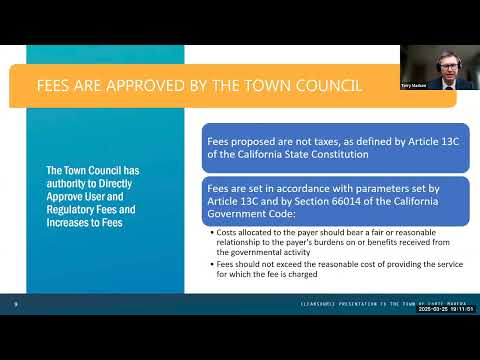
Terry Madsen, the ClearSource consultant leading the study, told the commission the review focuses on service-based fees such as permitting, plan review and inspection rather than impact fees, utilities or taxes. “Because these are fees and not taxes, we want to make sure we comply with California Constitution and California Government Code,” Madsen said, describing the legal principle that fees should reflect the cost of service and not exceed it. The consultant’s estimate of the fiscal effect of the draft schedule was an additional roughly $660,000 in potential building fee cost recovery and about $70,000 in additional planning revenue if the town targets higher cost recovery levels while keeping proposed targeted discounts.
Staff outlined several specific proposals in the draft schedule. On the building side, the study recommends restructuring fees so common minor permits use fixed fees and larger projects scale by size/complexity. The draft proposes targeted discounts: a 50% cost-recovery target for residential electrification work such as heat-pump HVAC and electric water heaters, and roughly 75% cost recovery for rooftop solar installations. The consultant and staff said any decision to accept less-than-full cost recovery would shift the under-recovered amount onto the town’s general fund.
Planning work would continue to use time-and-materials billing for many entitlement processes, but the study recommends increasing initial deposits and adjusting hourly billing rates to reflect actual cost of service. Staff and the consultant said those rate changes aim to improve cost recovery for planning deposits and better signal to applicants when additional funds will be needed.
The draft includes several new or adjusted line items. Staff proposed a new ‘‘long-range planning’’ fee to help offset periodic costs such as general-plan or housing-element updates, and a ‘‘technology enhancement’’ fee to help fund periodic land-management and permitting-system upgrades. The draft also proposes raising the administrative appeal filing fee from $300 to $1,000; Madsen said a typical appeal generates about $3,000 of staff time, and a $1,000 filing fee would still represent less-than-full cost recovery.
Commissioners pressed staff on enforcement and penalty-related fees. Bernie Cappay, the town’s building official, said the current investigative/enforcement practice allows staff to double the permit fee for work performed without a permit and that an administrative-citation fee is currently $100 per instance. Cappay also noted the proposed permit-extension fee would rise from $29 to $80 and that code-enforcement penalties and citation authorities are on staff’s work plan for a separate, more focused update.
Several commissioners and members of the public raised concerns about access and equity. Commissioners asked staff for clearer public explanations of how fee revenues and subsidies would be tracked and used, and asked for options to reduce the burden on low-income or senior residents in specific cases. Staff said the budget process already reports fee revenue in the town’s midyear and annual budgets and offered to prepare a plain-language FAQ or web summary for the development community and residents.
Public comment highlighted concerns about aggregate cost changes, variability in valuation-based fees, and the practical effect of higher fees on homeowners and neighbors. One speaker urged more ‘‘carrots and less sticks’’ to encourage permitting and quicker project completion; staff and the consultant responded that the study focuses on cost recovery for services the town already provides and that some minor permit fees are proposed to decrease while larger-project permit fees would more closely reflect service effort.
No formal action was taken at the session. Staff advised the commission of the next steps: the study is scheduled for a town-council study session on April 1, a public hearing before the council on April 15, and — if adopted — fees would take effect no sooner than 60 days after adoption (staff has proposed July 1 to align with the fiscal year). Staff and the consultant requested feedback on the proposed discounts (electrification, affordability, disability access) and on appeal and enforcement fee levels prior to the council hearings.
Commissioners said they would provide feedback to staff and noted a range of opinions: some supported a higher appeal filing fee to reduce frivolous appeals and reflect staff cost, while others said a $1,000 filing fee could restrict access to appeal rights. Commissioners also asked staff to consider annual inflation indexing of fees (the draft includes a column identifying which fees could be candidates for yearly inflationary adjustments) so that the town might avoid long periods with no changes followed by large catch-up adjustments.
The study session closed with staff and the consultant thanking the commission and the public; staff said they will refine the schedule and release the current-vs.-proposed fee comparison and other supporting materials before the council meetings.