Subcommittee adopts rule to license kin caregivers, enabling federal funds for board payments
Loading...
Summary
The Health and Health Care Industry Subcommittee approved regulation 5296 to create a kinship licensure pathway so relatives or other caregivers with an established relationship to a child in foster care can receive state-regulated board payments and allow South Carolina to draw down federal funds after a September 2023 federal rule change.
Connolly Ann Ragley, chief external affairs director at the South Carolina Department of Social Services, told the Health and Health Care Industry Subcommittee that regulation 5296 would update state rules to match a federal rule change from September 2023 and create a separate pathway to license kinship caregivers for children in foster care.
The measure, “Approval of Kinship Family Foster Homes and Kinship Adoptive Homes,” would allow relatives and others with an established relationship to a child — including grandparents, aunts, uncles or “fictive kin” such as teachers or coaches — to obtain licensure so they could receive monthly board payments. Ragley said the change would let the state draw down additional federal funds to help pay caregivers. “This regulation is looking to update based on the changes that were made at the federal government in September of 20 23 … to make less burdensome regulation on kinship placements for children that are in the foster care system,” Ragley said.
The department estimated an implementation cost in the regulatory-fiscal analysis of about $3,900,000 based on roughly 520 children currently placed in unlicensed kinship homes. Ragley explained the estimate assumes all eligible children participate and noted the state would need to invest some dollars to draw down federal funds at about a 2-to-1 match rate. She said board payments are set by the General Assembly via proviso and vary by age band; a back-of-envelope example discussed in the hearing put a likely net payment to caregivers of roughly $600–$700 per month in the example used by members.
Representative Reese pressed the department on the adequacy of the payment for caregivers on fixed incomes, saying, “It seems to me if it's only $700 that's still not enough money for for someone on a fixed income and your example of 83 to raise a kid for $700.” Ragley replied that federal funds would offset some administrative costs and that the General Assembly sets the actual monthly board rate annually via proviso.
Ragley emphasized that kinship placements would still require the licensing steps: FBI fingerprint background checks, home inspections and licensing administered by the DSS licensing unit. “We're still going to be licensing them … it's essentially creating a separate pathway for licensure,” she said, responding to a committee member’s concern that the program might become uncontrolled.
Committee members also asked about retroactivity and timing. Ragley said the new payments would not be retroactive except in limited judicial-ordered circumstances: if a judge’s order dated earlier than placement were later entered, payments could be adjusted back to the court-ordered date, but otherwise payments begin once licensing and placement are completed. She also said that once the payment process is established, payments can start quickly, with DSS using random moment-in-time studies and regular checks to initiate payments as placements occur.
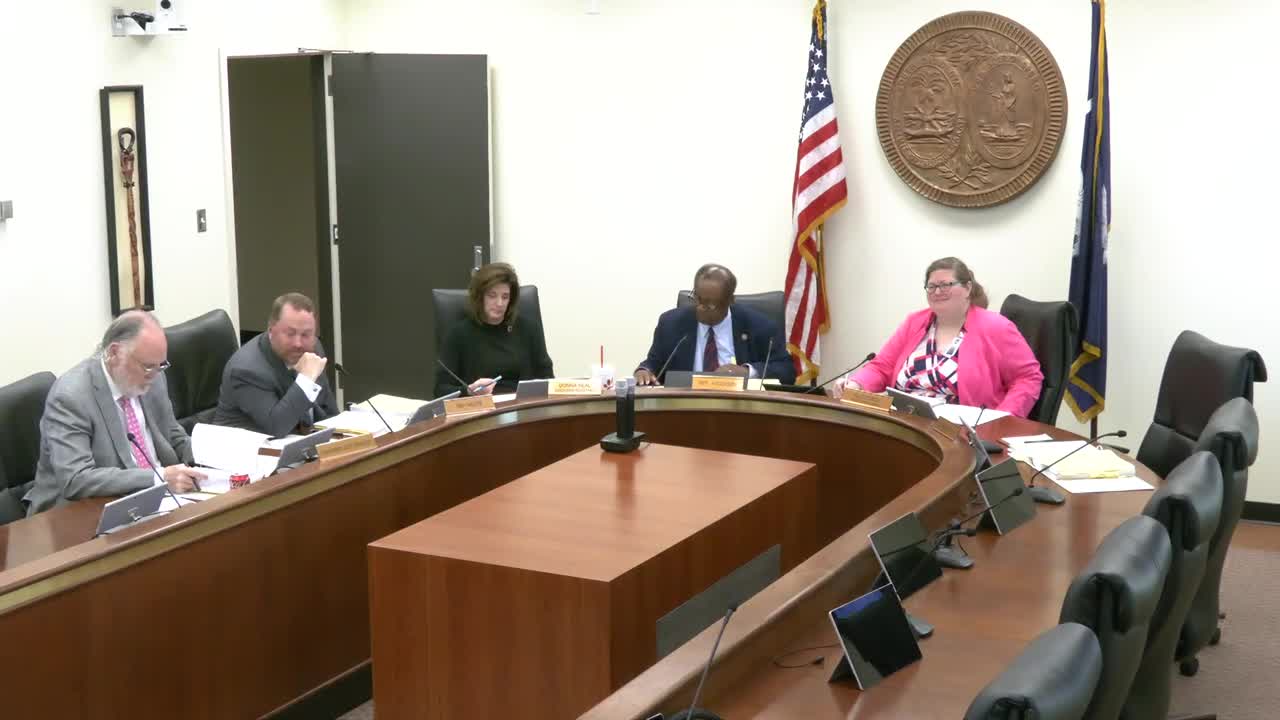
After questions from several members, a motion to adopt document 5296 passed by voice vote. The chair called for the ayes and declared, “The ayes have it and so is ordered.”
The regulation corresponds with pending legislation (S.415) noted by the presenter and with federal guidance; Ragley said South Carolina is among the first group of states to move on this federal change and one of the earlier southern states to do so.
Votes at the hearing on this item were voice votes; no roll-call tally was recorded in the transcript.
The committee adopted 5296 and ordered it as described; the department indicated implementation will require state appropriation action to provide the matching funds and to fund any additional staffing for licensing and administration.