Get Full Government Meeting Transcripts, Videos, & Alerts Forever!
Get email alerts on the Resilience topic
No spam. Unsubscribe anytime.
Office of Resilience seeks $117 million for mitigation, buyouts and systems; agencies describe coordinated conservation strategy
Summary
Director Ben Duncan outlined accomplishments and a multi‑part $117 million request to replenish disaster reserves, fund mitigation/stormwater projects, create a system of record and coordinate watershed work. Forestry and DNR officials described interagency collaboration on a 62,000‑acre conservation project supported by federal grants.
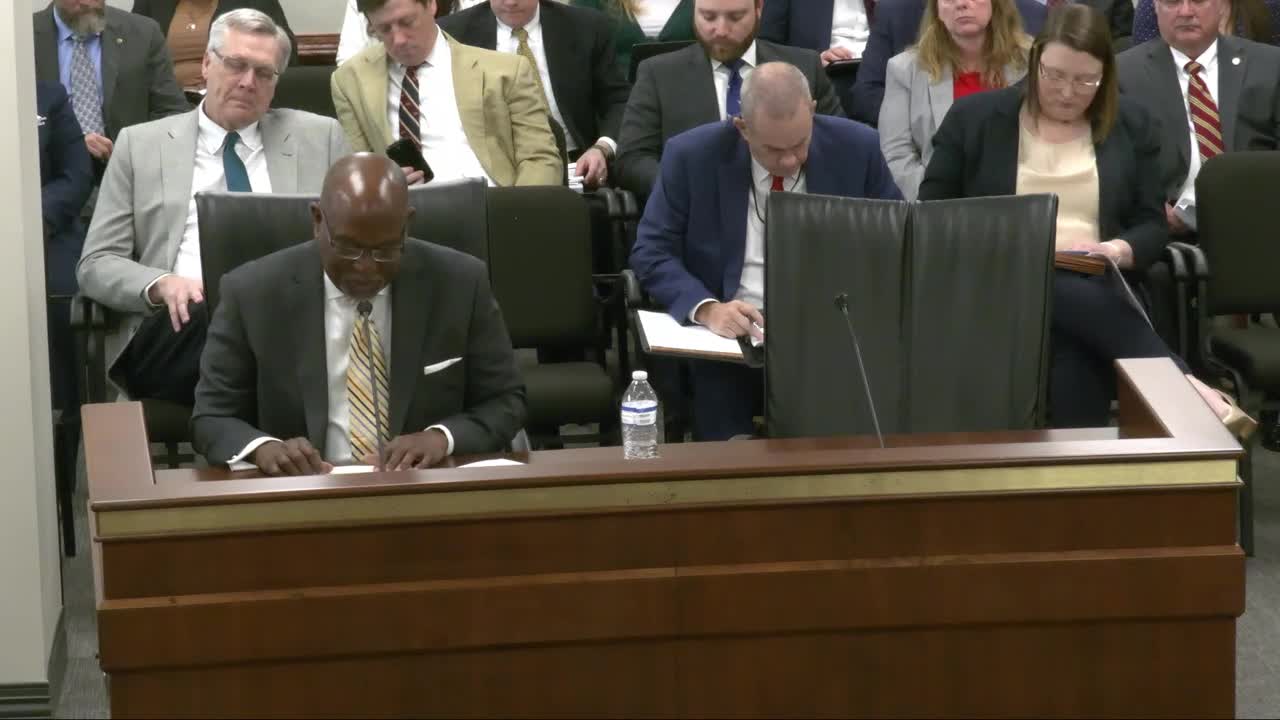
Ben Duncan, director and chief resilience officer at the Office of Resilience, told the Finance Committee and Natural Resources and Economic Development Subcommittee that the office is not seeking recurring general‑fund dollars but is requesting $117,000,000 in targeted, mostly one‑time funding to respond to recent storms and to expand mitigation and planning work across watersheds.
Duncan said the Office updated the statewide resilience plan in February 2024 and launched an online Resilience Atlas to let local governments and citizens visualize vulnerabilities. The office also completed a data coordination study with SAS to reduce duplicate data purchases across agencies, he said.
On disaster recovery and mitigation accomplishments, Duncan told the committee that the office has repaired or replaced 3,459 homes across multiple storms at a cumulative cost of about $293,000,000 and that it is managing 44 stormwater infrastructure projects and six buyout programs covering 90 homes. He said the office closed out the Hurricane Matthew grant and completed construction phases tied to Hurricane Florence and other events, and that HUD reviews of the office’s CDBG‑DR implementation yielded no audit findings.
Duncan presented a $117,000,000 package, described on the record as: $43,000,000 to replenish a reserve balance drawn down after Hurricane Helene, $68,000,000 for mitigation (stormwater infrastructure, planning/studies, voluntary buyouts and related projects including the MUSC walkway), $1,200,000 for a customized system of record to track incoming funds and project data, $5,000,000 for resilience planning and watershed coordination (eight watersheds at about $500,000 each), and $4,000,000 for additional data collection and flood‑modeling research. He said the Office had a recent EPA‑region multi‑state grant program with $421,000,000 across participating states and that South Carolina’s portion could include up to $50,000,000 for conservation purchases plus later Nature Conservancy funds.
Duncan flagged the scale of recent individual assistance demand: prior storms generated about 170,000 applicants collectively; he said individual assistance applicants for Hurricane Helene reached 443,000 and that the state received roughly $150,000,000 for home repair/replacement and mitigation for that storm. He warned that the available funds may not cover all needs and said the requested replenishment is intended to maximize recovery reach.
Forestry Commission and Department of Natural Resources officials described how agencies coordinate large land‑conservation and mitigation efforts. The Forestry Commission representative said a recent 62,000‑acre project across Georgetown, Marion and Williamsburg counties (referred to in testimony as the "PD initiative") secured a $50,000,000 federal Forest Legacy grant but required a $16,700,000 state match; the representative said Office of Resilience funds supplied the match and that the Joint Bond Review Committee (JBRC) approved the project that morning. The Commission noted that more than 30,000 acres of that project are wetlands and that working forests contribute to water quality and flood mitigation.
DNR Deputy Director Ken Rentiers testified that the agencies meet regularly — through a conservation agencies roundtable and other forums — to avoid duplication, leverage federal and private funds, and coordinate which agency is best suited to acquire or manage a given parcel. Rentiers said DNR and partner agencies have executed large acquisitions (Tiger Oaks, Snows Island referenced in testimony) and that interagency coordination extends to grant writing, local match strategies and non‑profit partnerships such as Open Space Institute.
Senators asked whether state agencies are prepared to absorb functions or funding streams if federal programs change; Duncan and DNR staff said they could prepare plans and that DNR has teams experienced in FEMA‑funded flood mitigation and related programs, though additional staffing or resources could be required if responsibilities expand.
The committee did not take formal votes on the Office of Resilience requests during the hearing; members thanked presenters and said they would consider the requests through the budget process.