Get Full Government Meeting Transcripts, Videos, & Alerts Forever!
Get email alerts on the Aeronautics Funding topic
No spam. Unsubscribe anytime.
Aeronautics Commission requests $100 million recurring capital; warns proposed airline property tax change would cut revenue
Summary
Aeronautics Commission Director Siegfried told the Senate subcommittee the commission requests $100 million recurring for statewide airport capital and an additional $300,000 in recurring operating support (the difference between a $400,000 request and $100,000 previously allocated).
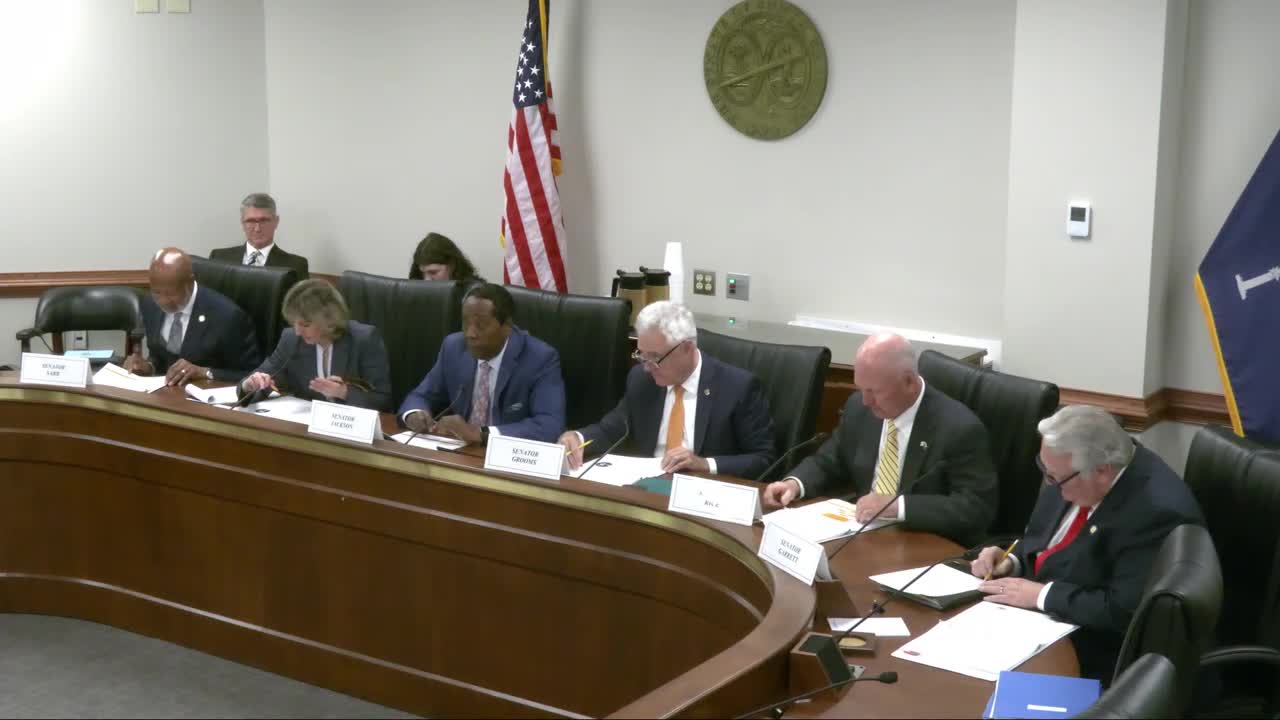
Aeronautics Commission Director Siegfried told the Senate Finance Committee’s Transportation Regulatory Subcommittee the commission is seeking transformative recurring capital funding and an increase in operating support, and he urged careful study of a bill that would change airline property taxation.
Priority funding request: "Priority 1, capital investing for statewide airport system, a hundred million dollars recurring funding for statewide airport development," Siegfried said. He asked the subcommittee to consider recurring capital that airports could count on year over year to plan projects, and suggested the funding could enable new programs (hangar construction, fuel farm development) to help small airports become more self-sufficient.
Budget context and current grant activity: Siegfried told senators the commission set records last year for both grants requested and grants issued, with 60 state grants totaling about $33.2 million and the Federal Aviation Administration adding roughly $70.7 million in federal grants to state airports. He said the commission’s normal revenue stream is modest (about $13 million) and that state grant awards last year totaled about $15.6 million with a projection of roughly $15.9 million this year. Siegfried warned that construction inflation — noting asphalt prices up about 100% over two years — and fewer bidders for airport paving projects are stretching the commission’s available dollars.
Airline property tax analysis: Siegfried described a proposed bill (he referenced prior House Bill 5310 and current discussions around Senate Bill 436) that would alter airline property taxation to encourage overnighting aircraft. He said an economic-impact estimate for the bill last year projected a $5.44 million reduction in airline property tax revenue and a 42% reduction in overall commission revenue in that analysis. To illustrate scale, he presented per-passenger estimates based on state Department of Revenue assessments and seat-load data: for the five largest carriers he analyzed the airline property tax equates to about $0.77 per round-trip passenger; expanding to the top 10 carriers raises the estimate to about $1.52 per round trip. Siegfried argued those per-passenger amounts are small relative to existing fees and taxes on tickets, and he urged preliminary planning if lawmakers pursue the tax change.
Operating request: Siegfried also asked for an increase in the Aeronautics Commission’s general fund appropriation. He said the commission had requested $400,000 but was allocated $100,000; he is requesting the remaining $300,000 difference to cover inflation, employee compensation (pilots and mechanics), and facility upkeep.
Questions and follow-up: Senators asked for clarification on how airline property tax is assessed (time in air versus time on ground) and asked the director to provide clarifying formulas and projections. Siegfried agreed to supply additional information to the committee. The director noted that the House Ways and Means package included several airport-related allocations (he cited $5.35 million recurring, $5 million nonrecurring, and $80 million in Commerce-directed airport funding) and said he would track distribution if the Senate approves similar amounts.
Ending: The committee did not take a vote on funding. Siegfried said the requested funding would allow airports to leverage state aid to attract carriers and expand service, citing recent announcements of new service at Columbia Metropolitan Airport.